
How Many Fish Structures for a Half-Acre Pond?
Posted by David Ewald on 20th Oct 2026
A half-acre pond contains 21,780 square feet of water surface, but that does not translate into one useful structure count. We count the protection a finished habitat group provides, not the number of boxes on the delivery truck. Start with existing cover, then map the gaps for fry, forage fish and larger fish.
- How many fish structures for a half-acre pond depends on existing cover, deployed dimensions and habitat purpose.
- Three Fishiding Bunkers can form a roughly 12-by-12-foot group; that is one cluster, not a complete pond plan.
- Count individual units separately from habitat clusters and the open water around them.
- Keep dense small-fish refuge connected to other usable freshwater cover.
How many fish structures for a half-acre pond?
Count from a layout, not a rule that every half-acre pond needs the same number. A pond with useful vegetation and submerged woody cover starts in a different place from a bare bowl. So does a pond that needs fry protection rather than another place to catch adult bass.
For a concrete example, the description for The Bunker Transition Fish Habitat explains that three units with neighboring branches touching make a patch roughly 12 by 12 feet. Those are three individual cribs in one habitat cluster. The outer rectangle is about 144 square feet, but the spaces within it are not equally dense.
That distinction matters. A predator can swim through a broad opening that a tiny forage fish cannot safely use as its hiding place. We want the fine protection inside the group as well as the larger outline around it.

Fish using Bunker cover underwater. A drawing shows the footprint; the interior and its use tell the rest of the story.
Put a real cluster on the pond drawing
Draw the shoreline, contours and useful existing cover. Mark swimming areas, access routes and equipment that must remain clear. Then draw the habitat in its opened shape, not the compact shape it arrives in.
Here is a counting example, not a prescription for every pond:
| Placement on your drawing | Individual units | Habitat groups | Approximate outer footprint |
|---|---|---|---|
| One Bunker cluster at a suitable transition-water site | 3 | 1 | 12 by 12 feet, or 144 square feet |
| Two similar, separate Bunker clusters | 6 | 2 | 288 square feet combined, before any overlap |
The second row does not mean six Bunkers finish a half-acre pond. It shows how to keep the arithmetic honest. The Bunker is recommended for 5–10 feet of freshwater; both locations still need suitable depth, bottom and usable water.
Do not count the water between separate groups as dense cover. A line drawn around two distant brush piles does not give every fish inside that line a hiding place.

This Fortress installation shows why the opened shape, nearby structures and changing water level belong on the same drawing.
Choose what fills the gap
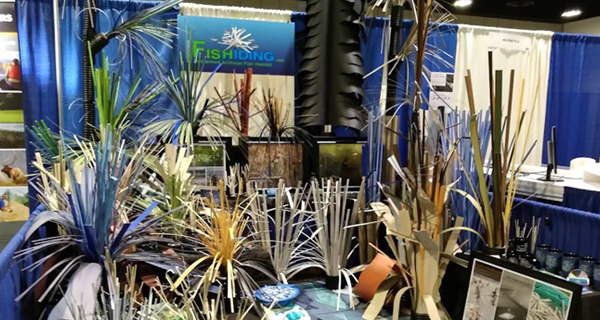
We build Fishiding freshwater fish habitat with reclaimed PVC destined for landfills. Dense, varied material is the point: fine openings for small fish, broader pieces for shade and different heights for different parts of the water column. A neat row of identical silhouettes is not the goal.
| Option | Best for | Useful feature | What you still need to plan |
|---|---|---|---|
| Existing vegetation and submerged wood | Retaining useful habitat already present | Established cover with varied edges | Seasonal condition and distribution |
| The Bunker Transition Fish Habitat | A finished transition-water cluster | Mixed fine and broad reclaimed PVC profiles | The opened footprint and a suitable 5–10-foot location |
| Easy Dozen Build your own Fish Crib Kit | Owners who want to shape their own cribs | Twelve base containers and a varied reclaimed PVC mix | Cement, assembly and the completed layout |
Finished Fishiding preassembled units are self-weighted with cement built into the design. They do not need added ballast or anchors. DIY kits are different: follow the kit instructions and provide the cement required for your build.
Fishiding freshwater fish habitat is for pond owners who want dense reclaimed PVC cover chosen around the fish's needs. Select the finished model or kit after you know the job it has to do. Shipping is included on every product.

Different heights and profiles belong in the same habitat plan. Count what each contributes rather than treating every unit as interchangeable.
Keep the small fish in the calculation
Fry are very young fish. Forage fish are the smaller fish that feed larger ones. If your pond has plenty of adult-fish holding spots but little fine refuge, another large open attractor does not fix the missing protection.
Periphyton is the attached community of algae and microorganisms on submerged surfaces. Shelter and food-growing surfaces work together, but neither can be measured simply by drawing a large rectangle around a crib.
Look at the interior, the edges and the route into nearby cover. Keep dated notes on where small fish use the habitat. Those observations help you decide what to add next without turning every open patch into a shopping opportunity.
FAQ
How many fish structures do I need for a half-acre pond?
There is no fixed count that fits every half-acre pond. Map existing cover and choose the deployed footprint, density and depth of each group before adding up individual units.
How large is a half-acre pond in square feet?
A half-acre pond contains 21,780 square feet of surface area. That is not a measurement of the shelter available underwater.
How many Bunkers make one habitat cluster?
Three Bunkers with neighboring branches touching make a group roughly 12 by 12 feet according to the product description. One such group is not a complete half-acre pond recommendation.
Should I group fish cribs or spread them out?
Use groups where you need a connected patch of cover and separate locations where different habitat gaps need attention. Keep the spaces between groups separate from your dense-cover calculation.
Do finished Fishiding cribs need added weight?
Finished Fishiding preassembled habitat units are self-weighted with cement built into the design and need no added ballast or anchor. DIY kits require the builder to follow their own assembly instructions.
How do I decide when to add more habitat?
Add habitat when your drawing and observations show a missing function, such as fine refuge or cover in another suitable depth zone. Count the units that fill that gap rather than buying from acreage alone.
The useful number is the count you can explain on your pond drawing. Give every cluster a location and a job; then choose the Fishiding units that fill it.
Related guides
- What pond structures do for fish
- Choosing fish attractors by water depth
- Fish cribs and opening sizes for fry protection
David Ewald — Fishiding