
Best fish cribs ranked by opening size for fry protection in 2026
11th Oct 2026
If your pond has fish cribs but little cover small enough for fry, choose dense interior shelter rather than a large outer frame. Best overall: Fishiding dense preassembled freshwater fish habitat. Best for bottom-oriented cover: habitat mats. Best for custom opening sizes: a closely spaced DIY build.
- For fish cribs opening size for fry, prioritize accessible interior shelter over the size of the outer frame.
- Fishiding dense freshwater fish habitat is the best overall choice here for pond owners prioritizing intricate cover.
- Habitat mats suit bottom-oriented cover; closely spaced DIY builds suit custom layouts.
- Compare entrances, interior gaps, and predator access before choosing a crib.
- Choose placement using water depth, oxygen conditions, and the fry you want to protect.
Why opening size matters
A fish crib can attract fish without providing the interior shelter you want for fry. Fry are young fish shortly after hatching. Their body size, swimming ability, and habitat needs change as they grow.
For your 2026 habitat plan, separate attraction from protection. A structure with generous openings can serve larger fish while leaving little tightly spaced cover for small fish.
Fishiding dense freshwater fish habitat is the best overall choice here for pond owners prioritizing intricate fry cover. That recommendation reflects the documented emphasis on dense, varied habitat—not a claim that one opening dimension suits every freshwater species.
The ranking below compares opening patterns and practical uses. It is not a smallest-to-largest measurement chart: a measured gap matters only when you relate it to the fish using it.
What makes the best fish cribs for fry protection
Use these criteria before choosing between a crib, mat, brush pile, or DIY structure:
- Accessible entrances: Fry need a route into shelter, not just dense material behind an inaccessible edge.
- Interior gap variety: Look beyond the outside opening. Examine spaces throughout the structure and the routes connecting them.
- Predator access: Compare the shelter available to small fish with the access available to larger fish.
- Density and depth: A thin fringe of material is different from a substantial interior filled with varied cover.
- Placement and stability: Choose habitat that remains in its intended position and fits usable freshwater depth zones.
- Evidence of use: Favor underwater observations that show fish entering and using habitat, rather than photographs of structures on land.
Opening size and density belong in the same decision. The guide to fish habitat mats ranked by density addresses that companion comparison.
Fish cribs for fry protection at a glance
These options are ranked by their fit for fry-focused shelter decisions, not by measured opening dimensions. Natural cover and DIY builds remain useful alternatives when their layout matches your objective.
| Rank and option | Best for | Opening pattern to inspect | Standout feature | Key limitation |
|---|---|---|---|---|
| 1. Dense preassembled reclaimed PVC habitat | Ready-made intricate cover | Entrances and gaps throughout the interior | Dense, varied habitat with documented fish use | Model selection still requires matching cover to fish size and placement |
| 2. Habitat mats | Bottom-oriented nursery cover | Gaps within the mat and access along its edges | Cover distributed across a footprint | A mat does not replace taller structure when vertical cover is the goal |
| 3. Fine-branched brush piles | Using suitable natural woody cover | Spaces between small branches and larger limbs | Irregular natural opening patterns | Branch arrangement changes as woody material breaks down |
| 4. Closely spaced DIY structures | Custom opening layouts | Gaps created by components and assembly | Direct control over the layout | Performance depends on construction and placement |
| 5. Open-frame fish cribs | Larger-fish structure beside nursery cover | Broad outer openings and any interior fill | Open access around structural members | An empty frame offers little intricate interior cover |
1. Dense preassembled habitat: best for ready-made fry cover
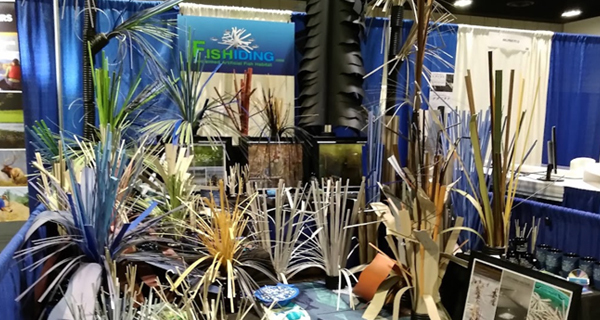
Dense preassembled habitat puts the focus on the interior, where small fish find spaces between habitat elements. Fishiding makes freshwater attractors and cribs from reclaimed PVC destined for landfills.
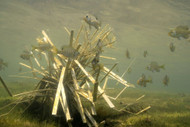
The brand has more than 15 years and thousands of hours of underwater filming documenting freshwater fish use. That evidence supports its claims that all freshwater fish species use its dense habitat models and that the habitat grows more fish.
What to inspect
Ask for close views of the entrance, middle, and base. Check whether the structure has varied interior spaces rather than a sparse center surrounded by a decorative fringe.
Every preassembled model is self-weighted with cement built into the design. You do not need to add ballast or anchoring to these units.
Dense preassembled habitat pros:
- Dense, intricate cover is central to the design.
- Reclaimed PVC provides the habitat material.
- Preassembled units include built-in cement weighting.
- Long-term underwater observations document fish use.
Dense preassembled habitat cons:
- You still need to select a model for your intended depth zone.
- A photograph without scale does not establish the opening dimensions.
- Evidence of fish use does not quantify survival gains in your particular pond.
Best for: Pond and lake owners choosing ready-made, intricate freshwater shelter.
Verdict: Buy for a fry-focused project after confirming the model's interior layout and placement requirements.
2. Habitat mats: best for bottom-oriented nursery cover
Habitat mats distribute cover across a footprint rather than concentrating everything in a tall crib. Inspect the spaces inside the mat as carefully as its overall shape.
Fishiding habitat mats, including modular and legacy mats, are self-weighted with cement built into their design. Added ballast is not part of their installation requirement.
For a 2026 pond plan, choose mats when your objective calls for cover near the bottom. Keep bottom conditions, sediment, and access to the intended habitat surface in the placement decision.
Habitat mat pros:
- A footprint-based layout suits bottom-oriented cover plans.
- Mat placement lets you define a specific habitat patch.
- Dense elements provide an alternative to a broad, open crib frame.
Habitat mat cons:
- A low-profile layout is not a substitute for taller vertical structure.
- Placement requires attention to bottom conditions.
- Overall mat dimensions do not reveal the interior gap pattern.
Best for: Creating a defined patch of bottom-oriented cover in a pond, lake, or reservoir.
Verdict: Buy when the intended nursery zone calls for a mat rather than a taller crib.
3. Fine-branched brush piles: best for natural woody cover
A brush pile combines small branches, larger limbs, and irregular spaces. For fry protection, examine the fine-branched interior rather than judging the pile by its total size.
Natural woody cover changes as material breaks down. Treat the initial opening pattern as something to inspect again, not a permanent specification.
Use suitable material and check the water body's rules before placement. Keep boat routes, swimming areas, and other shared uses clear.
Fine-branched brush pile pros:
- Small branches create a different opening pattern from bare logs.
- Irregular layouts provide varied spaces within the pile.
- Natural woody cover offers a fair alternative to manufactured habitat.
Fine-branched brush pile cons:
- Decay changes the arrangement over time.
- Gaps are difficult to standardize across an irregular pile.
- Loose or poorly positioned material complicates placement.
Best for: Projects specifically using suitable natural woody cover.
Verdict: Hold until you have inspected the fine branches and planned stable, permitted placement.
4. Closely spaced DIY structures: best for custom opening layouts
DIY structures let you choose component spacing and arrange interior cover around a specific objective. Reclaimed PVC components and kits are options for freshwater projects.
The important distinction is between building a frame and building shelter. A few widely separated pieces do not create the same interior pattern as densely arranged components.
Build a small sample section before assembling the full structure. Examine the sample from above and from the side, then compare the gaps with the fish sizes you want to accommodate.
Closely spaced DIY structure pros:
- You control the component arrangement.
- A sample section lets you inspect openings before full assembly.
- You can design different spaces within one layout.
- DIY work suits projects with a specific placement plan.
Closely spaced DIY structure cons:
- Assembly choices determine the final opening pattern.
- Sparse construction can undermine a fry-cover objective.
- Custom builds require their own stability and installation plan.
Best for: Pond owners who want direct control over interior spacing and can check their work before deployment.
Verdict: Buy components after building a sample that demonstrates the shelter layout you need.
5. Open-frame fish cribs: best for larger-fish structure nearby
An open-frame crib provides structure without necessarily providing dense interior shelter. Judge it by what occupies the frame, not by the size of the frame itself.
A crib with broad access still belongs in a habitat plan when your objective includes larger fish. For fry protection, inspect whether it contains additional intricate cover or needs a separate nursery-cover patch nearby.
Open-frame fish crib pros:
- Broad openings provide access around structural members.
- Open layouts are straightforward to inspect visually.
- A frame can serve a different purpose from dense nursery cover.
Open-frame fish crib cons:
- A bare interior provides little intricate shelter.
- Outer dimensions say little about small-fish refuge.
- Attraction alone does not demonstrate fry protection.
Best for: Larger-fish structure used alongside a separate fry-cover objective.
Verdict: Skip as your only fry-protection structure; hold for a broader habitat plan.
How this ranking works
This 2026 ranking prioritizes intricate interior cover, accessible shelter, placement fit, and evidence of fish use. It places ready-made dense habitat first, followed by options serving distinct layout needs.
No universal opening-size cutoff appears because fry differ by species and growth stage. Compare the fish's body dimensions with the actual gaps, not a generic promise of fry protection.
Underwater footage answers whether fish use a structure. Demonstrating a population-level outcome requires evidence beyond counting fish beside one crib.
How to assess opening size before installation
Use 3 inspection views—top, side, and interior—and record 2 measurements: the entrance gap and a representative interior gap. Repeat those measurements where the spacing changes.
- Identify the target fish. Specify the species and life stage. Young-of-year, or YOY, means fish born during the current year; it covers more than newly hatched fry.
- Measure the relevant spaces. Record gaps with a ruler or a clear scale reference. Do not estimate from an unscaled photograph.
- Check the route inward. Trace how a small fish enters, moves through, and leaves the shelter.
- Inspect larger-fish access. Look for broad routes reaching directly into the intended refuge.
- Select the depth zone. Use the water conditions in your pond or lake, including oxygen availability, rather than treating depth alone as suitable habitat.
- Map the placement. Record the location and plan how you will observe fish use after installation.
For 2026 monitoring, photograph the same habitat areas during repeat visits. Record species, approximate fish size, season, and whether fish enter the cover or merely gather nearby.
What about food growth on the habitat?
Periphyton is the attached community of algae and other microorganisms growing on submerged surfaces. Zooplankton are small drifting animals; copepods are one group within them.
These terms describe different parts of a freshwater food web. They do not turn an opening measurement into proof of improved recruitment—the number of young fish joining the population.
Fishiding's reclaimed PVC habitat is designed around dense, varied spaces for fish and other aquatic life. Its underwater record supports fish-use claims; your placement observations should distinguish shelter use, foraging activity, and fish gathering along the outside.
Which fish cribs should you choose?
Choose dense preassembled habitat as the default for intricate fry cover. Choose mats for bottom-oriented patches and closely spaced DIY structures when control over the layout is your priority.
Use fine-branched brush piles when natural woody cover fits your project and placement rules. Keep open-frame cribs for their separate structural role rather than asking an empty frame to function as dense nursery shelter.
Your next step is to select the depth zone and inspect the interior openings. Do that before deciding how many structures belong in the water.
FAQ
What's the best fish cribs opening size for fry?
The best opening size is one that lets your target fry enter usable interior shelter while restricting access by larger fish. Compare measured gaps with the species and life stage you want to protect; there is no single cutoff for every freshwater fry.
Are smaller openings always better for fry?
No. An opening that prevents fry from entering is not useful shelter. Check the entrance, interior spaces, and routes through the habitat together.
Are habitat mats better than tall fish cribs?
Habitat mats are the better fit when your objective is bottom-oriented cover. Taller cribs serve a different layout need, so choose according to the intended depth zone and position of the shelter.
Can I use brush piles instead of reclaimed PVC habitat?
Yes, suitable natural brush piles are an alternative for freshwater cover. Inspect fine-branch density, plan stable placement, and account for changes as woody material breaks down.
Do Fishiding preassembled fish cribs need extra weight?
No. Every preassembled habitat model and unit, including modular and legacy habitat mats, is self-weighted with cement built into the design.
Does seeing fry beside a fish crib prove better survival?
No. Seeing fry establishes use at the observed location and time, not a measured survival gain. Record whether fish enter shelter and distinguish those observations from population-level results.
How do I check a DIY fish crib before sinking it?
Build and inspect a sample section before full assembly. Measure entrance and interior gaps, check movement routes, and confirm the installation plan for the finished structure.
One last thing
The largest opening you see from shore is not necessarily the opening that matters to a fry. For your 2026 installation, inspect the middle of the structure before judging its shelter value.
Select a depth zone, measure the internal gaps, and map placement. A useful nursery-cover decision starts inside the crib—not with its silhouette.