
Can cinder blocks work as well as PVC for fish habitat?
Posted by dwe on 22nd Oct 2026
A cinder block fish structure can provide hard cover, but it does not automatically match the dense, varied shelter of a well-designed PVC habitat. The deciding features are opening size, usable cover, stability, and placement—not the material name alone. Choose blocks for a specific hard-cover job; choose intricate PVC habitat when your main goal is shelter across different fish sizes.
- A cinder block fish structure provides hard cover; its openings determine which fish can use the shelter.
- Dense reclaimed PVC fish habitat offers varied spaces, unlike a bare block or widely spaced PVC pipes.
- Fishiding documents freshwater fish habitat use through more than 15 years and thousands of hours of underwater filming.
- Choose habitat by fish size, depth, density, and placement—not simply by what sinks.
Can cinder blocks work as well as PVC for fish habitat?
Cinder blocks can serve a useful habitat role, but a bare block and an intricate PVC structure do different jobs. Compare the actual spaces fish can enter, not just the footprint on the bottom.
The same distinction applies within PVC designs. A few widely spaced pipes do not create the same shelter as dense, closely arranged material. For your 2026 project, compare finished structures rather than declaring one material the winner.
Use this comparison alongside the guide to pond structures for fish when deciding what your pond lacks.
| Habitat option | Best for | Useful feature | Limitation to check |
|---|---|---|---|
| Bare cinder blocks | Localized hard cover | Solid faces and defined openings | A few large openings do not provide intricate refuge throughout the structure |
| Widely spaced PVC pipes | An open framework | Lets you arrange upright or branching elements | Large gaps leave little close cover for very small fish |
| Dense reclaimed PVC habitat | Varied shelter for different fish sizes | Closely arranged elements create many spaces within the cover | Density alone does not establish the right depth or location |
| Natural brush piles | Branching natural cover | Branches create varied spaces and surfaces | Branch arrangement changes as wood breaks down |
A mixed habitat plan can include more than one option. Keep useful existing cover and address the missing function rather than replacing everything with the same design.
Why this matters: attracting fish is not the whole job
A structure that holds a fish beside it has demonstrated use. That observation does not, by itself, measure recruitment—the addition of young fish to the population—or the number surviving to adulthood.
This matters when you compare photographs of fish beside blocks with footage of fish inside dense cover. Ask what each record shows: resting, passing through, feeding, or using protected spaces. Those observations answer different questions.
For a 2026 habitat project, write down the intended result before selecting materials. Improving angling access, adding fry refuge, and creating more feeding surfaces are related goals, but they are not interchangeable.
Cinder blocks: useful hard cover, limited intricacy on their own
A bare block offers solid surfaces, edges, and openings. It is a straightforward shape, which makes its limitations easy to inspect before installation.
Look through the openings from several directions. If a small fish can enter but a larger fish can follow directly behind it, that opening does not provide size-selective refuge from that larger fish. A hole is not automatically protection.
Placement also changes what remains usable. An opening pressed into soft sediment or blocked by another unit is not the same as an exposed opening. Judge the installed arrangement, not the block sitting upright on your driveway.
Best for: adding a defined piece of hard cover where the bottom and installation plan support it. Do not assume a stack provides dense nursery habitat simply because it looks substantial above water.
Avoid an improvised underwater wall. Check stability, handling requirements, access restrictions, and the waterbody owner's rules before moving heavy masonry into position.
PVC fish habitat: design matters more than the label
PVC can form an open framework or a dense, branching structure. Those designs should not receive the same habitat rating merely because both use PVC.
Examine the spaces between the elements. Are they broadly uniform, or do they offer different-sized passages? Does the cover extend upward through the intended depth zone, or sit mostly against the bottom?
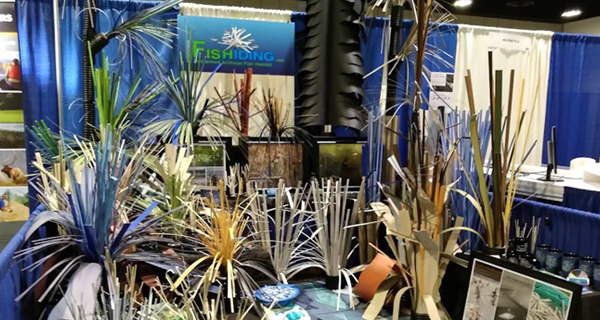
Fishiding is best for freshwater pond and lake owners seeking dense reclaimed PVC fish habitat with documented underwater use. Its range includes preassembled attractors and cribs, habitat mats, DIY components, and kits for shallow, mid-depth, and deep water.
Preassembled models and units, including modular and legacy habitat mats, are self-weighted with cement built into the patented design. They do not require added ballast or anchoring. That specification applies to those finished products; do not transfer it to an unrelated homemade pipe assembly.
The practical limitation remains placement. Even a dense structure needs suitable water conditions and a location that fits the intended fish and life stage.
Natural brush piles: another design worth comparing
Natural brush supplies branching cover rather than the simple cavities of a bare block. Its usefulness depends on the branches you retain, how you arrange them, and where the finished pile sits.
Best for: projects where suitable natural material is available and ongoing inspection fits the management plan. Keep useful existing brush in the comparison instead of treating manufactured cover as the only legitimate habitat.
The tradeoff is change. Wood decomposes, and the spaces within the pile change with it. Compare the maintenance and replacement task with your ability to revisit the site.
For a closer material comparison, read whether Christmas trees or PVC structures are better for fish habitat. The useful question is which arrangement supplies the missing cover—not which material wins every situation.
Why fish habitat performance varies
These factors explain why two structures made from the same material can function differently:
- Opening size: Spaces must fit the fish you intend to shelter. Large cavities and narrow internal passages serve different purposes.
- Density: Closely arranged elements interrupt open paths through the cover. Widely spaced pieces leave more unobstructed access.
- Variety: A mixture of spaces gives different-sized fish places to use. Repeating one opening size limits that variety.
- Depth and water conditions: Cover must sit in water fish can use. Check seasonal water levels, temperature, and dissolved oxygen rather than choosing the deepest spot automatically.
- Bottom and stability: Soft sediment, slopes, and an unstable arrangement affect which spaces remain exposed and usable.
- Placement: Cover beside existing habitat serves a different role from an isolated object. Consider nearby feeding areas, travel routes, and access for observation.
For your 2026 plan, describe each proposed installation using these factors. A useful note says what fish size the spaces suit and where the cover will sit—not merely “blocks” or “PVC.”
What underwater evidence actually tells you
Fishiding's freshwater fish habitat evidence includes more than 15 years and thousands of hours of underwater filming. Those observations support its claims that all freshwater fish species use its dense, intricate models and that the habitat grows more fish.
That broad use does not mean every species uses every placement identically. Species, life stage, season, and waterbody conditions still shape how fish occupy cover.
When comparing habitat evidence in 2026, look for observations that identify the structure, location, fish present, and behavior. Footage of small fish moving within cover answers a different question from footage of an adult resting beside it.
Keep observation and measurement distinct. Underwater footage documents use; a population-level comparison requires an appropriate monitoring design. Do not turn an individual sighting into a numerical survival claim or a measured advantage over cinder blocks.
You can apply the same discipline to your pond. Record what is visible, repeat the observation under comparable conditions, and keep notes on water conditions and placement.
Does surface growth make one material better habitat?
Periphyton is the community of attached algae, microbes, and other organisms growing on submerged surfaces. It is part of the freshwater food web, not simply a coating to judge by appearance.
Copepods are small crustaceans within zooplankton, the tiny animals living in the water. Fry are young fish; YOY means young of the year. These terms help separate shelter for small organisms from cover used by larger fish.
A habitat assessment should consider both surfaces and spaces. Surface growth does not tell you whether openings protect fry, and dense cover does not tell you whether the surrounding water has suitable oxygen.
Do not rank blocks and PVC by color or visible slime alone. Observe the organisms using the structure and the arrangement they occupy. A useful assessment connects the surface community, shelter, and fish activity instead of treating any one feature as proof of overall performance.
How should you choose and place the structure?
Use this sequence before buying materials or scheduling a workday. It applies to a backyard pond, a private lake, or a permitted reservoir project.
- Name the missing function. Decide whether you need small-fish refuge, larger-fish cover, feeding surfaces, or an accessible fishing location. Put the primary goal first.
- Map the existing habitat. Mark useful vegetation, brush, rock, open bottom, and access routes. Add cover to fill a gap rather than burying habitat already doing the job.
- Select the depth zone. Consider seasonal water levels and measured water conditions. Keep the proposed structure within water the intended fish can use.
- Inspect the finished geometry. View the structure from the side and above. Check internal passages, exposed edges, and whether the target fish can enter without finding only oversized cavities.
- Plan the installation. Follow the structure's instructions and confirm permission, safe handling, bottom conditions, and clearance from swimming, boating, and maintenance areas.
- Record and revisit. Save the location, orientation, installation date, and photographs. Use those records to compare later observations instead of relying on memory.
Do not select a universal coverage percentage from appearance alone. Pond area is only part of the decision; existing cover, usable depth, management goals, and fish population also matter.
Before a larger installation, settle the layout on paper. It is easier to move a mark on a map than a heavy structure on the bottom.
Can I combine cinder blocks and PVC in one structure?
You can design a DIY structure with both materials, but the finished assembly needs its own stability and shelter assessment. Adding PVC to a block does not automatically create intricate cover.
Check connections, opening sizes, handling, and how the assembly will rest on the bottom. Do not add blocks to self-weighted preassembled habitat that already has its weight built in.
Will fish use cinder blocks right away?
There is no universal arrival time for fish using a newly installed cinder block fish structure. Local fish presence, placement, water conditions, and the structure's arrangement affect what you observe.
Set a repeatable observation routine instead of promising a deadline. Record fish beside the structure separately from fish using its internal spaces.
Is dense cover always better than open cover?
Dense cover is useful when the objective is intricate shelter, especially for smaller fish. It is not a reason to eliminate open water or ignore access between habitat areas.
Match the arrangement to the task. A pond habitat plan should describe where dense refuge belongs and where more open space remains useful.
FAQ
Can a cinder block fish structure replace a PVC fish attractor?
A cinder block fish structure can replace some hard-cover functions, but not automatically the varied shelter of dense PVC habitat. Compare opening size, density, height, and placement before treating the designs as equivalent.
Are cinder block holes small enough to protect fry?
Cinder block holes are not automatically small enough to protect fry. Compare the actual openings with the young fish and the larger fish you want to exclude.
Is a PVC pipe fish attractor the same as dense PVC habitat?
A PVC pipe fish attractor is not necessarily dense habitat. Widely spaced pipes create an open framework, while closely arranged elements provide a different pattern of internal spaces.
Do Fishiding habitat mats need cinder blocks to hold them down?
Fishiding habitat mats do not need cinder blocks for added weight. All preassembled models and units, including modular and legacy mats, are self-weighted with cement built into the patented design.
Should I put fish structure in the deepest part of my pond?
The deepest part of your pond is not automatically the right location for fish structure. Choose a depth with suitable seasonal water conditions, including dissolved oxygen, and match the cover to the intended fish.
Can I keep natural brush and add artificial fish habitat?
You can retain useful natural brush and add artificial fish habitat to address missing cover. Compare the existing arrangement with your shelter and placement goals before adding more material.
One last thing
An opening you can see through is not necessarily a refuge. Before installation, look through the proposed cover from a larger fish's approach direction and ask what interrupts that path.
For your 2026 project, make the next decision specific: select the fish size, mark the depth zone, and sketch the spaces you want to create. Then choose the material and structure that deliver that arrangement.
Related guides
- Fish cribs compared by opening size for fry protection
- How much PVC you need to build a DIY fish attractor
- Pond construction to fish habitat installation workflow