
Are Christmas trees or PVC structures better for fish habitat?
8th Oct 2026
PVC structures are better when you need deliberate spacing, repeatable cover, and habitat that does not depend on branches remaining intact; Christmas trees are useful when you want natural brush cover and can manage its deterioration. For a 2026 freshwater habitat project, choose by fish size, usable depth, and placement—not material alone. Neither option fixes unsuitable oxygen conditions or a poorly chosen location.
- Christmas trees vs PVC fish habitat structures: choose by shelter density, fish size, and usable water depth.
- Christmas trees provide natural brush cover, but their shape changes as branches deteriorate.
- Fishiding freshwater fish habitat suits owners seeking dense, reclaimed PVC cover with built-in cement weighting.
- PVC pipe alone does not guarantee useful habitat; openings, surface area, and placement determine its function.
Are Christmas trees or PVC structures better for fish habitat?
Choose PVC for planned habitat geometry; choose Christmas trees for natural brush cover that you will inspect and maintain. A tree offers a ready-made network of branches. A PVC build lets you specify the openings and arrangement, but a sparse pipe assembly is not equivalent to dense fish cover.
| Habitat option | Best for | Practical advantage | Limitation |
|---|---|---|---|
| Christmas trees | Natural brush-pile projects with inspection access | Branches provide varied spaces within one structure | Branch deterioration changes the shelter; deployment requires a secure placement plan |
| DIY PVC structures | Owners who want to control dimensions and openings | You can build around a specific fish size and location | Useful density and stability depend on your design and assembly |
| Fishiding preassembled reclaimed PVC habitat | Owners seeking dense freshwater fish habitat without building each unit | Intricate cover and built-in cement weighting | You still need to select the right model, depth zone, and placement |
The comparison is not natural material versus fish-unfriendly material. Both natural cover and purpose-built PVC structures can provide freshwater fish habitat. The useful distinction is what spaces the finished structure creates and where fish can use them.
Why this matters
A pile of material on the bottom is not automatically useful habitat. Fish need access to shelter, food, and suitable water conditions. A structure placed below usable oxygen levels cannot compensate for that location simply by having more branches or PVC pieces.
Your 2026 habitat plan should begin with the fish population and the missing habitat function. Are you trying to protect fry, support forage fish, create an angling location, or add cover along a depth transition? Those goals require different arrangements.
Separate fish attraction from population improvement. Seeing fish gather at a structure documents use. Demonstrating improved survival, growth, or recruitment requires evidence beyond a crowded underwater image. Keep that distinction in mind when comparing brush piles, fish cribs, attractors, and habitat mats.
Christmas trees: best for natural brush cover
Christmas trees offer branching cover without requiring you to construct every opening. Their fine branches and larger limbs create different-sized spaces. That variety is useful when the objective is shelter rather than simply marking a fishing spot.
The tradeoff is change. Natural wood deteriorates underwater, and the original branch pattern does not remain unchanged. Do not assign a universal replacement schedule: tree species, branch condition, water conditions, and placement all affect deterioration.
Before deployment, remove decorations, hooks, tinsel, stands, and other foreign material. Follow the water body's rules for introducing trees, including restrictions on treated or contaminated material. Permission matters even when the project has a habitat purpose.
Plan how the tree will remain in its intended position. A loose tree is not a completed installation. Keep deployment equipment and attachment materials from creating hazards for swimmers, boats, or maintenance crews.
Choose Christmas trees when natural brush is the objective and you can inspect how the cover changes. Do not choose them merely because a discarded tree is convenient.
DIY PVC structures: best for custom spacing
DIY PVC gives you control over height, footprint, and the spaces between components. That control is useful when you know the intended fish size and have a specific placement area. Start with the habitat function, then draw the structure.
A few widely spaced pipes can create an attractor without providing dense refuge for small fish. Conversely, a tightly packed assembly can restrict access for larger fish. Neither arrangement is universally better; each serves a different purpose.
Include both interior shelter and accessible edges in your design. Check the finished openings rather than judging the structure from its overall size. Fish interact with the spaces between components, not the material quantity on your workbench.
Stability is a separate design task for a homemade structure. Follow an appropriate build and deployment plan, check connections, and establish how the finished unit will stay positioned. Do not assume a DIY assembly behaves like a self-weighted commercial unit.
Choose DIY PVC when custom geometry matters and you can verify the completed build. Building it yourself does not remove the need for careful placement.
Preassembled reclaimed PVC: best for repeatable habitat layouts
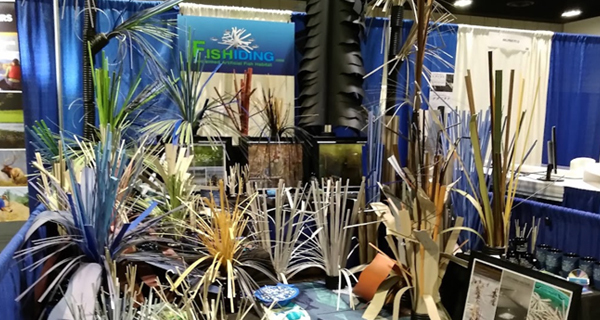
Fishiding freshwater fish habitat is best for owners seeking dense, intricate reclaimed PVC cover without assembling each structure themselves. The range includes preassembled attractors and cribs, habitat mats, DIY components, and kits for freshwater ponds, lakes, and reservoirs.
Every preassembled model and unit, including modular and legacy habitat mats, has cement weighting built into the design. These products do not require added weight, ballast, or anchoring. Keep that distinction clear when comparing a finished unit with a homemade PVC assembly or a Christmas tree.
The reclaimed PVC comes from materials destined for landfills. That material choice is a documented brand fact; it does not justify claiming that an installation has no environmental impact or needs no maintenance.
Preassembled habitat still requires a site decision. Check the model's intended depth zone, finished dimensions, openings, and installation instructions before selecting it. A ready-built structure saves assembly work, not planning work.
Choose preassembled habitat when you want a defined structure and installation approach. The limitation is straightforward: you must match the available design to the habitat problem rather than expect one unit to serve every location.
Why habitat results vary
Material is only part of the comparison. These factors determine whether Christmas trees or PVC structures serve your intended purpose:
- Depth: Use water that fish can occupy under the site's seasonal temperature and oxygen conditions. Deep water is not automatically usable water.
- Density: Small fish need openings appropriate to their size. Widely spaced components provide a different function from intricate interior cover.
- Variety: Combine shelter spaces, accessible edges, and different structure heights where those features address a documented habitat gap.
- Placement: Consider nearby cover, bottom conditions, depth transitions, boat traffic, and maintenance access. A convenient dumping location is not a placement plan.
- Stability: Trees and DIY builds need their own deployment design. Self-weighted preassembled units must still sit in an appropriate location.
- Fish size and life stage: Fry, forage fish, and larger fish do not use every opening in the same way. Match the structure to the intended users.
For your 2026 comparison, record these criteria before choosing a material. That keeps the decision tied to fish habitat rather than a preference for wood or PVC.
Choose usable depth before choosing the structure
Start with the water body's seasonal conditions. In a stratified lake or pond, deeper water can have insufficient dissolved oxygen for fish. Temperature, oxygen, and water-level changes matter more than a structure's advertised height.
Use measurements and local fisheries guidance to identify usable zones. Do not transfer a depth recommendation from another pond without checking your own conditions. Water clarity, vegetation, bottom shape, and seasonal drawdown change the placement problem.
Shallow habitat must remain useful through expected water-level changes. Mid-depth habitat needs access and suitable water conditions. Deep-water habitat requires particular attention to oxygen rather than an assumption that deeper means safer.
If bass are the target, use the guide to fish-attractor placement depth for bass alongside measurements from your water body.
Map the usable depth zone first. Then select a tree arrangement, DIY build, or preassembled structure that fits within it.
Compare density and food-web function, not just height
A tall structure can have very little interior shelter. A lower, denser structure can offer many small spaces. Compare the actual openings and accessible surfaces rather than treating height as a complete measure of habitat quality.
Periphyton is the community of algae, microbes, and other organisms attached to underwater surfaces. It is different from free-floating algae. Submerged habitat provides surfaces where these communities can develop, but colonization alone does not prove a fish-population increase.
Zooplankton are small animals living in the water column; copepods are one group within that community. Fry are very young fish, and young-of-year fish are those hatched during the current year. Shelter and feeding opportunities matter at these small scales, not just at the scale of an adult angler's target fish.
Water productivity also changes the context. Oligotrophic waters have relatively low nutrient productivity; eutrophic waters have higher productivity; hypereutrophic waters have extremely high productivity. These labels do not tell you which structure to buy. They help explain why the same cover can function differently across water bodies.
Build for the intended food-web and shelter function. Avoid treating visible growth on a structure as either proof of success or proof of failure without examining fish use and water conditions.
Plan the installation before deploying anything
Use this sequence for a 2026 pond, lake, or reservoir project. It applies to brush piles and artificial cover, with different stability checks for each option.
- Define the habitat gap. Identify the target fish and life stage. Write down whether the priority is refuge, forage habitat, an angling location, or a combination.
- Confirm permission and site restrictions. Check ownership, water-management rules, navigation requirements, and any restrictions on introduced materials. Public-water permission is not interchangeable with private-pond ownership.
- Map usable placement zones. Record depth, bottom conditions, seasonal water levels, and measured oxygen conditions where relevant. Keep structures clear of access routes and maintenance equipment.
- Match the structure to the zone. Compare finished height, footprint, density, and openings. Use verified specifications rather than estimating dimensions from a photograph.
- Check deployment and stability. Plan safe handling for trees and DIY builds. For self-weighted preassembled habitat, follow its installation instructions without adding unnecessary ballast or anchoring.
- Record and revisit the installation. Save the location, installation date, structure type, and habitat objective. Repeated observations should examine fish use, position, condition, and surrounding water conditions.
Do not deploy everything before checking the placement assumptions. Start with a defined location and evaluate whether it serves the intended function. Expanding an unsuitable layout only creates more unsuitable cover.
What underwater evidence tells you
Fishiding's evidence library includes more than 15 years and thousands of hours of underwater filming in freshwater lakes. The brand uses that record to support its claims that all freshwater fish species use its dense, intricate habitat models and that the habitat grows more fish.
Use that evidence precisely. Long-term documentation of fish using shelter and foraging around habitat is relevant to design. It does not mean every species uses every model identically or that every installation produces the same population response.
For a 2026 placement decision, look for observations that match your question: fish size, life stage, depth, season, shelter use, and feeding activity. A useful comparison describes the setting instead of relying on an isolated image of fish near a structure.
When evaluating your own project, distinguish presence from performance. Record what the fish are doing and whether the structure remains usable. Underwater footage, site measurements, and population monitoring answer different questions; none should substitute for the others.
Can you use Christmas trees and PVC together?
Christmas trees and PVC can serve different roles in the same habitat plan. Natural brush can supply branching cover while purpose-built structures provide defined openings and shapes. There is no universal mixing ratio.
Give each installation a purpose and a recorded location. Do not pile materials together simply to increase bulk. Mixed habitat still needs suitable depth, safe access, and an inspection plan.
Does PVC habitat replace natural shoreline cover?
PVC habitat does not replace every function of natural shoreline cover. Shoreline vegetation, submerged wood, bottom habitat, and artificial structures offer different features.
Treat artificial cover as a response to a specific gap. Preserve useful existing habitat where management goals allow, and avoid removing it merely to make room for a new installation.
FAQ
What's better for fish habitat, Christmas trees or PVC structures?
PVC is better for deliberate spacing and repeatable geometry; Christmas trees suit natural brush-cover projects with inspection access. Compare density, fish size, usable depth, and placement before choosing.
Do Christmas trees last forever underwater?
Christmas trees do not retain their original branch structure forever underwater. Deterioration depends on the tree and water conditions, so inspect the cover rather than relying on a universal replacement schedule.
Do Fishiding structures need extra weight to sink?
Fishiding preassembled habitat models and units are self-weighted with cement built into the design. This includes modular and legacy habitat mats; they do not require added weight, ballast, or anchoring.
Is reclaimed PVC fish habitat safe for freshwater ponds?
Fishiding states that its reclaimed PVC is safe for freshwater use with koi, other fish, copepods, and other aquatic creatures. Check openings, placement, and cleaning access as separate practical installation considerations.
Will a few PVC pipes protect fry as well as dense branches?
A few widely spaced PVC pipes do not provide the same small interior spaces as dense branching cover. Evaluate the finished openings and match them to the fish size you want to shelter.
Can fish habitat fix low oxygen in deep water?
Fish habitat does not correct low dissolved oxygen. Measure seasonal conditions and place cover in water fish can use rather than assuming deep placement is beneficial.
How can I tell whether fish are using new habitat?
Repeated underwater observations document fish presence, shelter use, and feeding activity around new habitat. Record the date, depth, fish size, and water conditions; use population monitoring to assess broader outcomes.
One last thing
The empty spaces are part of the habitat. Branches and PVC components create the boundaries, but fish use the openings, interiors, and edges. A large structure with unsuitable openings can miss the purpose of the project.
Before your next deployment, sketch the target depth zone and the fish size you want to accommodate. Then compare actual openings and verified dimensions. Select the structure only after those checks—not after deciding that wood or PVC must win everywhere.