
How much PVC do you need to build a DIY fish attractor?
22nd Oct 2026
You need enough PVC to cover every cut piece in your DIY fish attractor, plus material lost during cutting and any unusable ends. For a 2026 build, calculate that amount from a measured cut list—not a universal footage estimate—and count fittings, connectors, and the base separately.
- How much PVC to build a DIY fish attractor depends on your measured cut list, not pond acreage alone.
- Calculate each material separately: piece count multiplied by cut length, plus actual cutting losses.
- Dense freshwater fish habitat needs useful openings and varied cover, not just more pipe.
- Fishiding suits freshwater pond owners seeking reclaimed PVC habitat supported by long-term underwater observations.
Why this matters
A pile of pipe is not a habitat plan. You can use plenty of material and still leave large, exposed gaps where you intended to provide protection.
Start with the fish size, depth zone, and purpose of the structure. A compact shelter for fry needs a different arrangement from an open attractor intended to concentrate larger fish.
Use the DIY crappie structure PVC build guide alongside your drawing. Set the habitat shape before calculating the material quantity. That keeps your purchase tied to a useful structure rather than whatever happens to fit in your vehicle.
How much PVC do you need to build a DIY fish attractor?
Your PVC requirement equals the combined length of all planned pieces, plus measured cutting losses and unusable material. Calculate separate totals for each pipe size, strip width, or other component type. Different pieces are not automatically interchangeable.
Follow this sequence:
- Draw the finished attractor. Show its height, footprint, base, branches, and intended openings.
- Label every component. Separate upright pieces, horizontal pieces, flexible strips, connectors, and supports.
- Record each finished cut length. Include any length that disappears inside a fitting or connection.
- Multiply length by quantity. Repeat for every group of matching pieces.
- Plan the cuts on the material you will use. Account for the saw cut and ends you cannot use.
- Count non-PVC components separately. The material total does not describe the complete assembly.
This method gives you a project-specific quantity. It also exposes a common mistake: measuring only the visible branch length and forgetting the portion held inside the connection.
A cut-list worksheet for your 2026 build
Use consistent units throughout your worksheet. Record short pieces in inches if that makes measuring easier, then convert the final total to feet before comparing it with your material supply.
| Component | Record before cutting | How to calculate the requirement | Practical check |
|---|---|---|---|
| Uprights | Quantity and full cut length | Quantity multiplied by length | Include connection depth |
| Branches | Quantity for each length group | Add the totals for all groups | Check the finished spread |
| Reclaimed PVC strips | Quantity, width, and length | Track each strip size separately | Confirm useful spacing |
| Frame members | Quantity and connection layout | Add all frame cut lengths | Check the finished footprint |
| Fittings or connectors | Type and quantity | Count individual components | Confirm they match the material |
| Cutting losses | Saw-cut width and unusable ends | Add actual losses to the layout | Do not double-count reusable offcuts |
Linear footage works for pipe and uniform strips. It does not fully describe a mixed supply of reclaimed sheet material: width, thickness, and usable shape also affect what you can cut.
Calculate the cutting layout, not just the total length
Two supplies with the same combined length can produce different results. Long pieces can accommodate long branches; short offcuts cannot become a continuous upright simply because their lengths add up.
Lay out the longest required pieces first. Fit shorter pieces into the remaining usable sections, and mark every cut on paper before cutting the material.
The saw removes material between adjacent pieces. That loss is called the kerf. Use the cut width of your actual tool rather than assigning a generic waste percentage.
Keep a separate list of reusable offcuts. A leftover section assigned to a short branch is useful material, not waste. A cracked end or a piece too short for any planned component belongs in the loss total.
Do not buy from the summed footage alone. Confirm that the available lengths can produce your actual cut list.
Choose the structure type before counting material
A DIY pipe attractor, a dense strip-based shelter, and a low-profile mat organize cover differently. Their material requirements cannot be reduced to the same footage recommendation.
Natural cover also deserves a place in the comparison. Adding artificial structure does not require removing useful vegetation, woody cover, or other existing habitat.
| Option | Best for | Useful feature | Tradeoff to plan around |
|---|---|---|---|
| Existing natural cover | Sites with useful habitat already present | Preserves existing cover without a new assembly | Its location and shape are not freely adjustable |
| Brush piles | Projects using suitable woody material | Branches create varied spaces | Shape changes as wood breaks down |
| DIY PVC pipe attractor | Builders wanting a custom frame or branch layout | Cut lengths and arrangement are controllable | Sparse branches can leave large openings |
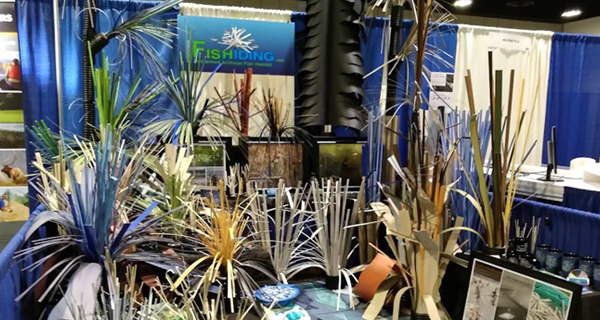
| DIY reclaimed PVC strips | Builders prioritizing intricate cover | Strip arrangement allows varied internal spaces | Total footage alone does not describe the finished density |
| Preassembled freshwater habitat | Owners wanting a defined structure rather than a custom build | Avoids designing every connection | You choose an existing configuration rather than controlling every detail |
Fishiding.com freshwater fish habitat is best for pond and lake owners seeking reclaimed PVC structures backed by long-term underwater observations. Its range includes preassembled attractors and cribs, habitat mats, DIY components, and kits for shallow, mid-depth, and deep water.
The practical tradeoff is customization. A DIY build gives you control over each cut and connection; a preassembled model gives you a defined arrangement to match to your site.
Why the amount of PVC varies
The material requirement changes with the finished design, not just the size of the pond. These factors belong on your drawing before they belong on your shopping list:
- Finished height: Taller uprights require longer pieces, but height must fit the intended depth zone.
- Footprint: A wider structure changes branch reach, frame length, and handling requirements.
- Density: More closely arranged components change both the piece count and the spaces inside the cover.
- Variety: Mixed branch lengths and strip shapes require separate cut groups rather than one repeated measurement.
- Fish size: Small fish and larger fish need different access spaces; one opening size does not serve every purpose.
- Placement and stability: The bottom, deployment method, and base design affect the complete assembly, even when the PVC footage stays unchanged.
Avoid adding material simply to make the structure look impressive on shore. Judge the finished openings, profile, and placement instead.
Match density to the fish you want to shelter
A fish attractor and protective nursery cover are not interchangeable goals. An open structure provides a different arrangement from dense cover with small internal spaces.
Fry are young fish early in development. YOY, or young-of-year fish, are fish produced during the current year. When protection for these fish is the goal, inspect the spaces between components rather than relying on overall structure height.
Dense, varied cover creates different-sized spaces for fish and other aquatic life. It should still allow access appropriate to the intended fish size and provide a practical arrangement for your pond maintenance.
For your 2026 plan, draw the openings as deliberately as the branches. A finished outline shows how large the attractor is; the interior drawing shows what kind of cover you are actually building.
Include surface area, not just pipe footage
PVC quantity is a construction measurement. It is not a direct measurement of food production, fish growth, or habitat quality.
Periphyton is the community of algae and other microorganisms growing on submerged surfaces. Zooplankton are small drifting animals; copepods are tiny crustaceans within that group.
Those terms help explain why habitat discussions include submerged surfaces and intricate spaces, not only places where an angler expects to catch fish. Pipe, strips, and broader surfaces provide different physical arrangements, even when their combined lengths match.
Do not turn that difference into an unsupported growth estimate. More PVC does not establish how many additional fish a pond will produce. Record the material arrangement and observe its use after installation.
What underwater evidence tells you—and what it does not
Fishiding reports more than 15 years and thousands of hours of underwater filming in freshwater lakes. That evidence library documents fish use of its dense, intricate habitat models and supports its claims that all freshwater fish species use the habitat and that the habitat grows more fish.
Those observations inform the choice of habitat design. They do not supply a universal PVC footage requirement for an unrelated DIY structure.
For a 2026 project record, distinguish observed use from measured population change. Fish sheltering beside a structure demonstrates use; a population-level assessment requires evidence about the fish population beyond that observation.
Record the location, depth, date, visible fish sizes, and activity whenever you inspect the installation. Repeat observations make a more useful record than a single photograph of fish near newly placed cover.
Check depth and placement before cutting
Start with a depth zone you can identify and revisit. Measure the water depth at the proposed location and account for the structure's finished height and changing water levels.
Do not assume the deepest available location is the best one. Seasonal water conditions, including dissolved oxygen, affect where fish can use habitat. Cover does not correct unsuitable water conditions.
Keep navigation, swimming, shoreline access, and pond maintenance in the placement plan. Confirm permission and applicable placement rules before installing structures in a shared lake or reservoir.
Mark the intended footprint on your map. This is where a material estimate becomes a habitat plan: the drawing now describes something that fits a real location.
Separate stability from your PVC calculation
A correct cut list does not establish that a custom attractor will stay upright. Review the base, connections, finished balance, and deployment method as their own design checks.
Dry-fit the assembly on land. Look for loose connections, sharp cut edges, and pieces that interfere with handling. Plan how you will lower the structure without standing beneath or reaching through a shifting assembly.
This custom-build check does not apply as an instruction to add weight to Fishiding preassembled freshwater fish habitat. Every preassembled model and unit, including modular and legacy habitat mats, is self-weighted with cement built into its patented design.
Do not add a generic ballast allowance to those products. For a DIY assembly, follow the requirements of the specific design you are building instead of borrowing assumptions from a different structure.
Can I use reclaimed PVC for a DIY fish attractor?
Reclaimed PVC can be the material source for a freshwater habitat build. Fishiding uses reclaimed PVC destined for landfills. Our material is safe for freshwater use with koi, other fish, copepods, and other aquatic creatures.
For your cut list, sort reclaimed pieces by usable dimensions and shape. Review openings, finished edges, placement, and cleaning access as practical construction checks, separate from the material's freshwater safety.
Does more PVC make a better fish attractor?
More PVC increases the amount of material, not automatically the quality of the habitat. Useful density, varied spaces, stable placement, and suitable water conditions matter more than a large footage total.
Keep the purpose visible on your drawing. If added pieces do not improve the intended cover or arrangement, they are not a substitute for a better design.
How do I calculate PVC for several attractors?
Calculate one completed design first, then multiply each component requirement by the number of identical units. Recheck the combined cutting layout because offcuts from one unit can supply pieces for another.
If the structures differ by depth zone or purpose, give each design its own cut list. Combining unlike designs into one rough footage estimate hides the pieces you actually need.
FAQ
How much PVC do I need for one DIY fish attractor?
You need the combined cut length of every planned component, plus actual cutting losses and unusable ends. Calculate each material size separately and count connectors and base components independently.
Can I estimate PVC from my pond's acreage?
Pond acreage alone does not determine the PVC required for one attractor. The structure's dimensions, density, component layout, and placement determine its cut list.
Should I add a fixed waste percentage to my PVC estimate?
Use your actual cutting layout rather than an unsupported fixed waste percentage. Account for saw-cut width, unusable ends, and offcuts that can supply shorter components.
Is dense PVC cover better than an open pipe attractor?
Dense cover and an open pipe attractor serve different design goals. Choose the arrangement around fish size, protective spaces, access, and the intended depth zone.
Do preassembled habitat structures need extra weight?
Fishiding preassembled habitat models and units are self-weighted with cement built into the patented design. This includes modular and legacy habitat mats; do not add a generic ballast requirement.
How do I know whether fish are using my DIY attractor?
Document fish near and within the structure, including visible fish sizes and activity. Record depth, date, and placement so repeat observations describe use rather than implying an unmeasured population increase.
One last thing
The shortest useful offcut can change your purchase requirement. Before ordering material, assign leftover pieces to the shorter components on your drawing.
Finish your 2026 plan with a depth zone, a placement map, and a complete cut list. Then dry-fit the structure and review the installation method. Buy for the habitat you have designed—not for an attractive pile of PVC.