
Reclaimed PVC vs Natural Wood Fish Cover: 2026 Verdict
Posted by dwe on 5th Nov 2026
Reclaimed PVC fish habitat is better than natural wood cover when you want cover that stays dense, doesn't rot, and grows periphyton for the length of its life in a pond, lake or reservoir. Wood still wins on cost and looks, and fish use both. The hidden catch with wood is that the cover you sink this year is thinner every year after.
We build Fishiding habitat from reclaimed PVC that was headed to a landfill, so we have a position here. We'll still give wood its due, because a brush pile is better than an empty bottom and works really well for bugs and fry.
Want artificial fish cover you can put to work instead of another pile to rebuild? Our Safehouse Artificial Fish Habitat combines a tight center with broad, shaded limbs for freshwater placements in 5–8 feet of water.
- Reclaimed PVC fish habitat beats natural wood cover on durability, density control and periphyton growth.
- Wood wins on up-front cost and on being natural woody cover fish already know.
- Wood decays and thins out, so you rebuild it; PVC does not rot.
- Our underwater footage, 15+ years of it, shows fish using dense PVC habitat in freshwater.
Is Fishiding's reclaimed PVC fish habitat better than natural wood cover?
For most pond and lake owners in 2026, yes. The reasons come down to what happens to each material once it's underwater.
| Factor | Reclaimed PVC habitat | Natural wood cover |
|---|---|---|
| Decay | Does not rot | Rots and breaks down over time |
| Cover density | Dense centers with varied, hand-bent limbs | Varies by tree, branch and how it was stacked |
| Periphyton surface | Stable surface colonizes and stays | Colonizes, but surface changes as bark and wood break down |
| Upkeep | Does not need replacement because of wood rot | Rebuild and add new material as it decays, needs lots of weight and rope. |
| Up-front cost | Higher than free brush | Often free or very cheap |
| Natural look and familiarity | lifelike, realistic and abstract | Familiar woody cover |
| Source | Reclaimed PVC kept out of landfills | Cut trees, pallets, scrap |
Verdict: Fishiding reclaimed PVC habitat is best for owners who want cover that lasts and stays dense. Natural wood is best for owners with a tight budget and a chainsaw.
Fishiding reclaimed PVC fish cribs are best for owners who want lasting, intricate cover without repeatedly replacing decayed brush. That does not mean every spot needs the same shape. Match the habitat to the fish and the water depth.
Where wood cover wins
We won't pretend wood is useless. Fish have used sunken trees and brush since there were fish and trees. A felled cedar dropped in a pond holds crappie, bluegill and bass, and it costs you a few hours of labor.
Three honest points for wood:
- Cost. Free material beats purchased material on day one.
- Familiarity. Anglers know how to fish a brush pile, and fish relate to woody cover naturally.
- Availability. If you're clearing trees anyway, the cover is already on your property.
Keeping useful submerged woody cover and adding reclaimed PVC where protection is missing gives you more variety, not an argument over which material belongs in the pond.
Where submerged woody cover loses density
Wood is organic, and organic things break down. That is the whole problem.
A brush pile starts dense, and then the small limbs go first. Those fine branches are exactly what shelters fry and forage fish. As those fine branches disappear, larger gaps let a bass cruise through places that once protected small fish. Think of a rabbit in briars: it's safe because the briars are tight. Thin the briars and the rabbit is a meal.
Wood also varies. Two brush piles built the same afternoon from different species of tree will hold up differently, and you can't see the decay happening from the bank.
There is a second cost people forget: you have to keep feeding the pile. Fish habitat that needs replacing is habitat you pay for in labor, forever.
Why reclaimed PVC fish cribs hold their cover
PVC doesn't rot. A Fishiding unit is the same unit this year and next, with the same dense openings that protect fry, copepods and other small aquatic life. Every Fishiding preassembled habitat unit is self-weighted with cement built into the patented design, so it sinks and stays put without you adding anything.
It's also reclaimed. We only use PVC that was destined for landfills, so you are putting a diverted material to work for the fish instead of buying new plastic or cutting new trees.
Safety is a fair question and a short answer. Fishiding reclaimed PVC is safe for freshwater use with koi, other fish, copepods and other aquatic creatures.
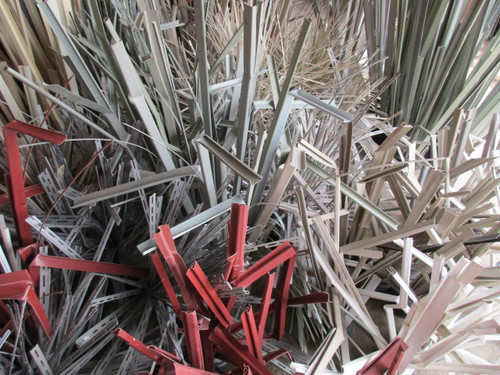
Fine strips mixed with wider profiles in our shallow habitat materials. Small spaces and varied shapes are the point—not a tidy row of identical branches.
For a shallow nursery, choose our Cradle artificial shallow fry habitat. Its recommended freshwater depth is 2–6 feet, with fine, grass-like strands for fry and forage fish. That is habitat complexity with a purpose: more small spaces for the little fish, not simply a larger object on the bottom.
Periphyton: where PVC pulls ahead
Periphyton is the attached community of algae, bacteria and tiny organisms growing on submerged surfaces as a living film, or biofilm. We call it the mother's milk of the aquatic food chain, because it feeds the copepods and zooplankton that feed fry, which feed everything bigger.
Periphyton grows on smooth surfaces, including PVC, and it doesn't need roughening or scuffing to attach. Most of our material is textured, but some is more smooth. It all gathers life quite well; see the video library for the proof. Our position is that PVC grows periphyton better than other plastics, and we have the only substantial underwater proof of it. Compared with wood, a stable surface that doesn't break down gives the growth something steady to hold onto.

Different reclaimed PVC profiles before they become underwater cover. Broad faces add surface area and shade; fine material supplies the smaller hiding spaces.
Surface area, light and placement matter along with the material. We explain that distinction in the related periphyton guide below.
Why the answer varies by pond
The right choice isn't identical for every water body. These factors move it:
- Your budget this season. If you have nothing to spend, wood is a legitimate start.
- How long you want the cover to last. Longer horizons favor PVC.
- Fry and forage protection. Tight, intricate openings matter most for small fish, and they're the first thing wood loses.
- Water depth. Shallow, mid and deep water call for different habitat designs, and Fishiding makes preassembled attractors and cribs, habitat mats, DIY components and kits for each.
- Your labor. Wood is cheap in dollars and expensive in repeat trips.
- Your goals. Fishing spots, a self-sustaining population, or fry protection each weigh differently.
Can you use both wood and PVC in the same pond?
Yes, and many owners should. Natural woody cover and engineered habitat do different jobs. Wood gives you a familiar shape and a free start; PVC gives you dense, lasting protection where fry and forage fish need it most.
For taller cover, our Keeper Artificial Fish Habitat Tree is recommended for freshwater depths over 8 feet. It stands more than 6 feet tall and opens more than 11 feet wide, bringing cover up off the bottom rather than leaving everything in a low mound.

An example from our taller HighRise range after placement. Broad lower limbs and higher branches extend cover through different levels of the water column.
Which Fishiding habitat should you buy?
| Your placement | Best fit | Why it fits | Where to choose something else |
|---|---|---|---|
| Shallow nursery in 2–6 feet of freshwater | Cradle artificial shallow fry habitat | Fine strands provide intricate refuge for fry and forage fish | Choose a taller model when you need cover farther up the water column |
| Dock or mid-depth placement in 5–8 feet | Safehouse Artificial Fish Habitat | Tight center refuge with broader shaded outer limbs | Not the tallest choice for deeper placements |
| Taller cover in freshwater over 8 feet deep | Keeper Artificial Fish Habitat Tree | More than 6 feet tall with a wide spread and built-in weighted base | Too tall for a shallow nursery site |
Measure your placement depth, then open the matching product page above and order for that job. All three finished models have cement built into the base; you do not need separate ballast. Free shipping is included on every Fishiding product.
The honest downsides of PVC
We'd rather you hear them from us.
- It costs more than free brush. Check current pricing on the site.
- It's engineered. Some owners just prefer the look of a natural tree.
- Placement still matters. No habitat, wood or PVC, helps if you drop it where fish don't go. Match the depth to the water and the species you want.
None of these change the verdict for anyone who plans to still be fishing the same pond in several years.
FAQ
Is PVC fish habitat better than wood?
For long-term cover, yes. PVC does not rot, so a Fishiding unit keeps the same dense openings year after year, while wood thins out as it decays. Wood is cheaper up front.
Does PVC fish habitat actually work in 2026?
Yes. Fishiding has 15+ years and thousands of hours of freshwater underwater footage showing fish using its dense, intricate habitat models.
Is reclaimed PVC safe for fish?
Yes. Fishiding reclaimed PVC is safe for freshwater use with koi, other fish, copepods and other aquatic creatures.
Do fish use natural wood cover?
Yes. Fish use sunken trees and brush piles. The weakness of wood is that it breaks down, and the fine branches that shelter fry go first.
Does periphyton grow on PVC?
Yes. Periphyton colonizes smooth submerged surfaces, including PVC, and does not need roughening to attach. Fishiding's position is that PVC grows it better than other plastics.
Do I need to add weight to Fishiding habitat?
No. Every Fishiding preassembled habitat unit is self-weighted with cement built into the patented design from day one.
Does Fishiding charge for shipping?
No. Free shipping has been standard on every Fishiding product since the beginning, and displayed prices are the complete fixed cost.
One last thing
If you're building a brush pile this winter, put a few dense reclaimed PVC units at the center of it. The wood gives you the familiar outline, and the PVC keeps the tight cover that fry need after the small limbs are gone. You get a pile that doesn't thin out on you.
Choose cover for your fish, then put it to work
Shop shallow nursery cover or mid-depth fish habitat. Free shipping is included on every product.
Not sure which model fits? Tell us your placement depth and whether you need fry refuge, dock cover or taller fish structure. We'll point you toward habitat built for that task.
Related guide
By David Ewald, Fishiding.