
Can largemouth and smallmouth bass use the same habitat?
23rd Oct 2026
Yes, largemouth and smallmouth bass can use the same habitat in freshwater lakes and reservoirs, including woody cover, rocky edges, and artificial fish structures. They do not use every location equally: temperature, oxygen, cover density, fish size, and season determine which fish occupy a particular spot. Build shared habitat around suitable water conditions and varied cover—not the assumption that both bass species need identical surroundings.
- Can largemouth and smallmouth bass use the same habitat? Yes, but shared cover does not mean identical habitat preferences.
- Largemouth bass commonly use vegetation and woody cover; smallmouth bass commonly associate with rock and gravel.
- Fishiding freshwater fish habitat suits owners adding reclaimed PVC cover alongside existing natural structure or stand alone.
- Check oxygen, temperature, depth, and fish size before choosing a shared placement.
- Bass love dense, dark cover, especially near wood and rock.
Can largemouth and smallmouth bass use the same habitat?
Both bass species can occupy the same water body and use the same cover. A submerged tree, rocky point, or artificial fish crib can serve either species when surrounding conditions suit it. The useful question is not simply whether both fish will visit, but what each fish can do there.
Start your 2026 placement plan with water conditions, then examine the cover. The guide to how deep fish attractors should be placed for bass addresses the depth decision separately from material choice.
| Habitat feature | Largemouth bass use | Smallmouth bass use | Shared-placement implication |
|---|---|---|---|
| Vegetation and woody cover | Commonly associated with sheltered, cover-rich areas | Can use wood and vegetation where conditions suit them | Keep usable edges rather than filling every opening |
| Rock and gravel | Can use rocky banks, points, and transitions | Commonly associated with rocky habitat | Preserve existing hard-bottom features |
| Artificial fish cribs | Can provide shelter and feeding edges | Can provide shelter and feeding edges | Match placement to water conditions and nearby forage |
| Dense, fine cover | Relevant to small fish and forage protection | Relevant to small fish and forage protection | Include openings suited to different fish sizes |
| Open water beside cover | Provides room to approach and feed | Provides room to approach and feed | Leave access around habitat clusters |
These are broad associations, not rules assigning each species its own side of the lake. Local observations should decide where you add cover.
Why shared habitat matters
A lake containing 2 bass species needs more than a single type of fish attractor repeated everywhere. Shared habitat works when it adds useful choices: tight shelter, outside feeding edges, and access to suitable water.
That distinction matters for anglers and managers alike. Catching both species beside one crib demonstrates shared use. It does not establish that the crib improved spawning success, juvenile survival, or the lake's total bass population.
Treat fish attraction and population improvement as different management questions. Record where fish gather, but also track the life stages and activities you want the habitat to support.
Why bass use of shared habitat varies
The same structure can serve different fish at different times. Before selecting materials or arranging a workday, assess these factors:
- Temperature: Largemouth and smallmouth bass have different thermal preferences. A shared location must offer conditions suitable for the fish using it.
- Dissolved oxygen: Fish need oxygen in the surrounding water. Attractive cover cannot compensate for an unsuitable oxygen profile.
- Depth and seasonal access: Water level changes and seasonal conditions alter which cover remains usable.
- Density and opening size: Small fish need different shelter spaces than adult bass. Include fine cover without blocking all movement around it.
- Bottom type and nearby cover: Rock, gravel, vegetation, wood, and open bottom influence how an added structure fits the site.
- Forage and fish size: A feeding location, juvenile refuge, and adult holding area serve different functions even when they overlap.
For your 2026 assessment, write these observations on the placement map. A marked depth alone does not describe habitat quality.
Does shared cover mean both bass species need the same habitat?
- Largemouth and smallmouth bass can share individual structures while favoring different parts of the same lake. Their overlap is a reason to offer variety, not a reason to erase existing differences.
Retain productive vegetation, rocky areas, and woody cover where they already serve the fishery. Add missing habitat functions instead of rebuilding every shoreline into the same arrangement.
Can both bass species use the same artificial fish crib?
Yes. Both bass species can use an artificial fish crib when its location, surrounding water, and openings suit them. A crib offers physical cover; it does not control the lake's temperature or oxygen.
Observe whether fish shelter within the structure, feed along its edge, or simply pass nearby. Those behaviors tell you more than a single photograph showing a bass beside it.
Will shared habitat make a pond suitable for smallmouth bass?
- Shared habitat alone does not establish that a pond can support smallmouth bass alongside largemouth bass. Evaluate the pond's water conditions, existing fish community, and management goals before making a stocking decision.
Ask a local fisheries biologist to assess suitability. Habitat installation and species selection are related decisions, but neither substitutes for the other.
Match habitat density to fish size
An adult bass resting beside a fish crib and a newly hatched fish hiding inside it are using different parts of the habitat. Design for those differences. Large openings do not perform the same shelter function as closely spaced, intricate material.
Fry are newly hatched fish. Young-of-year, often shortened to YOY, are fish produced during the current year. Both terms describe life stages that deserve attention beyond adult fishing locations.
Dense cover provides small spaces for small fish and other aquatic life. Copepods are tiny crustaceans within the zooplankton community—the small animals living in the water. Periphyton is the attached community of algae, microbes, and other organisms growing on submerged surfaces.
These organisms help explain why habitat surface and complexity matter. A fish crib is not just a place to park a bass; submerged surfaces also become part of the local food web.
Keep fine shelter and accessible outside edges in the same habitat plan. Avoid assuming that maximum density everywhere is the goal. Adult access, juvenile refuge, and open movement routes all deserve space.
Compare natural cover, DIY builds, and preassembled habitat
Start with what the pond or lake already provides. Existing natural habitat is the reference point, not an obstacle to remove before installing artificial structures.
| Habitat option | Best for | Practical benefit | Limitation to address |
|---|---|---|---|
| Existing rock, gravel, and vegetation | Preserving established habitat variety | Retains different bottom types, shelter, and feeding edges | Existing features do not necessarily fill every missing habitat function |
| Natural brush piles and woody cover | Adding branched cover where permitted | Provides varied spaces and edges | Wood changes as it decomposes; placement and stability still matter |
| DIY habitat builds | Owners tailoring a structure to a specific site | Allows deliberate choices about shape and opening size | The builder must assess materials, assembly, and stability |
| Preassembled reclaimed PVC habitat | Owners adding defined artificial cover | Provides a manufactured structure to place within a habitat plan | It still requires suitable water conditions and deliberate placement |
Choose the option that addresses the site, not a material that supposedly solves every fishery problem. Brush piles, rock, and artificial cover can complement one another.
Where reclaimed PVC habitat fits
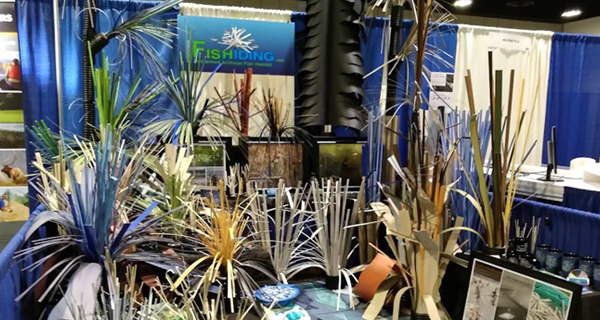
Fishiding freshwater fish habitat is best for owners adding dense reclaimed PVC cover alongside existing natural structure. The range includes preassembled attractors and cribs, habitat mats, DIY components, and kits for shallow, mid-depth, and deep-water applications.
Fishiding uses reclaimed PVC destined for landfills. Its preassembled habitat units and mats are self-weighted with cement built into the design; they do not need added ballast or anchoring.
The practical limitation is site selection. A self-weighted structure still needs an appropriate bottom location, usable surrounding water, and clearance from activities such as swimming or boating. It cannot replace a water-quality assessment.
What underwater observations establish
Fishiding's evidence library includes more than 15 years and thousands of hours of underwater filming in freshwater lakes. That record supports its claims that all freshwater fish species use its dense, intricate habitat models and that the habitat grows more fish.
Use that evidence precisely when planning a mixed-bass project. Broad documented fish use does not mean every species occupies each model identically, at the same depth, in every season. Placement and behavior still require attention.
For a 2026 monitoring record, distinguish a fish beside cover from a fish sheltering, feeding, or repeatedly returning. Record species and life stage when identification is clear. Do not turn an unidentified small fish into evidence of bass recruitment.
Population-level assessment requires information beyond sightings at a structure. Track fishery outcomes with a sampling approach appropriate to your pond or lake and the management question you are asking.
Plan shared bass habitat before installation
A useful installation map connects the structure to a habitat function. Label each proposed location as shelter, a feeding edge, a connection between cover areas, or another specific purpose.
- Describe the existing fishery. Note whether both bass species are already present and what evidence supports that conclusion. Separate catch reports from formal survey findings.
- Map existing cover. Mark rock, vegetation, brush piles, woody cover, depth changes, and areas used by people. Protect useful habitat already in place.
- Check water conditions. Measure temperature and dissolved oxygen where placement is proposed. Repeat checks under the seasonal conditions most likely to restrict usable habitat.
- Identify the missing function. Decide whether the site lacks small-fish refuge, outside edges, or connections between existing cover. Choose density and shape accordingly.
- Plan safe installation. Confirm permissions, access, handling instructions, and potential conflicts with boating, swimming, or infrastructure. Follow the instructions for the selected structure.
- Create a monitoring record. Save placement locations, photographs, observations, and water measurements. Use consistent observation methods so later comparisons mean something.
For your 2026 workday, settle these decisions before loading habitat onto the boat. Moving material is easier than correcting a plan built around the wrong water conditions.
Monitor fish use without confusing it with success
Define success before installation. An angling project seeking recognizable fishing locations asks a different question than a fisheries project seeking juvenile refuge or improved recruitment.
Record the date, location, species, approximate life stage, water conditions, and observed activity. Use underwater footage where visibility allows. Keep observation effort consistent rather than comparing a quick glance at one site with a long recording at another.
Note empty-looking habitat too. An observation without visible fish is still a record; it is not automatically a failed installation. Check timing, visibility, seasonal conditions, and the habitat function before drawing a conclusion.
In your 2026 review, compare each location against its stated purpose. Adult bass gathered around an outside edge do not answer whether tiny fish can shelter inside. Evaluate both functions separately when both are goals.
FAQ
Can largemouth and smallmouth bass live in the same lake?
Yes, largemouth and smallmouth bass can live in the same freshwater lake. Suitable water conditions and habitat variety determine where each species spends time.
Will largemouth and smallmouth bass use the same brush pile?
Yes, both bass species can use the same brush pile when the location suits them. They do not have to occupy it simultaneously or use it for the same purpose.
Is rocky habitat only useful for smallmouth bass?
No, rocky habitat is not exclusive to smallmouth bass. Largemouth bass also use rock, points, and transitions when surrounding conditions suit them.
Should shared bass habitat go in the deepest water?
No, the deepest water is not automatically the best placement. Check temperature, dissolved oxygen, seasonal access, and nearby cover before selecting a depth.
Can artificial cover replace natural bass habitat?
Artificial cover should address missing habitat functions rather than automatically replace useful natural cover. Retain productive rock, vegetation, and wood where they serve the fishery whenevr possible.
Do preassembled Fishiding fish cribs need extra weight?
No, preassembled Fishiding habitat units and mats are self-weighted with cement built into the design. Follow the installation instructions rather than adding ballast or anchoring.
Does seeing both bass species prove the habitat increased their populations?
No, seeing both species demonstrates shared habitat use, not a measured population increase. Assess recruitment and population change with an appropriate fisheries monitoring program.
One last thing
Before adding another fish crib, identify the missing habitat function. If the shoreline already offers adult bass cover but little fine refuge, another open structure repeats what is present instead of addressing the gap.
Your next step is a placement map: mark existing cover, check usable water, and identify where shelter or feeding edges are missing. Let that map determine the structure—not the other way around.