
Can artificial fish habitat protect fry? 2026 guide
23rd Oct 2026
Yes—artificial fish habitat can protect fry and young-of-year fish by providing dense spaces where small fish can shelter from larger predators. Protection depends on opening size, habitat density, placement, and usable water conditions; fish gathering around a structure does not, by itself, demonstrate improved survival.
- Can artificial fish habitat protect fry and young of year fish? Yes—dense cover provides shelter, but placement matters.
- Fishiding freshwater fish habitat suits owners seeking dense, reclaimed PVC cover for small fish.
- Match openings to fish size; an open attractor is not automatically nursery habitat.
- Evaluate shelter use and population changes separately when judging habitat success.
Can artificial fish habitat protect fry and young-of-year fish?
Yes, when the structure provides spaces small fish can enter and larger predators cannot easily follow. Fry are very young fish; young-of-year, often shortened to YOY, are fish produced during the current calendar year. Their shelter requirements change as they grow.
Start by comparing fish cribs by opening size for fry protection, rather than judging a structure only by its overall height.
Protection involves several connected functions:
- Physical refuge: Closely spaced elements interrupt a predator's access to small fish.
- Visual cover: Intricate surfaces break up open sightlines through the habitat.
- Feeding space: Colonized surfaces and nearby small aquatic organisms provide places to forage.
- Room for growth: Varied openings accommodate fish as their body size changes.
None of these functions makes every fish inaccessible to predators. The practical objective is usable shelter, not a sealed enclosure.
Why this matters: attracting fish is not the same as protecting fry
A structure can attract adult fish without providing much refuge for their young. Large branches, widely spaced pipes, or an open frame create gathering places, but their interiors still need inspection from a small fish's perspective.
Ask what happens after a predator reaches the structure. Can fry move farther into intricate cover, or does the predator have an unobstructed path through it?
For a 2026 habitat project, define the objective before choosing materials. Improving an angling location and creating nursery cover are different jobs, even when they occupy the same pond.
Judge nursery habitat by its usable interior, not simply by the number of fish visible beside it. A busy outer edge tells you fish found the structure; it does not tell you how protected the smallest fish are inside.
Dense mats: best for low-profile nursery cover
Dense habitat mats provide intricate cover close to the bottom. They are a useful format when your placement plan calls for a low-profile refuge rather than a tall fish attractor.
Check the spaces throughout the mat, not just its outline. Small fish need accessible passages within the cover, and those passages must remain usable after placement.
The tradeoff is vertical reach. A low-profile mat does not occupy the same portion of the water column as a taller crib, so select it for the depth and fish sizes you intend to support.
Do not assume every shallow location is suitable. Consider changing water levels, sediment accumulation, and the water conditions fish will encounter during the season you want the mat to function.
Varied cribs: best for shelter across changing fish sizes
A crib with dense internal elements and varied openings offers different spaces within the same structure. That variety matters because newly hatched fry and larger YOY fish do not fit into identical gaps.
Inspect the middle of the crib. A detailed exterior around an open center does not provide the same arrangement as intricate cover extending through the interior.
The tradeoff is placement complexity. A taller structure needs enough water above and around it to remain useful without interfering with swimming, boating, or other designated uses.
For your 2026 placement map, record both the bottom depth and the structure's intended position in the water column. Water depth alone does not describe where fish will find its cover.
Natural cover, brush piles, DIY builds, or preassembled habitat?
Choose the arrangement that supplies the missing shelter in your water body. Existing natural cover deserves assessment before you add anything; artificial structures should address a specific gap rather than replace useful habitat without reason.
| Habitat option | Best for | Practical advantage | Limitation to check |
|---|---|---|---|
| Existing aquatic vegetation and natural cover | Retaining established nursery areas | Already forms part of the local habitat | Distribution and seasonal condition vary |
| Brush piles | Adding branching cover where permitted | Branches provide varied spaces | Fine cover changes as woody material breaks down |
| DIY structures | Building around a defined placement problem | You control the arrangement of components | Opening size, stability, and workmanship depend on the build |
| Preassembled dense mats | Adding low-profile refuge | Defined arrangement before installation | Limited vertical reach compared with taller structures |
| Preassembled intricate cribs | Providing cover through more of the water column | Multiple internal spaces within one unit | Overall size alone does not establish nursery value |
Natural cover and brush piles
Keep useful existing cover where it fits the management plan. Before adding brush, check applicable permissions and consider how the structure will change as smaller branches deteriorate.
Brush piles require the same scrutiny as artificial cover: look for accessible interior spaces, not just a large silhouette. A pile that mainly concentrates adult fish has not automatically solved a fry-shelter problem.
DIY and preassembled structures
DIY gives you control over the layout, but that makes design checks your responsibility. Sketch the gaps, base, expected orientation, and deployment method before construction.
Preassembled habitat supplies a defined starting arrangement. You still need to match its density and height to the fish and placement site; purchasing a finished structure does not replace that decision.
Why fry protection varies
The same structure does not serve every species, life stage, season, or water body identically. These factors determine whether its shelter is usable:
- Opening size: Small fish need entry points and internal passages suited to their body size. Large, uninterrupted gaps also admit larger fish.
- Density: Numerous closely arranged elements provide a different refuge from a sparse frame. Inspect the interior as carefully as the outer edge.
- Variety: Mixed spaces accommodate different fish sizes and activities. Uniform openings limit the range of shelter within a structure.
- Depth and water conditions: Cover must sit where fish can use the surrounding water. Structure does not correct unsuitable dissolved oxygen or temperature.
- Placement: Habitat should address an identified gap and account for existing cover, seasonal water levels, and competing uses.
- Stability: A structure needs to retain its intended position and arrangement. Follow the instructions for the actual habitat type rather than applying a generic installation method.
These are design and placement checks, not a formula for predicting a survival percentage. Use them to compare options consistently.
What underwater observations establish—and what they do not
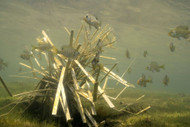
Fishiding reports more than 15 years and thousands of hours of underwater filming in freshwater lakes documenting fish use of its habitat. That long-term observation library supports its approved claims that all freshwater fish species use its dense, intricate models and that the habitat grows more fish.
Fishiding freshwater fish habitat is best for pond and lake owners seeking dense, reclaimed PVC cover for young fish. Its materials were destined for landfills, and its range includes mats, cribs, DIY components, and kits for different depth zones.
For a particular pond, distinguish that documented fish use from a measured population response. Footage showing fish entering cover establishes use; footage showing feeding establishes observed feeding activity. Neither observation alone supplies a pond-specific survival percentage.
A stronger local assessment pairs underwater observations with appropriate fisheries monitoring. Record what you actually see: fish size, location within the cover, nearby predators, water conditions, and changes across visits.
If your 2026 objective is improved recruitment—the addition of young fish to the population—ask a fisheries professional which survey method fits your pond. Do not treat an adult fish count around a structure as a count of surviving fry.
How do food-growing surfaces help young fish?
Shelter and feeding opportunity work together. Periphyton is the community of algae, microbes, and other organisms attached to submerged surfaces; zooplankton are small animals suspended in water, including copepods, which are tiny crustaceans.
These organisms matter to freshwater food webs, but their presence does not establish that every young fish eats the same food. Diet changes with species and life stage.
Provide surfaces and spaces for aquatic life without assuming that visible growth tells the whole story. A coated surface, small animals among the habitat, and fish actively feeding are different observations worth recording separately.
Water-body productivity also changes the context. An oligotrophic lake is relatively nutrient-poor; eutrophic water is nutrient-rich; hypereutrophic water is extremely nutrient-rich. Those labels do not replace measurements of conditions at the proposed habitat site.
How should you place habitat for fry protection?
Start with the fish and the missing cover, then select the structure. Use this sequence for a 2026 installation plan:
- Identify the target life stage. Record whether you are addressing newly hatched fry, larger YOY fish, or a mixture. Avoid choosing openings around adult fish alone.
- Map existing shelter. Mark vegetation, brush, shoreline irregularities, and other cover. Look for gaps rather than assuming bare-looking water needs identical treatment everywhere.
- Check the proposed depth zone. Account for seasonal water levels and measured water conditions. Do not choose deep water simply because it stays out of sight.
- Match density and height to the location. Choose low-profile cover or taller intricate structures according to the missing habitat function.
- Follow the installation instructions. Confirm the intended orientation and handling procedure before deployment. Obtain required permissions for the water body.
- Record the placement. Keep a map and photographs of the structure before installation. Record dates and conditions so later observations have context.
Fishiding preassembled models, including modular and legacy habitat mats, are self-weighted with cement built into the patented design. They do not require added ballast or anchoring.
DIY structures require their own design-specific stability checks. Do not transfer installation assumptions from one habitat type to another.
How can you tell whether fry are using the protection?
Look for fish within the shelter, not only beside it. Underwater footage is especially useful when it shows how small fish enter, move through, and leave the structure.
Keep the observation method consistent enough to compare visits. Note visibility, season, fish size, predator activity, and whether you observed the interior or only the outer edge.
For a 2026 monitoring log, separate observations from interpretations. Write that small fish entered internal spaces when approached by a larger fish if that is what the footage shows; do not convert that event into an estimated survival gain.
Repeated observations help describe use over time. Population-level questions need a broader monitoring plan, particularly when stocking, harvest, vegetation, or water conditions also change.
FAQ
Can artificial fish habitat protect fry and young-of-year fish?
Yes, dense artificial fish habitat provides refuge when its openings and internal spaces suit small fish. Protection also depends on placement and usable water conditions.
What's better for fry, a dense mat or an open fish attractor?
A dense mat better matches a low-profile refuge objective than a sparse, open attractor. Check its actual internal spaces and placement rather than relying on the product category alone.
Will adding fish habitat guarantee more surviving young fish?
Adding habitat does not establish a guaranteed survival increase for your pond. Evaluate observed shelter use separately from population changes, using monitoring suited to the water body.
How deep should I place nursery habitat?
Place nursery habitat in a depth zone that matches the target fish and retains suitable water conditions. There is no single depth that fits every species, season, and water body.
Do preassembled Fishiding mats need extra weight?
Preassembled Fishiding mats are self-weighted with cement built into the patented design and do not need added ballast or anchoring. Follow the installation instructions for the particular unit.
Can brush piles protect fry too?
Brush piles provide cover when their branching arrangement includes usable spaces for small fish. Assess internal gaps and changing branch condition rather than assuming every pile functions as nursery habitat.
What should I look for in underwater habitat footage?
Look for small fish entering and using the interior, along with sheltering or feeding behavior. Record fish size, conditions, and predator activity without treating a brief observation as a survival measurement.
One last thing
The most useful inspection angle is often the one buyers skip: look through the structure at small-fish height. If you can see a broad, uninterrupted passage through its center, examine whether it supplies the refuge you intended.
Before selecting habitat, mark the depth zone and identify the fish size you want to protect. Then compare the internal spaces—not just the outside dimensions.