Fish habitat in a shaded pond: Does it work?
Posted by dwe on 17th Nov 2026
Yes, fish habitat in a shaded pond works. A shadow is not a hiding place by itself. Trees can darken the water without putting a single protective passage within reach of a newly hatched fish. Dense submerged cover supplies those missing spaces; available light, leaf accumulation and dissolved oxygen help determine where we place it.
By David Ewald, Fishiding.
Think about standing in the shade of a tree in an otherwise empty parking lot. Cooler? Possibly. Hidden? Not even close. Fry face the underwater version of that problem when the pond has a leafy roof and a bare bottom. Our explanation of true fish habitat versus fish attractors starts with the same distinction: what can the fish actually do inside the cover?
- Fish habitat in a shaded pond gives fry physical refuge that tree shade alone cannot supply.
- Place food-web surfaces in useful light, with dense shelter nearby.
- Match Fishiding cover to water depth, leaf accumulation and oxygen—not the darkest spot.
- Use fine nursery cover and broader branching habitat to provide different-sized spaces.
Can fish habitat work beneath a tree canopy?
Yes. The protective job comes from the structure: overlapping pieces, broken sightlines and passages a small fish can use without giving every larger fish the same access. Those features still exist on an overcast day, under a dock and beneath overhanging branches.
That does not make every dark corner equally useful. Fish need suitable water as well as something to hide in. We want refuge where they can breathe, feed and move into nearby cover as they grow—not simply where the bank looks pleasantly wooded to us.
Shade and habitat complexity are different tools. Tree shade changes the light; dense artificial fish habitat changes the spaces available to the fish. A pond can have plenty of the first and very little of the second.
For fine shallow refuge, our Briar Bush Artificial Fish Habitat uses hundreds of flexible reclaimed PVC cutoffs. It is 32 inches tall, with a recommended freshwater placement depth of 2–4 feet. The small branching pieces put detail inside the habitat rather than leaving an open center.
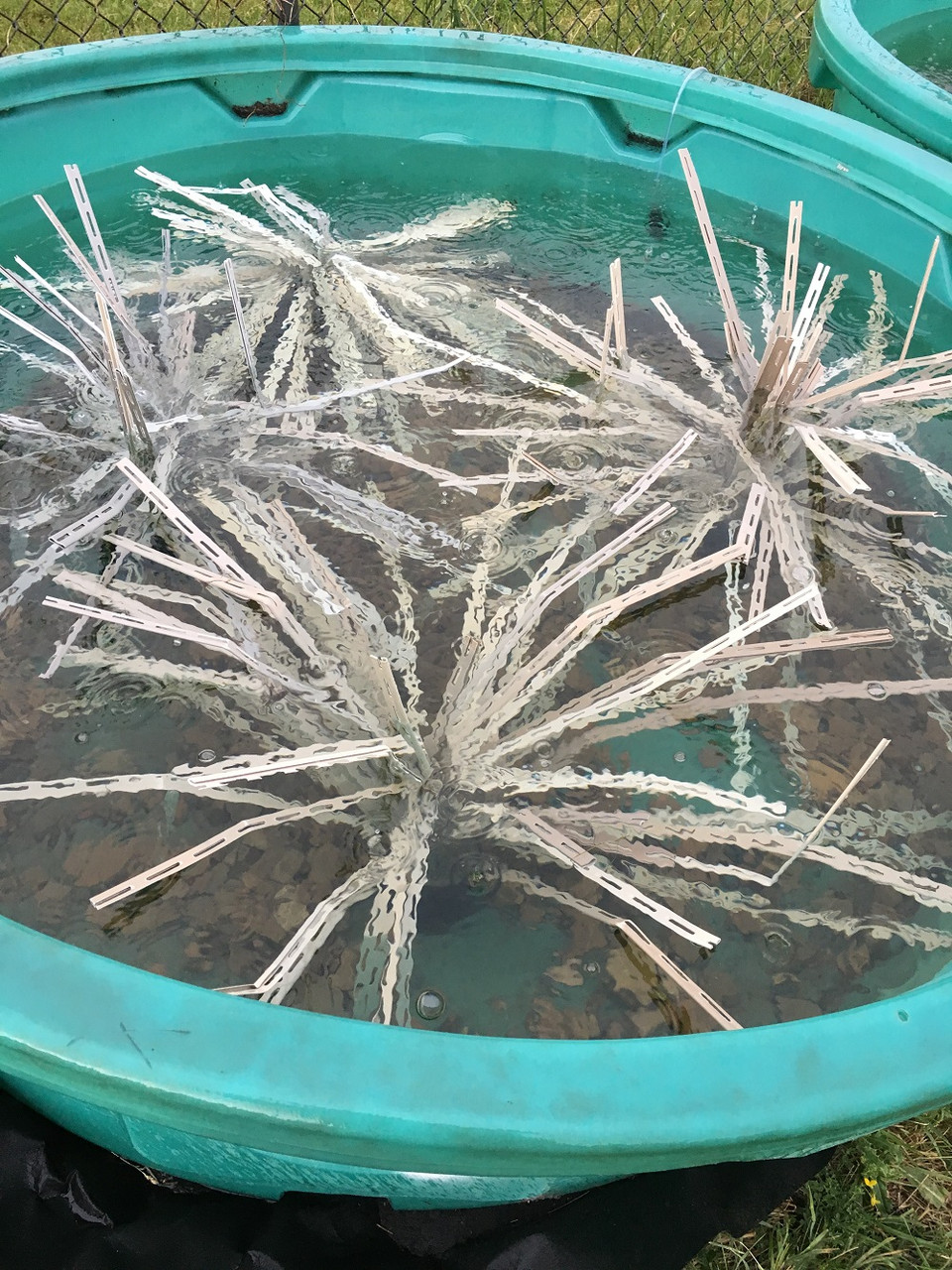
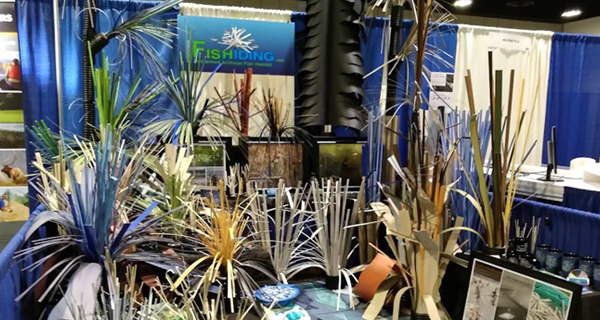
Briar Bush units in a tank show the narrow, branching pieces clearly. This photograph illustrates the construction; it is not a tree-shaded pond installation.
Give the food-growing surfaces useful light
Periphyton is the attached community of algae, microbes and associated material on submerged surfaces. We call it the mother's milk of the aquatic food chain. It supports grazing and small aquatic life around the habitat, alongside the suspended plankton pathways that feed young fish.
The algae within that community use light. Deep shade can restrict that part of production, but periphyton is not just algae, and partial shade does not make a surface biologically useless. Water clarity, nutrients, season and the depth of the individual limb matter too. Copepods—tiny crustaceans within the zooplankton community—and other small organisms do not all use the same food sources or spaces.
Our practical approach is to combine exposed outer surfaces with protected inner spaces. Let some limbs receive available light while the interior gives small fish somewhere to disappear. A habitat unit does not have to choose between being a sun porch and a hiding place.
Look across your pond in the morning, around midday and later in the day. A gap in the canopy may light a different patch each time. Check again with the trees in leaf; a bright winter shoreline can be a very different place in summer. There is no honest universal sunlight-hours requirement we can hand you for every shaded pond.

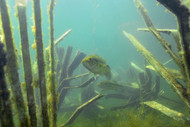
Light reaches the upper Safehouse limbs while spaces remain beneath and between them. The product library identifies this photograph as three weeks underwater; it does not measure growth under a tree canopy.
Read the leaves and the water, not just the shade
Trees contribute more than shadows. Leaves collect in particular pockets, and heavy accumulation can bury low cover or cover its growing surfaces. An ordinary scattering of organic material is not the same thing as a thick blanket swallowing the useful spaces.
Inspect where debris actually settles before choosing the placement. Keep fine nursery openings accessible and use appropriate vertical cover where you need usable habitat above the bottom. Our mats also work on slopes and soft bottoms; a shaded pond does not suddenly need a flat, firm floor.
Dissolved oxygen means oxygen available in the water for fish and other aquatic life. Decomposition consumes it, while tree shelter can reduce wind mixing. Shade alone does not diagnose an oxygen problem, and adding a fish crib is not a substitute for addressing one.
Clemson Extension's October 2022 pond turnover and dissolved oxygen guidance identifies leaf litter and dense tree cover among relevant risk factors. It recommends oxygen and temperature measurements through the water column and notes that oxygen is generally lowest in the morning. Use those measurements to choose usable depths rather than assuming the deepest, coolest-looking spot is best.
Choose cover for the depth you actually have
We build with reclaimed PVC destined for landfills, using different profiles and flexible pieces to create variety. The choice for a tree-lined pond is not a special shade-only model. It is the habitat that supplies the missing refuge at the right depth.
| Fishiding habitat | Best fit in the layout | Verified placement details |
|---|---|---|
| Briar Bush | Fine nursery refuge in suitable shallow water | 32 inches tall; recommended freshwater depth 2–4 feet |
| Safehouse Artificial Fish Habitat | Broad branching cover beside finer refuge | 48 inches tall; recommended freshwater depth 5–8 feet |
| The BassGrass Modular Fish Habitat Mat | A connected patch of grass-like refuge | At least 48 inches tall; five reclaimed PVC profiles; recommended freshwater depth 5–9 feet |
Safehouse offers broad limbs you bend by hand into an abstract profile. BassGrass combines different widths, lengths, thicknesses and flexibility across a larger patch. Keep the fine cover useful for the little fish while providing nearby spaces for larger fish—not one open room where every mouth has access to everything.

Fine strands and broader panels create different scales of cover. This above-water close-up from the BassGrass product gallery shows material variety, not the final shape or a shaded-pond result.
These finished habitats have cement weighting built into their designs. You do not add ballast or anchors. Shape selected limbs by hand, follow the model's installation guidance and plan safe handling before taking it to the pond. Keep swimming, diving and required access routes clear.
Questions about shaded pond habitat
Does fish habitat work in a pond shaded by trees?
Yes. Dense submerged structure provides physical refuge even when trees shade the water. Choose the location using water depth, oxygen, available light and debris accumulation.
Will periphyton grow on PVC fish habitat in partial shade?
Periphyton can colonize submerged PVC in partial shade. Its light-using algae respond to the light reaching each surface, while nutrients, clarity and season also affect growth.
Does a shady pond still need fry cover?
Yes, when suitable submerged refuge is missing. Tree shade does not create the narrow passages and overlapping cover that fry and young-of-year fish—fish born that year—can use.
Will falling leaves ruin artificial fish habitat?
Falling leaves do not automatically ruin it. Heavy accumulation can bury useful openings and surfaces, so inspect debris pockets and choose placement and habitat height accordingly.
Which Fishiding habitat fits a shaded pond?
Choose by the missing function and the measured depth. Briar Bush provides fine shallow refuge, Safehouse adds broad branching cover and BassGrass provides a connected patch of grass-like habitat.
Should I put all the habitat in the sunniest water?
No. Useful light helps the food-growing surfaces, but oxygen, depth, existing cover and fish access also matter. Combine light-exposed surfaces with nearby dense refuge rather than making sunlight the only placement rule.
Put useful cover beneath the shade
Start with what the pond lacks. If there are already fallen limbs with useful fine branches, work with them. If the bottom is bare, give small fish a connected patch of refuge instead of assuming the trees have handled that job overhead.
Fishiding artificial fish habitat suits pond owners who want protective spaces and food-web surfaces beneath the shade—not just another dark patch of water. Choose the depth-matched cover above, or tell us where the light reaches, where the leaves gather and which fish you want to protect. Free shipping is standard on every product.
Build habitat for your shaded pond
Tell us the water depths, fish species and where tree shade falls. We will help you choose the cover before you order.