
True fish habitat vs. attractors: What fisheries need
Posted by dwe on 13th Nov 2026
Putting fish where we can catch them is not the same as giving a fishery what it needs to replace them. If a pond, lake, or reservoir lacks nursery cover and a dependable food base, another gathering spot for adult predators does not finish the job.
By David Ewald, Fishiding
- Fish habitat vs fish attractors comes down to function: support feeding, refuge, and recruitment—not concentration alone.
- Fishiding builds freshwater fish habitat around dense, varied cover for fry, forage fish, and the food web.
- Judge nursery spaces against the fish that can enter them, including small predators.
- Connect fine refuge with transition cover and usable deeper habitat; let local water conditions set placement.
We made this distinction in our earlier discussion of artificial fish habitat and fish attractors, and it still deserves a place at the beginning of every habitat-budget meeting. What are we buying: a place to catch existing fish, or places that help the next generation survive?
Both can improve fishing. They are not the same assignment.
A fish finder does not count the fish that never grew up
An open structure can hold a handsome bass and look convincing on a screen. That tells you something useful about where that bass spends time. It does not, by itself, tell you whether more young fish are surviving elsewhere in the lake.
Our concern is what happens when the visible part becomes the whole plan. A depleted fishery needs more than a collection of adult-fish waypoints. It needs food, suitable spawning conditions, nursery refuge, and cover that remains useful as fish grow.
Concentrating predators without addressing missing nursery habitat leaves the small-fish problem unsolved. Where prey lack escape spaces, adding another hunting location can work against the survival goal. That is a design concern worth examining before installation, not after the budget is gone.
Snag resistance and efficient delivery are useful features. Neither tells a newly hatched fish where to hide.

Adult fish use is visible here, along with growth on submerged surfaces. A complete habitat assessment also looks for the smaller life stages using the cover.
Build the food supply before planning the dinner guests
Periphyton is the attached community of algae, microbes, and associated material growing on submerged surfaces. We call it the mother's milk of the aquatic food chain. It is living food-web real estate, not merely a dirty coating on a piece of habitat.
That attached community supports grazing organisms and feeding opportunities around the structure. Copepods are tiny crustaceans within the broader zooplankton community; their young stages and other small prey are important foods for many fish larvae. Which prey a larva can eat depends on its species, mouth size, and development.
This is a food web, not a single conveyor belt where all periphyton feeds all copepods and every fry eats the same meal. Attached growth, suspended plankton, small invertebrates, and fish connect through several feeding pathways.
The practical point is straightforward: give the small food organisms somewhere to live, and give small fish places to feed without exposing themselves at every turn.
The Food and Agriculture Organization's 2009 review of algae and aquatic plants in small-scale aquaculture describes periphyton as a natural food resource and discusses adding submerged surfaces to support production. Those aquaculture findings help explain the food-base principle; they are not a numerical forecast for a particular lake.
Surface area matters, but so do light and water conditions. A submerged surface in useful light serves a different growth opportunity from one buried under excessive sediment. Periphyton can attach to smooth surfaces, including PVC. Sanding is not a prerequisite for life to move in.
The predator does not have to be a trophy
A nursery can fail long before a large bass gets anywhere near it.
Picture fry under 1 inch long and a 2-inch bluegill moving through the same wide opening. Calling that opening shelter does not make it inaccessible to a small predator. The useful question is not whether a fish can get inside. It is which fish can get inside, turn around, and feed there.
Interstitial spacing means the gaps between the pieces of cover. For fry refuge, those spaces need fine detail: overlapping strands, broken sightlines, irregular passages, and pockets that restrict larger bodies while giving smaller fish alternatives.
There is no single opening size that protects every species at every age. Fish length alone does not determine passage; body depth, width, flexibility, and the shape of the route matter too. A dense interior with several narrow escape paths does a different job from a hollow frame with an unobstructed center.
A 2025 freshwater pond experiment on medaka tested this size-selective principle. Edeline and colleagues found that increased structural complexity reduced cannibalism and increased young-fish survival and population growth. The structures hindered larger fish rather than creating an absolute barrier to every one of them.
That study did not test our products. It supports the biological reason we put so much attention into the spaces between the pieces.
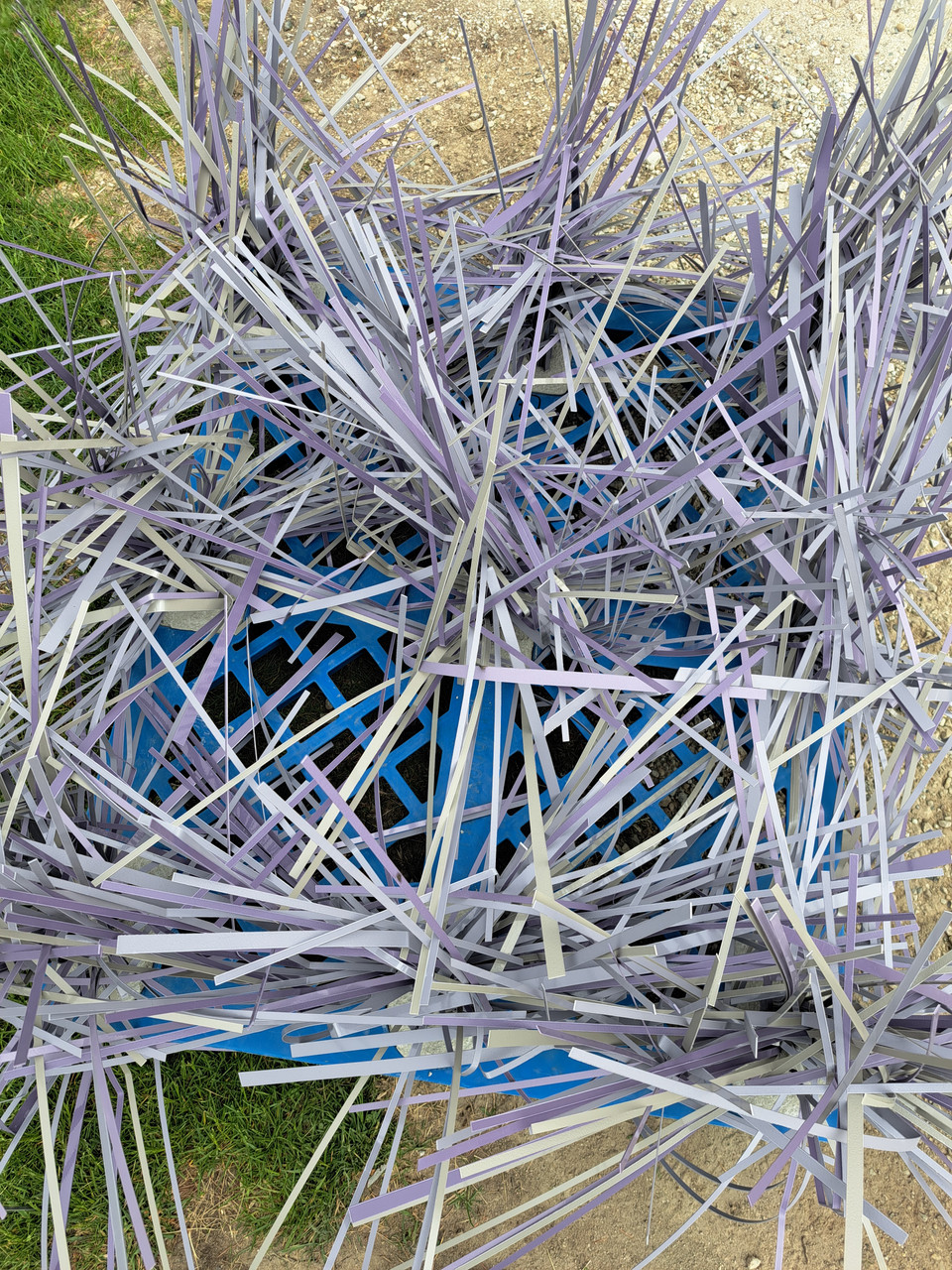
Look into the interior, not just around the outline. These overlapping strands show the fine-scale detail that an outside silhouette cannot describe.
Give growing fish somewhere to go
Young-of-year fish, often shortened to YOY, are fish born during the current year. Their needs change as they grow. Cover that suits a tiny fry is not the whole lifetime plan.
We favor connected habitat across usable depths: fine nursery refuge near appropriate spawning and rearing areas, intermediate cover nearby, and taller structure where deeper-water conditions support fish. Age-class separation means providing different-sized fish with different usable spaces—not trying to keep every age group in a separate postal code.
A shallow band around 2–6 feet and a transition around 5–8 feet can be useful places to begin a site discussion. They are not universal biological boundaries or instructions to put any product in those depths. Water clarity, seasonal drawdown, oxygen, species, and the height of the actual habitat determine the final layout.
Start with existing conditions. Preserve useful native cover. Check applicable placement permission, keep swimming and navigation routes clear, and use the installation guidance for the model you choose.
Then connect the missing pieces. Do not put every structure in the same deep-water cluster simply because that is where the boat stops easily.
Irregularity is useful when it changes what fish can do
Nature gives fish a mixture of fine stems, broad leaves, roots, branches, shade, and openings. Our aim is to reproduce useful variety, not arrange identical objects into a tidy underwater showroom.
At Fishiding, we use reclaimed PVC destined for landfills, with different widths, lengths, thicknesses, and flexibility. Hand-shaping selected limbs changes the angles and spaces within a habitat unit. Fine strands can fill the interior while wider pieces add overhead cover and separation.
A shape is not biologically useful just because it looks random. The variation must create different places to shelter, feed, and move. That is what to look for in the finished unit.

Broad panels and narrow strands occupy different parts of this Palace unit. The mixture creates more than one scale of opening within the same structure.
Match the Fishiding habitat to the missing function
Fishiding freshwater fish habitat is built for owners and managers who want protective cover and food-web surfaces, not just another fishing marker. Choose the layout around the habitat gap you actually need to fill.
| Fishiding option | Best fit | Design details that serve the job |
|---|---|---|
| The BassGrass Modular Fish Habitat Mat | Dense, grass-like cover in suitable shallow-water zones | Five reclaimed PVC profiles; at least 48 inches tall; recommended water depth 5–9 feet |
| Legacy Lifetime Shallow Fish Habitat Structures Mat Twin Pack | A configurable group of nursery and forage cover | Nine interchangeable habitat units per mat; habitat heights 3–5 feet; recommended water depth 4–10 feet |
| The Palace Ultimate Transition Fish Habitat | Connecting finer refuge with larger-fish cover in transition water | Fine center strands and broad panels; more than 60 inches tall; recommended water depth 7–12 feet |
Cement weighting is built into these finished habitat designs. You do not need to add ballast or an anchor. With Legacy mats, the habitat units fit into their compartments; shape selected limbs to create the mixture of cover your placement needs.
Our more than 15 years and thousands of hours of freshwater underwater filming support our position that this dense, intricate habitat grows more fish. The footage also keeps the design discussion where it belongs: underwater, with the fish using it.
Four questions every lake manager and agency should ask
1. Production or concentration?
What is the project supposed to change: adult-fish location, young-fish survival, forage availability, or all three? Ask for evidence that matches the objective. Recruitment means young fish surviving into the next population stage; fish appearing around a new object is not the same measurement.
2. Who fits inside?
Inspect the dense center as well as the outside branches. Are there places a fry can enter that a small bluegill or juvenile bass cannot readily follow? Ask for close photographs, dimensions where available, and observations of small-fish use—not just pictures of the largest resident.
3. What is the material, and what keeps the finished habitat in place?
Ask for the exact material, its suitability for freshwater, and documented service underwater. Separate the polymer's buoyancy from the stability of the complete structure. Our reclaimed PVC is safe for freshwater fish and aquatic life, and our finished units incorporate cement weighting rather than leaving you to improvise it.
4. Who was it built for?
Was fish function the starting point, or did shipping and fishing convenience become the whole specification? A structure can ship efficiently and fish well while still providing intricate refuge. Ask to see that refuge. The answer should be in the habitat, not just on the box.
Measure the next generation, not only the next catch
Take baseline notes before installation and repeat observations under comparable conditions. Record the placement depth, seasonal water conditions, attached growth, and sizes of fish present. Where an agency or fisheries professional conducts population sampling, keep that record separate from angler catch reports and camera observations.
Good fishing around a structure is useful information. Seeing fry, forage fish, and different age classes use connected cover answers additional questions. Tracking recruitment over time gets closer to the fishery-restoration goal.
Do not make catchability the only scorecard for a project meant to grow fish.
Questions about true fish habitat
What is the difference between fish habitat and fish attractors?
Fish attractors concentrate fish at a location; true fish habitat also supports life functions such as feeding, refuge, spawning, and rearing. One structure can serve both purposes when its design and placement provide the necessary spaces.
Can a fish attractor also provide nursery habitat?
Yes, if its actual structure includes suitable fine refuge and the placement supports young fish. The label matters less than whether small fish have feeding opportunities and places larger predators cannot readily follow.
Why do newly hatched fish need such dense cover?
Newly hatched fish need escape spaces suited to their small bodies because even small predators can threaten them. Overlapping strands and irregular passages can restrict predator access and interrupt pursuit.
Does periphyton feed the freshwater food web?
Yes. Periphyton provides attached biological growth that supports grazing and associated small organisms. Those feeding pathways connect with forage fish and larger predators, alongside plankton-based food pathways.
Should every lake use the same nursery habitat depth?
No. Nursery placement depends on species, light, oxygen, water-level changes, existing cover, and the dimensions of the selected habitat. Use depth bands as planning references rather than fixed rules.
Do Fishiding finished habitat units need additional weights?
No. Fishiding finished habitat units and mats have cement weighting built into their designs. Follow the model's handling and installation instructions without adding separate ballast or anchoring.
Put the little fish into the purchasing decision
If your project needs nursery cover, start there. Choose fine, varied refuge, provide surfaces for the food base, and connect that nursery to cover fish can use as they grow. The fishing belongs in the plan—around the edges, without stripping the center of its protection.
Talk with Fishiding about your habitat layout. Bring your water depths, target species, existing cover, and the problem you want to solve. We can help match the habitat to the job before you order.
Protect the little fish and feed the bottom of the food chain. Give tomorrow's fishing somewhere to begin.