
How to increase a pond's fish population with habitat
Posted by dwe on 4th Nov 2026
To increase a pond's fish population, start by finding what prevents young fish from becoming the next generation. Stocking more fish into a pond with little usable shelter does not address that habitat gap. Neither does adding an open fishing attractor and assuming the nursery problem is solved.
At Fishiding, we build dense, varied reclaimed PVC cover for freshwater ponds, lakes and reservoirs. Our BassGrass Modular Fish Habitat Mat is one option where a pond needs grass-like refuge in suitable 5–9-foot water. Choose it for the living spaces it adds, not because one product can correct every population problem.
- Identify the limiting problem before buying fish or habitat: shelter, water conditions, species balance and management all need consideration.
- Protect fry and forage with intricate cover, while retaining useful natural vegetation and wood.
- Use Fishiding mats, finished cribs or DIY kits to fill a defined habitat gap, not as a fixed number per acre.
- Measure young fish, fish sizes and water conditions separately from the number caught around a new structure.
First decide what “more fish” means
More small bluegill, more harvestable bass and a more balanced fish population are not the same objective. Write down what has changed and what you want to improve before adding anything.
Are you seeing young fish along the bank? Do catches show several sizes or mostly one size? Has the water level changed? Have vegetation, harvest or stocking practices changed? Keep those observations together rather than treating a slow fishing afternoon as a complete pond survey.
Where the problem is unclear, involve a fisheries professional. A proper assessment can distinguish a habitat shortage from other limits. Habitat is important, but it cannot make fish breathe in unsuitable water or determine the correct harvest decision for every pond.
Protect the fish before they reach the frying pan
Fry are very young fish. Young-of-year, or YOY, means fish produced during the current calendar year. They need usable spaces in the habitat interior, not merely a place beside a large object.
Look from small-fish height. Fine strands and overlapping pieces create a different shelter from a few wide-open tubes. There should be routes into the cover and different-sized spaces as fish grow, rather than an empty middle anyone can swim through.
Our guide to protecting fry and young-of-year fish with habitat explains the distinction between seeing fish near a structure and examining the refuge inside it.
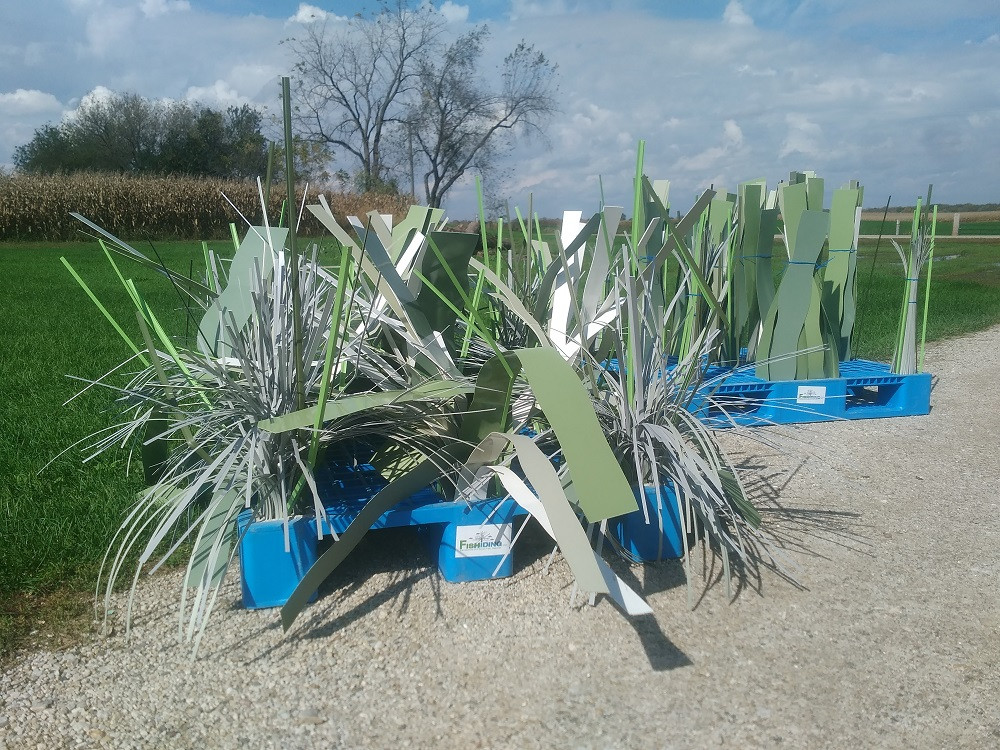
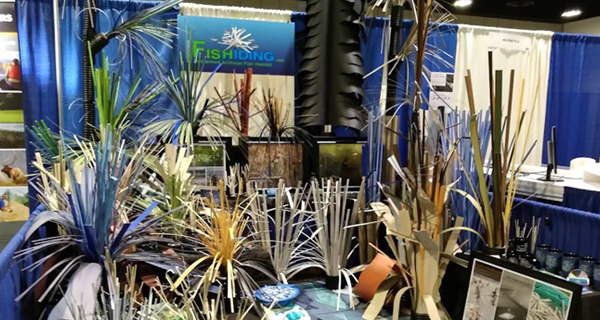
Nursery cover is about the internal spaces, not just the outside size. This Fishiding photograph shows varied profiles in modular habitat above water.
BassGrass stands at least 48 inches tall and opens to approximately 8 by 7 feet. Its five reclaimed PVC profiles provide more than 350 square feet of material surface area. That is not the same measurement as the lake-bottom footprint; do not use it as an acreage formula.
Best for: a planned patch of dense grass-like cover with appropriate depth, usable water and room for the finished mat. Check handling access before ordering.
Add complementary cover where it is missing
A pond can have useful shallow shelter and still lack cover nearby as fish move into another depth zone. Map existing vegetation, timber, rock and depth changes before deciding where a new unit belongs.
Our Safehouse Artificial Fish Habitat stands 48 inches tall, opens more than 7 feet wide and is recommended for 5–8 feet of freshwater. It is a finished individual cover option where those dimensions fit the location. Shape selected flexible limbs by hand rather than repeating one uniform arrangement everywhere.
If you want to build several cribs yourself, the Easy Dozen build your own Fish Crib kit supplies twelve base containers and 35 pounds of reclaimed PVC in three material types. You add cement, assemble the units and allow the bases to cure according to the instructions.

Building your own lets you divide and shape mixed material for the planned placements. The kit requires your cement and assembly. Photograph: Fishiding.
Every preassembled Fishiding unit and habitat mat is self-weighted with cement built into the patented design. No separate ballast or anchor is required. Loose materials and kits are different: complete their design-specific build before deployment.
Support the food-web surfaces as well as the fish
Periphyton is the attached community of algae, microbes and other organisms on submerged surfaces. We call it the mother's milk of the aquatic food chain. Copepods—tiny crustaceans—and other small aquatic animals matter along with the fry, forage fish and predators.
A reclaimed PVC limb provides surface as well as physical cover. Fine strands, broader panels and different orientations create a varied arrangement. Visible growth and observed feeding activity are worth recording separately; a coating on a limb is not a population count.

An underwater view brings the surface-growth story and fish-use story together. It still does not replace a pond survey. Photograph: Fishiding.
Water-body productivity changes the context. Oligotrophic water is relatively nutrient-poor; eutrophic water is nutrient-rich, and hypereutrophic water has extreme nutrient enrichment. These terms do not tell you to fertilize the pond or add feed without an assessment. Measure conditions and discuss management changes with a qualified professional.
A practical sequence for your pond
| Step | What to do | What the record tells you |
|---|---|---|
| Describe the problem | Write down the fish sizes and changes observed | Gives the project a specific objective |
| Check conditions | Assess water, seasonal depth and existing cover | Separates usable sites from unsuitable ones |
| Fill the habitat gap | Add the model and arrangement that fit | Creates a defined change you can inspect |
| Observe and assess | Keep comparable records over time | Distinguishes habitat use from population response |
Do not remove good natural cover just to replace it with products. Keep habitat away from swimming, diving and navigation routes. Obtain permission and check applicable requirements before installation.
Spread the plan according to the pond, not a universal count of units per acre. One large pile can create a fishing location while leaving other nursery or transition gaps untouched. A staged project is easier to evaluate than several simultaneous changes whose effects cannot be separated.
What our underwater work supports
Fishiding has more than 15 years and thousands of hours of underwater freshwater filming documenting fish use of our dense, intricate habitat. Those observations support our claim that the habitat grows more fish and guide what we put into production.
For your pond, record what actually happens. Fish moving into the interior, young fish using narrow spaces and larger fish along the edge are useful observations. A claim about increased recruitment—the addition of young fish to the population—needs an appropriate monitoring method rather than a photograph of one bass.
Keep stocking, harvest and other changes in the same log. Otherwise, an apparent improvement or decline can be assigned to the wrong cause. Better records lead to a better next habitat decision.
Population and habitat questions
Will adding habitat guarantee more fish in my pond?
No pond-specific increase is guaranteed. Dense, varied habitat addresses shelter and living-space needs, but water conditions and fisheries management also influence the population.
Should I stock more fish before adding cover?
Assess the limiting problem first. If usable shelter is missing, stocking alone does not fix that gap. Ask a fisheries professional to guide stocking decisions for the pond.
Does seeing bass near new habitat prove the population grew?
No. It documents habitat use. Population response should be evaluated separately with appropriate records or surveys.
Do finished Fishiding units need an anchor?
No. Every preassembled Fishiding unit and habitat mat is self-weighted with cement integrated into the patented design. No extra ballast or anchor is needed.
How many structures should I buy per acre?
There is no single count for every pond. Match the arrangement to existing cover, fish sizes, depth zones, usable water and the habitat function that is missing.
The fish you hope to catch later need somewhere to live now. Start there, keep the records and build the habitat around the missing pieces of your pond—not around an arbitrary shopping-cart total.
Build a fish-first pond plan with Fishiding
Tell us what you are seeing, the pond's depths and the cover already present. Free shipping is standard on every product.
By David Ewald, Fishiding.