
How long does fish habitat take to sink and settle?
Posted by dwe on 4th Nov 2026
A finished Fishiding habitat unit does not need added weight or an anchor to sink. Cement is built into the patented design. It goes to the bottom as a completed structure; there is no separate ballast installation to finish afterward.
If you are asking how long fish habitat takes to sink and settle, there are really three questions: when it reaches the bottom, how it rests on that bottom, and when fish and attached growth start using it. Those are different clocks. We do not give a universal number of seconds for the first or a guaranteed number of days for the others.
Our Safehouse Artificial Fish Habitat is a useful example: a 48-inch-tall finished unit with integrated weight, recommended for 5–8 feet of freshwater. You shape its flexible limbs by hand and plan the placement around that finished size—not around a bag of loose pipes.
- Finished Fishiding structures and mats are self-weighted with integrated cement; no added ballast or anchor is required.
- Reaching bottom, resting on the substrate and developing attached growth are different processes.
- Bottom conditions, slope and the actual habitat model matter more than a generic settling deadline.
- DIY kits must be assembled and their cement bases cured before deployment.
Sinking is not the same as settling
Sinking means the completed habitat travels down through the water. Settling describes how it rests on the pond or lake bed. A firm shelf, loose silt and an uneven slope are not interchangeable landing surfaces.
Neither term tells you when fish will use it. A fish swimming around a newly placed structure is an observation of use. Attached growth on the limbs is another observation. Neither is a timer that tells you a habitat project is biologically complete.
Do not add a random weight because an internet guide assumes every plastic structure floats. Our finished Fishiding units already contain the cement their design requires. Adding chains, ropes or ballast to solve a problem that model does not have is unnecessary.
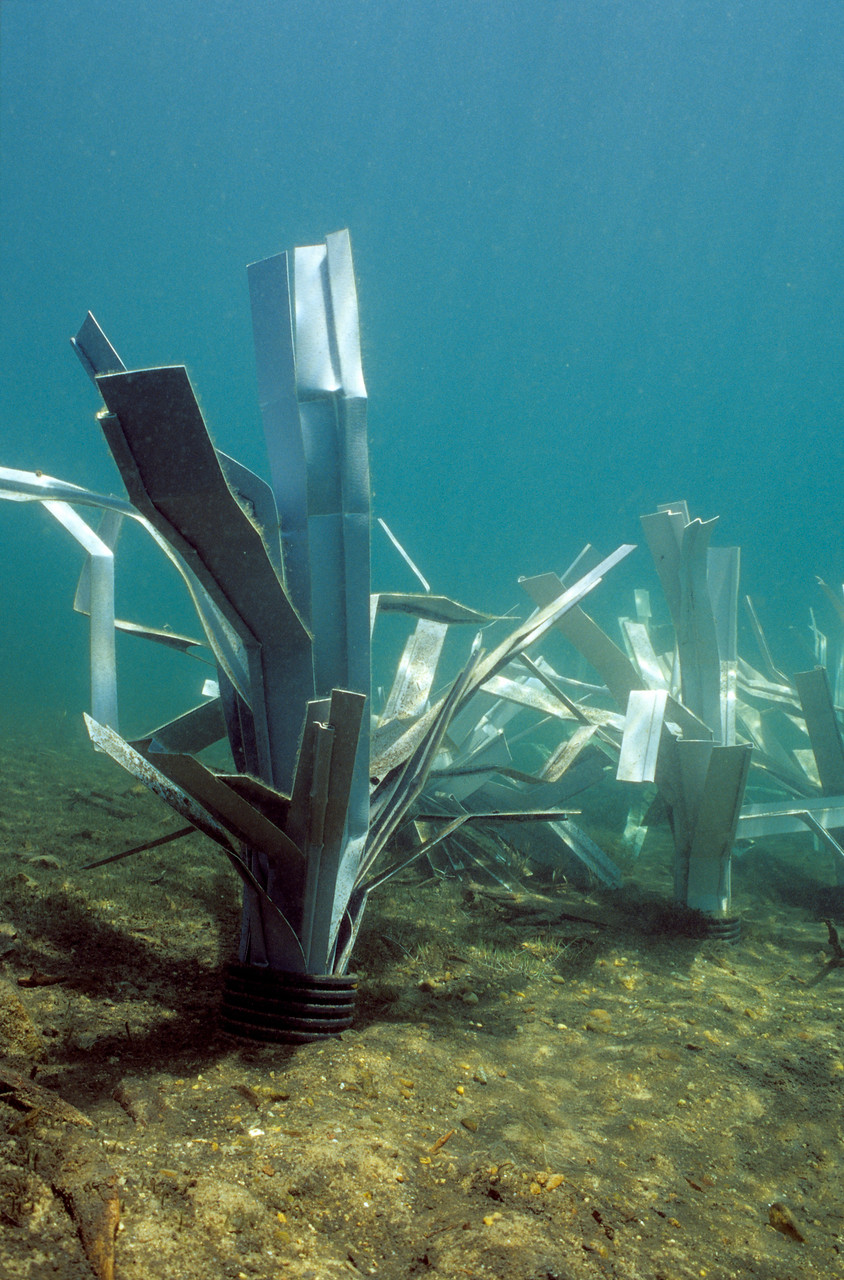
The finished base and upright cover are visible in this Fishiding underwater photograph. The bottom contact and available interior are worth inspecting separately.
What changes how a unit rests?
Check the placement site before deployment. The habitat cannot choose a better landing spot after it leaves the platform.
Bottom firmness matters. Soft sediment can cover part of a base or lower limbs. We do not publish a one-size-fits-all settling period or penetration depth for every substrate. If your pond has deep muck, discuss it before ordering rather than assuming the heaviest unit is automatically the right one.
Slope and bottom irregularities matter. Look at the model's footprint, height and intended orientation. A location suited to a compact individual crib is not automatically suited to a broad mat or a taller transition unit.
Water conditions matter. Consider seasonal levels, water movement and safe clearance. Measure dissolved oxygen at the intended depth when that is a concern. A stable structure is not useful fish cover if the surrounding water cannot support the fish you want there.
Match the model to the location
Safehouse opens more than 7 feet wide and is recommended for 5–8 feet of freshwater. Its integrated base and flexible limbs make it a finished-cover option for a suitable mid-depth site.
The Palace Ultimate Transition Fish Habitat is taller: more than 60 inches, with a spread approaching 10 feet and a recommended depth of 7–12 feet. Choose it for the space it fills, not because a larger object must sink faster or work better in every pond.
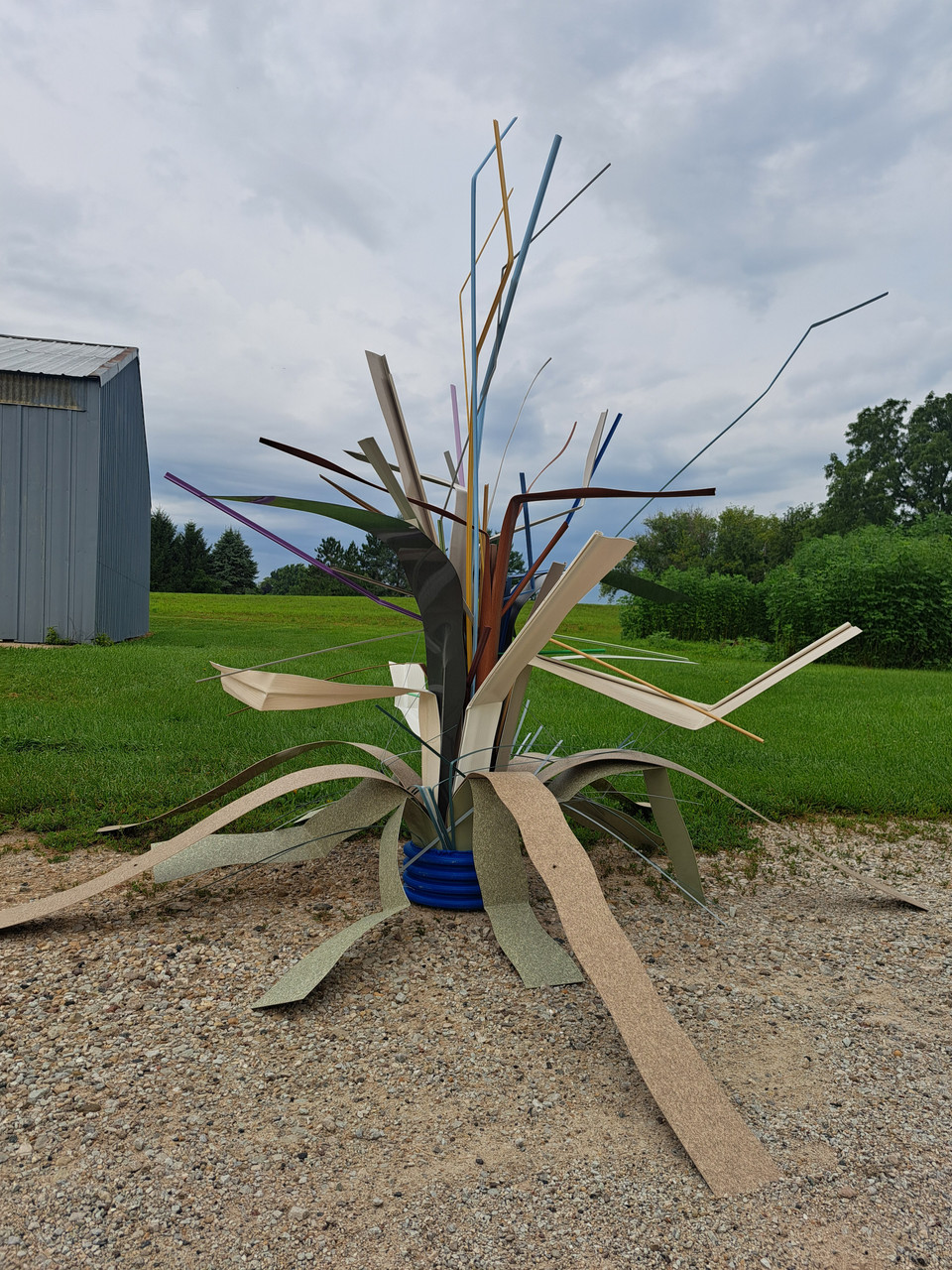
Check the whole profile above water: base, height, spread and the spaces between the limbs. Photograph: Fishiding.
| Stage | What to check | What not to assume |
|---|---|---|
| Before deployment | Model, finished size, site, access and permissions | Every artificial structure needs separate ballast |
| At the bottom | Intended orientation and usable cover | A universal settling time fits every sediment type |
| Later observations | Fish inside the cover and changes on surfaces | One fish sighting proves a population increase |
The same principle applies to habitat mats: use the actual model's handling instructions and finished dimensions. No extra ballast is required for preassembled Fishiding mats, but safe handling still has to match their weight.
A DIY kit has a preparation stage
Our Easy Dozen build your own Fish Crib kit includes twelve base containers and reclaimed PVC. You supply the cement and assemble the units. Those bases need to cure according to the cement and kit instructions before handling and placement.
Do not confuse curing time with the time a finished habitat takes to sink. They happen in different places and for different reasons. Your cement amount sets the finished weight of a DIY build, so keep the completed design and stability in view.

DIY builds require your own cement and an appropriate curing period. The photograph does not establish that the bases are ready to lift; follow the instructions for your build. Photograph: Fishiding.
Plan the placement instead of timing the drop
Confirm permission from the owner or managing agency and check applicable requirements. Keep habitat clear of swimming and diving routes, navigation channels and other designated uses.
Choose a safe method matched to the actual unit and available access. Do not balance a heavy mat on the edge of an undersized boat or try to correct its position by entering the water during deployment. Discuss an uncertain site or handling method before the workday.
Mark the placement and keep photographs of the unit before installation. If you can inspect the finished position safely from an appropriate observation method, record the orientation and surrounding conditions. That information is more useful than “we dropped it somewhere near the old tree.”
The living surface takes its own course
Periphyton is attached algae, microbes and other organisms on submerged surfaces. It is part of the food-web story, not a coating that must finish growing before a habitat can provide physical cover. Copepods are tiny crustaceans; their presence and fish feeding activity are separate things worth recording.
Light, nutrients, season and water conditions differ between sites. We do not promise that every placement will look like the same underwater photograph after the same number of days.
Over more than 15 years and thousands of hours of underwater freshwater filming, Fishiding has documented fish using our dense, intricate habitat. That supports our claim that the habitat grows more fish. It does not supply a stopwatch reading for every installation.
The arrangement remains important after sinking. Our discussion of why varied habitat profiles matter explains why we look inside the cover rather than judging it only by whether it reached the bottom.
Sinking and settling questions
How long does Fishiding habitat take to sink?
Finished Fishiding units are self-weighted and sink without added ballast. We do not give a universal number of seconds because the unit, depth and deployment conditions vary.
Does sinking mean the habitat is fully settled?
No. Reaching the bottom and resting on the local sediment are different processes. Inspect the site and model rather than relying on a fixed settling deadline.
Should I add weight to a preassembled Fishiding unit?
No. Cement is integrated into the patented design of every preassembled Fishiding unit and habitat mat. No separate ballast or anchor is required.
Do Easy Dozen kits go straight into the pond?
No. You supply cement, assemble the cribs and let the bases cure according to the instructions before handling and placement.
When will attached growth and fish appear?
Timing varies with placement and water conditions. Record physical cover use, attached growth and feeding activity separately rather than promising a fixed day.
Choose a place the fish can use, a model that fits it and a deployment method that is safe. Getting a structure wet is the easy part; putting useful cover in the right place is the job.
Choose finished cover that fits your pond
Tell Fishiding about the bottom, depths and access before your installation day. Free shipping on every product.
By David Ewald, Fishiding.