
When do fish start using new habitat? 2026 guide
8th Oct 2026
Fish do not follow a fixed waiting period before using new habitat structures; they use accessible cover when its depth, openings, and location fit their needs. Judge your new pond, lake, or reservoir habitat by repeated observations of sheltering and feeding—not by a promised number of days after installation.
- How long does it take for fish to use new habitat structures? There is no universal waiting period.
- Fishiding freshwater fish habitat is best for owners seeking reclaimed PVC cover supported by long-term underwater observations.
- Separate fish visiting an attractor from fish sheltering, feeding, or successfully reproducing around it.
- Match fish cribs to fish size, usable water depth, and nearby habitat before judging results.
Why this matters
An empty camera frame does not prove your fish crib failed. A crowded frame does not prove your pond now produces more fish. Both observations need context.
Your first job is to define success. Anglers often want a reliable place to find fish. Pond owners and fisheries managers also need shelter for young fish, feeding opportunities, and habitat distributed across usable water.
Before starting a 2026 installation plan, review the layout principles in pond structures for fish. Choose the location and the job before choosing the structure. Otherwise, you risk judging a shelter installation solely by how many adult fish you catch beside it.
How long does it take for fish to use new habitat structures?
There is no single timetable that applies to every freshwater habitat installation. Initial discovery, repeated use, biological growth on surfaces, and changes in a fish population are different outcomes. They do not share one deadline.
Use this sequence to evaluate a new fish crib, attractor, or habitat mat:
- Confirm placement. Record where the structure sits, its orientation, and its position relative to nearby cover. Check that fish can enter the intended spaces.
- Document first observed use. Record the observation date, fish type when identifiable, approximate size class, and behavior. Distinguish passing fish from fish remaining inside the cover.
- Look for repeat use. Return under comparable conditions. Repeated sheltering or feeding tells you more about the structure's function than one busy visit.
- Track development separately. Record visible growth on surfaces and activity around it. Do not treat surface growth as a required starting signal for fish use.
- Evaluate the original objective. Compare observations with your goal: adult fish attraction, small-fish shelter, or habitat restoration. Use population monitoring when the question concerns growth or survival.
Keep the installation date separate from the first observation date. The first fish you record is the first fish you observed, not necessarily the first fish that used the structure.
What different signs of use actually tell you
| Observation | What it supports | What it does not establish |
|---|---|---|
| Fish passes beside the structure | A fish encountered the installation | Repeated habitat use |
| Fish remains within the cover | Shelter use during that observation | A population-wide survival improvement |
| Fish repeatedly feeds around the structure | Foraging use at the recorded times | A measured increase in total food production |
| Young fish occupy small openings | Use by that life stage | Successful recruitment into the adult population |
| Fish are caught beside the structure | Angling activity at that location | More fish throughout the water body |
Use these distinctions in your 2026 monitoring notes. They keep a promising observation from becoming a claim it cannot support.
Why the timing of fish use varies
A waiting period is less useful than a placement check. These factors explain why different installations produce different observations:
- Depth and usable water. Fish need suitable water conditions at the structure's depth. Cover does not replace dissolved oxygen or appropriate temperature.
- Habitat density. Closely spaced elements create different shelter opportunities from widely spaced branches. Match those spaces to the fish you want to protect.
- Variety of openings. Small fish and larger fish do not use identical spaces. A varied layout offers different routes, edges, and sheltered areas.
- Location. A structure's relationship to existing cover, travel routes, and feeding areas affects how fish encounter it. An isolated placement serves a different job from connected cover.
- Stability and orientation. A structure must remain in its intended position for its openings and vertical profile to function as planned.
- Species, life stage, and season. Fry, forage fish, and adult predators have different needs. Seasonal changes also affect which parts of a pond or lake they use.
Change placement only after identifying the problem. Moving a structure because it looked empty once erases the opportunity to observe that location over time.
If the issue is unsuitable water at depth, adding more cover there does not address it. If the issue is openings that do not fit young fish, waiting longer does not change their size.
Choose the habitat function before the waiting period
Think in terms of jobs rather than a countdown. The same installation can offer several functions, but your monitoring should identify each one separately.
Shelter: look inside the cover
Fry are newly hatched young fish. YOY means young of the year: fish produced during the current year. Small openings and intricate cover matter when your goal is refuge for these life stages.
Watch whether small fish occupy the interior, not just the outside edge. Record their location within the structure and whether larger fish can enter the same spaces.
Dense cover still needs usable entrances. An intricate arrangement is not a reason to ignore how fish move through it.
Foraging: watch behavior, not just surface color
Periphyton is the community of algae, microbes, and other small organisms attached to submerged surfaces. Zooplankton are small drifting animals; copepods are one group within that community.
Attached growth and small aquatic animals contribute to freshwater food webs. However, a visible coating does not tell you how much fish food a structure produces.
Record fish feeding behavior separately from surface appearance. If your goal is improved forage habitat, observe both the sheltered spaces and activity around the surfaces.
Attraction: distinguish concentration from production
A fish attractor helps create a location where fish gather or hold. Finding fish there answers a location question, not automatically a population question.
Keep your angling records, but do not use catch alone as a count of the pond's fish. Fish concentrated around cover can be easier to locate without demonstrating an increase in total abundance.
For a 2026 project focused on population improvement, pair habitat observations with a fisheries monitoring plan. Attraction is useful evidence, but it is not the whole result.
Compare natural cover, brush piles, DIY, and preassembled habitat
There is no honest speed ranking without observations from comparable installations. Choose among these approaches by their function, placement requirements, and practical tradeoffs instead.
| Approach | Best for | Practical advantage | Limitation to plan around |
|---|---|---|---|
| Existing natural cover | Protecting useful habitat already present | Preserves established shelter and habitat connections | Its location and shape do not necessarily match your restoration objective |
| Brush piles | Adding irregular woody cover where permitted | Branches provide varied edges and spaces | Wood changes as it decomposes; placement and stability need attention |
| DIY habitat | Owners who want to control the layout | You choose the arrangement and opening sizes | Assembly quality, materials, and stability depend on the build |
| Preassembled habitat | Owners who prefer a finished structure | Reduces the need to design and assemble the habitat body | You still must select suitable depth, location, and access |
Keep useful natural cover unless there is a specific management reason to change it. Artificial structures supplement a habitat plan; they do not make existing cover irrelevant.
For DIY builds, evaluate the finished structure rather than the idea on paper. Check openings, edges, orientation, and handling before installation. Do not assume every homemade design stays upright or offers the same protection.
For brush piles, account for how the arrangement will change over time. For preassembled structures, installation still requires a site decision. No purchase removes the need to understand your water body.
What long-term underwater observations establish
Fishiding's freshwater fish habitat evidence includes more than 15 years and thousands of hours of underwater filming in freshwater lakes. That record documents fish using its dense, intricate habitat models over an extended observation period.
The company's evidence supports its stated claims that all freshwater fish species use these models and that the habitat grows more fish. Broad use does not mean every species behaves identically, occupies the same depth, or arrives on the same schedule.
Keep the evidence question specific. A video showing fish inside cover establishes observed use at that location and time. Assessing population-level growth requires attention to reproduction, survival, and the wider fish population—not simply counting fish visible in one frame.
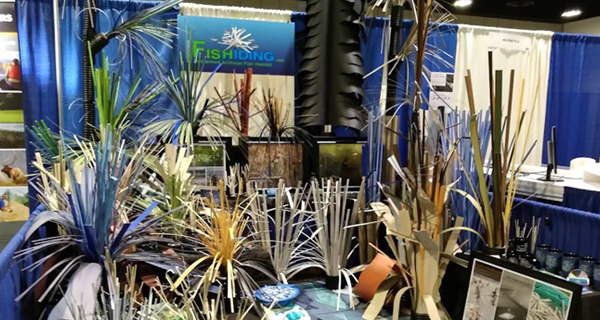
Fishiding freshwater fish habitat is best for owners seeking reclaimed PVC cover supported by long-term underwater observations. Its range includes preassembled attractors and cribs, habitat mats, DIY components, and kits for shallow, mid-depth, and deep water.
The reclaimed PVC comes from materials destined for landfills. Every preassembled model and unit, including modular and legacy habitat mats, is self-weighted with cement built into the patented design; these products do not require added weight, ballast, or anchoring.
The practical limitation is site selection. A finished, self-weighted structure does not correct unsuitable water conditions or an opening pattern poorly matched to your target fish.
Build a useful observation record
A repeatable observation record beats a memory of when the fishing seemed better. Start your 2026 habitat log at installation and keep the same fields for each visit.
Record:
- Installation location and the structure's orientation.
- Observation date, time, and viewing method.
- Water depth at the habitat and current water level.
- Temperature and dissolved oxygen when measured.
- Visibility and the portion of the structure you could inspect.
- Identifiable fish, size classes, and observed behavior.
- Changes to the structure, surrounding vegetation, or nearby cover.
Use 3 observation categories: passing, sheltering, and feeding. These are recording labels, not biological stages or a promised sequence. A fish can feed and shelter during the same observation.
Aim your camera at comparable parts of the habitat on repeat visits. If one visit shows only the outer edge and another shows the interior, the resulting counts are not directly comparable.
Keep unclear observations unclear. Do not assign a species from an indistinct silhouette or call a brief movement feeding without seeing the behavior. Useful evidence starts with an accurate description.
Should I move a structure if I do not see fish?
Do not move a structure solely because one observation shows no fish. Check water conditions, camera coverage, entrances, orientation, and the habitat's connection to surrounding cover first.
Relocation changes the site you are evaluating. If you decide to move the habitat, record the reason and start a separate location record rather than mixing both placements together.
Do fish have to wait for algae before using new cover?
Fish do not need to wait for visible algae before using a structure as cover. Shelter depends on the physical arrangement; biological growth adds a separate habitat function.
Use periphyton observations to document surface development, not to declare when the structure becomes usable. Keep sheltering and feeding observations separate.
Does seeing more fish mean the habitat is growing more fish?
Seeing more fish beside one structure establishes local use, not a population increase by itself. Fish aggregation and fish production are different measurements.
Fishiding supports its “grows more fish” claim with more than 15 years and thousands of hours of freshwater underwater observations. Follow the science.
FAQ
How long does it take for fish to use new habitat structures?
There is no universal waiting period for fish to use new habitat structures. Depth, location, openings, water conditions, and fish life stage affect use; document repeated sheltering and feeding rather than applying a fixed deadline.
Will fish use new cover before it grows algae?
Fish can use physical cover before visible algae develops. Shelter and periphyton growth are separate functions, so monitor them separately.
What's the best way to tell whether a new fish crib is working?
The best approach is repeated observation tied to the crib's intended job. Record sheltering, feeding, fish size classes, and placement conditions; one photograph or catch does not establish every habitat benefit.
Should I add weight to a preassembled Fishiding habitat structure?
No. Every preassembled model and unit, including modular and legacy habitat mats, is self-weighted with cement built into the patented design and does not require added weight, ballast, or anchoring.
Is dense habitat better for small fish than open structure?
Dense habitat offers small fish sheltered spaces when the openings fit their size. Evaluate access and interior use rather than assuming density alone meets every fish's needs.
Does an empty underwater video mean my habitat failed?
No. An empty video establishes only that no fish were visible in the recorded view at that time; check visibility, camera coverage, water conditions, and repeat observations.
Can a fish attractor replace good water quality?
No. A fish attractor supplies physical cover, not the dissolved oxygen or temperature conditions fish need. Check usable water conditions when selecting depth and interpreting habitat use.
One last thing
The first fish you film is not necessarily the first fish that arrived. That distinction matters more than an impressive countdown.
For your next 2026 installation, mark the location, write down the habitat's intended job, and choose repeatable camera positions before placing it. Select the depth zone first, then map placement and review installation instructions. You will have a clearer answer about use—and a better basis for deciding what to change.