Fishiding: The evolution of artificial fish habitat
Posted by dwe on 13th Nov 2026
A fish-first history of reclaimed PVC, changing industry language and what actually works underwater.
By David Ewald
Calling a fish attractor “habitat” does not make its openings smaller, its cover denser or its protection better. At Fishiding, that distinction has shaped our artificial fish habitat work since the beginning: not just where you can catch a fish, but where that fish can survive long enough to be caught.
- Fishiding's 2016 article publicly challenged the shift from fish-attractor marketing to artificial fish habitat claims.
- MossBack acknowledges its original Fish Rack was marketed as a fish attractor before its company name changed.
- A different name or limb arrangement is not, by itself, proof of a different biological function.
- Material tests, years of underwater use and measured fish-population results answer different questions.
We were building places to live, not just places to fish
Our January 12, 2016 article on artificial fish habitat and fish attractors put the argument plainly:
“Both products attract fish, but only true habitat can grow more fish.”
There is nothing wrong with wanting a good fishing spot. We like those, too. But a collection of bass around a structure tells you where the bass are. It does not, by itself, tell you whether more young fish survived, more food developed or the lake became more productive.
Our approach starts with the little fish and works outward. Give fry fine spaces to disappear into. Give forage fish cover they can feed around without becoming an instant meal. Give attached aquatic life surfaces to colonize. Then provide the larger openings, shade and vertical cover the bigger fish use.
The fish attractor question is, “Will fish gather here?” The habitat question goes further: “What can live, feed and grow here?”
That was our position in 2016. It remains our position today.
Reclaimed materials came before the industry argument
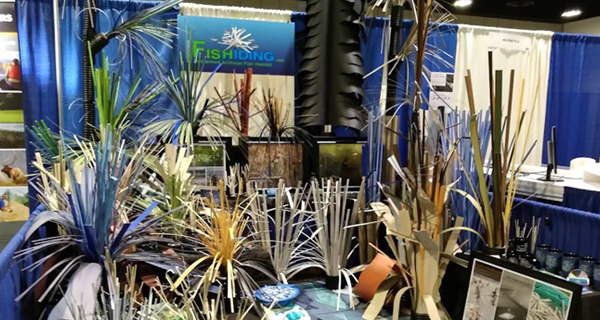
Our account of the company's beginnings dates reclaimed artificial fish habitat production to 2007. The starting material was unwanted vinyl and PVC that would otherwise have gone to landfills. The challenge was making useful freshwater cover from it, not making identical objects that looked tidy on a shelf.
Widths, thicknesses, flexibility, buoyancy and shape all offered different possibilities. Broad pieces could create overhead cover. Fine strands could form intricate nursery spaces. Different materials could be combined and bent by hand instead of forcing every habitat unit into one repeated silhouette.

The raw material story matters: discarded PVC becomes the starting point for freshwater fish cover instead of another load headed for disposal.
The original Cradle, Safehouse and Keeper models gave that approach three different jobs: shallow nursery protection, intermediate cover and taller structure. Our 2016 account describes handmade variation within those models, with no two units exactly alike.
That variety was intentional. A fish does not need every doorway in the neighborhood to be the same size.
A lake installation record from 2011
A preserved November 2011 Wonder Lake Sportsman's Club account records 56 habitat units added beside spawning grounds. About 10 shallow Cradles went into 3–5 feet of water. Safehouse units led toward 5–8 feet and deeper, with a cluster of Keepers farther out.
The club used temporary surface markers to check the underwater arrangement. The account reported more than 125 units installed cumulatively by that point.
This is a historical installation record, not a controlled population experiment. What it documents is specific: different cover types connected across depths, with nursery protection already part of the plan years before the 2016 article.
The 2016 article did not merely define two words
The original article showed products labeled Mossback Fish Rack, HoneyHole Shrub and other attractor designs. It compared the structures through 16 subjects, from density and flexibility to anchoring, installation and location.
More importantly, it challenged a change in the industry's language. Section 2 stated:
“Changing company names, copying verbiage, ideas and marketing strategy, does not make artificial fish habitat from a fish attractor design.”
Section 16 made the historical observation even more directly:
“Over five years went by before other companies began to use ‘habitat’ in their names and product descriptions instead of attractors.”
That is our publicly stated observation from 2016, not a complaint invented a decade later. The same section associates “Protection for the little guys” with our original website and Cradle models in 2007.
From our perspective, the industry moved toward the fish-first argument we had been making. The public records below document parts of that shift. They do not give us access to every competitor's internal naming decision, and we do not need to invent those conversations to make the design argument.
What those 16 subjects were really asking
| Original subject | The practical question for your fish |
|---|---|
| 1. Goals | Are you concentrating catchable fish, supporting younger fish or doing both? |
| 2. Common ground | Which biological needs does the design address? |
| 3. Materials | What is the structure made from, and are its components suitable for the intended use? |
| 4. Rigidity and flexibility | How do the limbs create and maintain usable spaces? |
| 5. Surface area and shape | How much surface is exposed to the conditions that support attached growth? |
| 6. Solid portions and shade | Where are the shaded areas and visual barriers? |
| 7. Density | Can small fish get into spaces larger predators cannot use as easily? |
| 8. Variety and texture | Are there different openings and profiles for different-sized organisms? |
| 9. Height and stability | Does the cover occupy the intended part of the water column? |
| 10. Color | Does the appearance matter to fish use, or mainly to the person buying it? |
| 11. Weight and anchoring | How does the finished structure stay in its intended position? |
| 12. Assembly | What must be done before useful cover reaches the water? |
| 13. Cost and surface area | What habitat are you actually getting for the complete project cost? |
| 14. Location | Is the cover where the target fish can use it through changing conditions? |
| 15. Versatility | Can the design serve different life stages and freshwater applications? |
| 16. History and philosophy | Was protecting fish part of the design from the beginning? |
The comparison was never simply “ours looks different.” It was about whether the physical structure matched the biological job being advertised.
MossBack: a new name is not automatically a new design
The clearest statement about MossBack's earlier positioning comes from MossBack's own company history. President and owner David King writes:
“Although the original MossBack Fish Rack was designed and marketed to anglers to be used as a fish attractor...”
He goes on to describe a broader product line for fishing and fisheries management, which prompted the company name change to MossBack Fish Habitat.
That confirms an earlier fish-attractor identity and a later habitat identity. It does not mean that the fundamental pipe-and-projecting-limb concept suddenly became an entirely different technology.
Our design criticism is straightforward: a central pipe with V-shaped limbs remains that basic construction family when the limbs are rearranged, their number changes or the finished configuration receives another product name. Those changes can alter density, shade and usable space. The biological benefit must come from what changed underwater, not what changed on the label.
| What is being compared? | What it can establish |
|---|---|
| Company and product wording | A change in identity or positioning |
| Limb number and arrangement | A change in the structure's configuration |
| Material specifications | What the components are made from at a stated time |
| Observed fish behavior | How fish use a particular installation |
| Survival and recruitment measurements | Whether more young fish reach later life stages under the study conditions |
There is a useful distinction between construction and formulation. MossBack's current materials page says its manufacturing materials were improved over time and now identifies rigid PVC trunks and limbs, with HDPE bases and shade tops. We therefore distinguish our criticism of the continuing design family from a claim that every resin formulation remained identical throughout its history.
A Mossy Oak announcement dated April 27, 2016 already used the MossBack Fish Habitat name and described shallow fry sanctuary through deeper trophy-fish applications. That announcement confirms the identity was in use then; it is not evidence that the name change happened on that date or after our January article.
The central issue remains the one we raised at the time: expanded habitat language deserves a corresponding explanation of habitat function.
Honey Hole: distinguish the product line from the company name
Honey Hole is Pond King's product line. Calling its history a confirmed corporate renaming would confuse two different things.
Andrew Norris's Churchill Fellowship report discusses Honey Hole polyethylene structures as fish attractors and describes Fishiding's reclaimed PVC structures in the same report. Our 2016 article also illustrated the HoneyHole Shrub in the attractor comparison.
Today, Pond King's Artificial Habitat FAQs describe Honey Hole products as intended to augment or replace aquatic vegetation, attract gamefish and protect forage fish. That is a broader statement of purpose than simply creating a place to catch fish.
The historical comparison concerns that emphasis. What did the original product promise? What physical design changed? What new evidence supports the expanded promise?
We are not assigning an exact date to every wording change. The earlier attractor descriptions and the current habitat descriptions are the records being compared. A product's name, its marketing purpose and its actual performance should not be treated as interchangeable.
Independent fisheries work asked the same important question
The Queensland archive record for Andrew Norris's report supplies a useful date distinction: Norris was a 2015 Churchill Fellow, but the report is dated 2016 and signed January 28, 2016. Its full title is Increasing Australian impoundment fisheries potential: Habitat enhancement to improve angling and productivity in impoundments.
Its first recommendation is especially relevant:
“Habitat enhancement projects must set clear objectives and identify whether their primary goal is attracting fish for anglers or increasing reservoir productivity.”
Another recommends structures with as much structural complexity as possible, without large open voids. The report describes our reclaimed PVC construction, flat limbs of different lengths and widths, and hand-shaped configurations. It includes photographs of shaping a structure and a bass using one underwater.
Andrew Norris also examined our products firsthand. I met Andrew at a Friends of Reservoirs annual meeting in Athens, Texas, where he took a hands-on look at the Fishiding structures and spoke highly of their potential. He was not simply reading a product description or looking at photographs; he could handle the materials and examine the construction for himself.
This is independent historical documentation of the products and the management questions. It is not a controlled head-to-head trial proving one brand increases fish populations more than another.
The broader lesson is useful to any pond owner: decide which result you want before counting structures. A better fishing location and a more productive fish population can overlap, but one does not automatically measure the other.

Fine branching cover is a design choice, not a naming choice. The openings available to small fish are part of the habitat itself.
Ugly Tree: tell the buyer what the branches are made from
The Ugly Tree raises a different question: material disclosure.
On the Outdoor Water Solutions Ugly Tree product page, reviewed November 13, 2026, the materials specification reads:
“Durable artificial branches designed to hold algae growth”
That describes an intended property. It does not identify a polymer.
The same page specifies a three-piece clip system, a block-holding fork and recommended placement in 5–12 feet of water. It also makes claims about improving fish populations and sizes. Yet the reviewed specifications do not identify the resin used for the branches or provide a controlled, long-term lake study supporting those population claims.
| Buyer question | What the reviewed page supplies |
|---|---|
| What is the exact branch polymer? | Not identified in the material specification |
| Is it PVC, polyethylene, polypropylene or something else? | Not identified |
| What recycled content or additives are used? | Not specified |
| Where is it manufactured? | Not established by the reviewed specifications |
| Where are the long-term lake inspection records? | Not supplied on the reviewed page |
| Where is the product-specific survival or recruitment study? | Not supplied on the reviewed page |
Those are specific information gaps, not proof that the product is unsafe or that no fish ever use it. Nor does a tree-like appearance establish where it was manufactured. Those claims require their own records.
Our question is simpler: if a product is sold for long-term underwater use, why leave the buyer guessing about the material?
And if improved fish populations are part of the promise, show the study design, location, duration and result. “Fish gather here” and “this lake now produces more fish” are different claims.
A laboratory is not a lake
Laboratory work is useful. So are underwater cameras. They are useful for different reasons.
A controlled materials test can identify composition or measure deterioration and chemical release under stated conditions. It does not show how a complete structure performs through years of changing water levels, sediment, seasons and fish behavior.
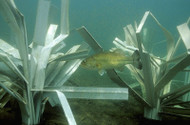
Likewise, an underwater photograph of a bass beside a structure does not measure the survival rate of the fry inside it. You need evidence matched to the question.
| Evidence | What it can answer | What it does not establish by itself |
|---|---|---|
| Laboratory materials testing | Composition and behavior under the tested exposure | Years of functional habitat use in a natural lake |
| Repeated field inspections | Condition, position and durability over documented time | Increased population size |
| Underwater photographs and video | Species, size classes and behaviors visible around the structure | A lake-wide percentage improvement in recruitment |
| Comparative biological studies | Differences in survival, growth or recruitment under a defined design | Identical results in every lake or with every species |
A structure can remain intact without providing much refuge. It can grow attached algae without having enough small openings to protect fry. It can hold fish while the lake's total fish population stays the same.
None of those distinctions makes field observation unimportant. It makes clear, dated observation more valuable.
What newer research adds about protecting small fish
A 2025 peer-reviewed study by Eric Edeline and colleagues tested structural complexity in Japanese medaka, a small fish, using laboratory behavioral work and replicated outdoor pond experiments in 2021 and 2022.
The outdoor work used 16 experimental ponds. In 2021, high-complexity ponds averaged 39.4% surface coverage by the refuge material, compared with 8.6% in low-complexity ponds. The structures disproportionately hindered larger fish moving through them.
The researchers reported increased survival of young-of-year fish, greater coexistence of age classes and increased population growth under more complex conditions, associated with reduced cannibalism. They also reported increased competition for food at higher population density.
That last result matters. Shelter and food work together; adding cover does not make every other limit disappear.
This was not a Fishiding product trial, a bass experiment or a multi-year natural-lake durability study. It is useful independent support for the mechanism behind our fish-first question: can the smaller fish use spaces that make life harder for the fish trying to eat them?
The size of the refuge relative to the fish matters more than the word printed on the box.
The food web needs surfaces as well as hiding spaces
Early in Fishiding's history, we coined the description of periphyton as “the mother's milk of the aquatic food chain.” It is the attached community of algae, microbes and other tiny organisms developing on submerged surfaces, not the phytoplankton suspended in the water.
Those surfaces sit within a larger food web that includes aquatic insects, zooplankton and copepods—tiny crustaceans important as food for many young fish. Protective cover and feeding opportunities should be considered together, not sold as unrelated features.
Periphyton can colonize smooth surfaces, including PVC. Sanding and scuffing are not prerequisites for attachment. Light, nutrients, grazing, water conditions and excessive sediment burial also influence the growth you actually get.
Our interest in broad, varied reclaimed PVC limbs is practical: surface, shade and spaces can be combined within the same structure. Fine strands provide a different arrangement of refuge. Neither “more plastic” nor “more algae” tells the whole story without looking at how the fish use it.

Flat limbs, different angles and varied openings create more than a recognizable outline. The useful question is what those spaces offer the fish living around them.
The original three models still explain our approach
You can see the design philosophy without turning it into a vocabulary dispute. Start with the life stage and water depth, then choose the cover that serves it.
These are current product specifications, not an attempt to assign today's dimensions to a 2007 model.
| Fishiding model | Useful role | Current design details |
|---|---|---|
| Cradle artificial shallow fry habitat | Best for shallow nursery cover: fine refuge for fry and forage fish | Approximately 28–32 inches tall; recommended depth 2–6 feet; opens beyond 50 inches |
| Safehouse Artificial Fish Habitat | Best for intermediate cover: dense central spaces with broad outer limbs | 48 inches tall; recommended depth 5–8 feet; opens beyond 7 feet |
| Keeper Artificial Fish Habitat Tree | Best for taller vertical cover: structure extending farther through the water column | More than 72 inches tall; recommended depth over 8 feet; opens beyond 11 feet |
All three use reclaimed PVC and built-in cement weighting. You do not need separate ballast or an anchor for these preassembled models. Free shipping is included on every product.
Our range has expanded to self-opening structures, modular mats, barrel habitat and DIY materials, but the practical starting point remains the same: give the fish useful cover, not just another object on the bottom.
Fishiding artificial fish habitat suits pond and lake owners who want dense, varied freshwater cover designed around fry, forage fish and the larger fish that depend on them.
What long-term proof should look like
We have more than 15 years and thousands of hours of underwater filming behind our habitat work. That field record supports our claim that the habitat grows more fish. The useful part is not simply how many years have passed, but what can be seen and documented during those years.
The Fishiding underwater video library brings that evidence into view. Its Safehouse-after-ten-years entry describes established cover still providing dense, varied habitat after more than a decade. Eric Engbretson's ten-part series explains fish use, configurations and changes over time.
For a project of your own, keep records that let later observations mean something:
- Record the installation date, location, depth and model or material.
- Photograph the original configuration and note bottom and water conditions.
- Return through different seasons, including periods when vegetation dies back.
- Record species and size classes using the interior, edges and overhead cover.
- Document attached growth, feeding activity and structural condition.
- Use comparable untreated locations and professional surveys when measuring population effects.
That standard applies to our work, too. Documented fish use, product longevity and measured population changes belong together, but they should retain their separate meanings.
The industry's evolution should happen underwater
Our 2016 article challenged the idea that changing an attractor's name was enough. Ten years later, that challenge is still useful—and still needed. The distinction between attracting fish and providing functional habitat continues to be misrepresented.
MossBack's own history documents its earlier attractor positioning. Honey Hole appears in historical attractor discussions and current habitat marketing. Ugly Tree's reviewed product page describes its branches without identifying their polymer. Each record raises a different question; lumping them together would miss the point.
The Fishiding story is not a claim that we invented fish habitat, fisheries biology or every useful word in the subject. It is the record of a business that used fisheries science to design reclaimed PVC cover around protecting little fish, explained why the distinction between attracting fish and providing habitat mattered, and publicly challenged an industry to do more than change its language.
Change the fish's chances, not just the product description.
If your pond is missing shallow refuge, start with the Cradle. If you need intermediate shade and cover, look at the Safehouse. If the missing piece is height, consider the Keeper. Build the habitat around the fish you want to raise—not only the ones you hope to catch.
Questions pond owners ask
What is the difference between a fish attractor and artificial fish habitat?
A fish attractor concentrates fish at a location. Functional artificial fish habitat also supplies useful living space, such as refuge, feeding surfaces and cover suited to different life stages; one structure can serve both purposes.
When did Fishiding publish its habitat-versus-attractor argument?
David Ewald's detailed Fishiding article was published January 12, 2016. Its 16 sections compare design, materials, density, surface area, installation and biological purpose, and explicitly challenge changes in competitor terminology.
Did MossBack originally market its Fish Rack as a fish attractor?
Yes. MossBack president David King's company history says the original Fish Rack was designed and marketed to anglers as a fish attractor, and describes the later company name change to MossBack Fish Habitat.
Does changing the number of limbs prove a structure improves fish populations?
No. Limb number and arrangement can change physical cover, but population claims require biological evidence matched to the installation, species and outcome being measured.
Does the Ugly Tree specification identify its plastic?
The Outdoor Water Solutions product page reviewed November 13, 2026 describes durable artificial branches but does not identify their exact polymer. That is a disclosure gap, not proof of unsafe material or absent fish use.
Can laboratory testing prove fifteen years of fish habitat performance in a lake?
No. Laboratory testing measures properties under stated test conditions. Long-term lake inspections document field condition, and underwater observations or comparative biological studies address fish use and population outcomes.
What did Andrew Norris's Churchill report say about project goals?
The report recommends identifying whether the primary goal is attracting fish for anglers or increasing reservoir productivity. Norris was a 2015 Churchill Fellow; the report itself is dated 2016.
Which original Fishiding habitat should I consider for shallow fry protection?
The Cradle provides fine, dense nursery cover and is recommended for freshwater depths of 2–6 feet. Safehouse and Keeper models address intermediate and taller cover needs; choose placement around your fish, oxygen conditions and seasonal water levels.
David Ewald is the owner of Fishiding. His work centers on reclaimed PVC freshwater habitat, protective cover and documenting how fish use it underwater.