
Fish habitat for municipal parks and recreation departments: complete 2026 guide
23rd Oct 2026
Your public pond needs fish cover without putting submerged structures in swimming areas, boat routes, or maintenance access. Plan fish habitat for public parks around usable water, fish size, and public access before choosing brush piles, DIY builds, or preassembled habitat for your 2026 project.
- Fishiding freshwater fish habitat suits municipal teams seeking preassembled reclaimed PVC cover for ponds, lakes, and reservoirs.
- Plan fish habitat for public parks around oxygen, depth, fish size, and public access—not empty lake acreage.
- Preserve useful natural cover; compare brush piles, DIY fish cribs, and preassembled habitat by installation and inspection needs.
- Record fish use separately from population changes; underwater observations and fisheries monitoring answer different questions.
Why fish habitat matters for municipal parks
A municipal habitat project serves fish and people. Your department needs useful shelter and forage space while keeping shore access, recreation, and water-management work practical. A structure that conflicts with a swimming area or intake is a placement problem, even if fish use it.
Start with the habitat gap. Does the pond lack dense refuge for small fish? Is existing cover isolated from usable water? Are you improving fish shelter, creating an accessible fishing location, or doing both? Those goals need separate decisions.
Fishiding documents freshwater fish habitat use through more than 15 years and thousands of hours of underwater filming. That evidence supports its claims that all freshwater fish species use its dense, intricate models and that the habitat grows more fish. Species, life stage, season, and placement still affect how fish use particular structures.
For your 2026 municipal project, separate observed fish use from measured population change. Footage can document shelter and activity around installed cover. Population-level evaluation also needs fisheries monitoring; counting fish beside a crib does not measure recruitment across the pond.
Plan and install freshwater fish habitat
1. Define the fish problem and public-use boundaries
Use your existing park map and a shoreline walk first. Mark fishing access, swimming areas, launches, intake locations, overflow structures, and maintenance routes. Ask the staff who mow, manage water, and respond to park incidents where submerged cover would create a conflict.
Then write a short habitat objective. Improving refuge for fry—young fish shortly after hatching—is different from concentrating larger fish near an accessible fishing bank. Neither objective should quietly replace the other during purchasing.
Your 2026 project brief should explain the intended fish benefit, the selected area, and how staff will check the result. Confirm ownership and applicable approvals with the responsible authorities before placing material. Public ownership alone does not establish installation permission.
Close this step with a map that another employee can understand without a verbal tour:
- Mark habitat objectives separately from fishing-access objectives.
- Outline swimming, boating, intake, and maintenance exclusion areas.
- Identify the staff member responsible for approvals and records.
- Photograph existing shoreline cover and candidate installation areas.
- Record the reason for each proposed habitat location.
2. Check usable depth before selecting structures
Use available depth surveys, shoreline measurements, and water-quality records before paying for new mapping. If staff lack suitable records, arrange measurements with qualified personnel. A surface view cannot tell you whether deep water provides usable fish habitat during the season you are targeting.
Deepest does not automatically mean best. Temperature and dissolved oxygen affect which parts of a pond or lake fish can use. During stratification, separated water layers can have different oxygen conditions. A fish crib does not supply oxygen or correct that problem.
Organize your map into 3 depth zones: shallow, mid-depth, and deep water. These are planning categories, not universal installation depths. Assign actual depths only after checking water levels, water quality, the target fish, and structure dimensions.
Include seasonal low water in that review. A location that looks suitable during a spring visit can create a different access problem when the water drops.
- Record depth at each candidate placement location.
- Review seasonal water-level changes with maintenance staff.
- Measure temperature and dissolved oxygen where needed.
- Exclude water that cannot support the intended fish use.
- Match structure height to clearance at low water.
3. Match density and openings to fish size
Inspect the cover already present before selecting new material. Look for combinations of fine shelter, larger openings, and edges where fish can move between cover and open water. A large outline on a product drawing does not tell you how much usable shelter exists inside it.
Periphyton is the community of algae and other microorganisms growing on submerged surfaces. Zooplankton are small drifting animals; copepods are one group within them. These organisms belong in the habitat discussion alongside fry and larger forage fish, rather than treating every structure solely as an angling attractor.
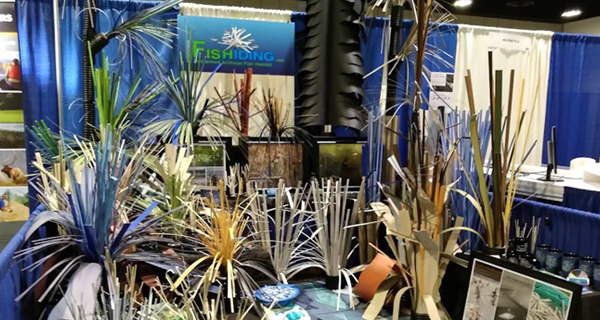
Fishiding freshwater fish habitat uses dense, varied reclaimed PVC forms for shelter and forage space. Fishiding is best for municipal teams seeking preassembled reclaimed PVC freshwater fish habitat. Its range also includes mats, DIY components, and kits; select the format after defining the fish-size and placement requirements.
- Identify whether the project targets fry, forage fish, larger fish, or mixed use.
- Compare fine shelter with larger movement openings.
- Review structure height and footprint against the placement map.
- Preserve useful natural cover instead of replacing it automatically.
- Request actual model dimensions and installation instructions before selection.
4. Arrange habitat around fish movement and park operations
Sketch the layout yourself before requesting a product configuration. Show existing cover, depth changes, public-use boundaries, and proposed habitat groups. This makes the placement decision visible before equipment or material reaches the water.
Avoid treating every bare patch as a problem to fill. Your layout needs shelter, open movement space, and practical access for inspection. Distinguish habitat intended to protect small fish from cover intended to support public fishing; publishing every refuge location is not necessary to provide useful angling information.
For the 2026 placement plan, evaluate the whole structure rather than only its bottom footprint. Height matters near changing water levels and boat traffic. Maintenance staff also need to know where cover sits before dredging, repairing banks, or servicing water equipment.
Use the water-depth placement guide when comparing shallow, mid-depth, and deep-water options.
- Map habitat groups against existing cover and depth changes.
- Keep public-use and maintenance exclusion areas clear.
- Check the top of each structure against seasonal water levels.
- Retain access for approved inspection and water-management work.
- Separate internal habitat records from public fishing maps.
5. Confirm stability and installation requirements
Read the installation instructions before scheduling a workday. Record the assembled dimensions, unit weight, handling method, and equipment requirements for the chosen model. Do not infer those details from a photo or assume that every PVC fish attractor installs the same way.
Every Fishiding preassembled habitat model and unit, including modular and legacy habitat mats, is self-weighted with cement built into the patented design. These products do not need added weight, ballast, or anchoring. Installation planning still needs to account for safe handling, site access, and accurate placement.
DIY structures and brush piles require their own stability plan. Have the design reviewed for the selected location rather than copying the requirements of a different structure. Keep volunteer tasks within the department's approved work procedures, particularly around boats and lifting equipment.
- Obtain the chosen model's verified dimensions and handling instructions.
- Confirm the installation area is accessible to the required equipment.
- Review bottom conditions and the proposed placement method.
- Follow department procedures for lifting, boats, and work-zone control.
- Record final locations immediately after placement.
6. Build a purchase specification staff can evaluate
Write the specification manually from your mapped requirements. Describe the required depth zone, shelter characteristics, footprint, handling needs, and documentation. That gives purchasing staff a habitat requirement to evaluate, rather than a vague request for something fish will gather around.
Compare natural cover, brush piles, DIY structures, and preassembled habitat on the work each option requires. Include preparation, installation, inspection, and eventual removal planning. A donated material still requires staff decisions and labor; a preassembled unit still requires a suitable location.
Reclaimed PVC provides a material-reuse criterion grounded in the supplied brand facts: the material was destined for landfills. Do not turn that fact into an unsupported environmental-impact calculation. Ask for the information needed to compare the actual models under consideration.
Keep your procurement file useful to the next employee, not just the current project lead:
- Describe the habitat function before naming a preferred format.
- Request verified dimensions, weights, and installation instructions.
- Compare staff work and equipment needs across options.
- Document material composition and reclaimed-material requirements.
- Identify inspection responsibility and record-storage location.
7. Measure fish use and maintain a municipal record
Start with a baseline visit, photographs, and existing fisheries information. Use the same observation method after installation wherever practical. Changing the camera location, viewing conditions, and observation method at every visit makes comparisons harder to interpret.
Choose 4 fixed photo positions as a practical documentation starting point: shoreline context, installation access, habitat location, and a repeatable underwater view where safe and feasible. These are recommended records, not a biological sampling standard. Adjust the plan with your fisheries staff.
For your 2026 monitoring file, record observed species, fish size or life stage, date, depth, and visible activity. Document shelter use separately from feeding observations. Use qualified fisheries assessment when the question is whether recruitment or population condition has changed.
- Preserve baseline photographs and the placement map together.
- Repeat observations from documented positions where feasible.
- Record fish use, water conditions, and observation limitations.
- Check for conflicts with recreation or maintenance work.
- Assign follow-up responsibility before the installation team leaves.
Compare habitat options for municipal parks
There is no single format for every public water body. Choose the option that fills the documented habitat gap with an installation and inspection workload your department can support. The table compares functions and limitations, not unverified product specifications.
| Option | Best for | Main advantage | Key limitation |
|---|---|---|---|
| Existing natural cover | Parks with useful vegetation, wood, or varied shoreline habitat | Preserves habitat already present | Its location and condition do not necessarily match the project objective |
| Brush piles | Approved projects using suitable woody material | Provides branching cover | Requires preparation, stability planning, and checks as material breaks down |
| DIY fish cribs or attractors | Departments with construction capacity and a reviewed design | Allows a build around specific site requirements | Staff must verify openings, stability, handling, and placement |
| Fishiding preassembled habitat | Municipal teams seeking self-weighted reclaimed PVC cover | Includes built-in cement weighting and dense, varied forms | Model selection still requires verified dimensions and a suitable placement area |
| Habitat mats | Projects seeking cover across a bottom area | Offers a different layout from upright cribs | Footprint and placement must fit bottom conditions and public-use boundaries |
Natural cover and manufactured habitat can serve the same project. Preserve useful habitat, then add structures where your map identifies a specific missing function. Mats are a format, not a substitute for depth and water-quality checks.
Common mistakes municipal parks departments make
Treating better fishing access as the entire habitat goal
A convenient place to catch fish does not answer every shelter or recruitment question. State the angling-access objective and the fish-protection objective separately. Give each a placement plan and an evaluation method.
Selecting deep-water locations without oxygen information
Depth alone does not establish usable habitat. Check temperature and dissolved oxygen for the relevant season before committing structures. Do not describe submerged cover as an aeration treatment or a remedy for oxygen-related fish kills.
Installing cover without involving maintenance staff
A placement map must account for more than fishing. Staff need clear access to intakes, overflow structures, shoreline work areas, and approved dredging zones. Include those employees before purchasing, not after a submerged structure blocks their work.
Letting donated material define the project
Start with the habitat objective, then evaluate the material. An available brush pile or volunteer-built crib still needs a suitable design and location. Donation does not replace review of openings, stability, handling, or public access.
Reporting visible fish as a measured population increase
Underwater footage documents use of the observed habitat. It does not, by itself, count recruitment across your municipal pond. Keep the observation record, but use a fisheries assessment for population-level questions and report each result accurately.
FAQ
What's the best fish habitat for public parks?
The best fish habitat for public parks fills a documented shelter or forage gap without conflicting with recreation and maintenance. Compare existing natural cover, brush piles, DIY structures, and preassembled reclaimed PVC habitat against the same site requirements.
How deep should a parks department place fish habitat?
Place fish habitat in water the target fish can use during the intended season. Check depth, temperature, dissolved oxygen, seasonal water levels, and structure height before assigning an installation depth.
Do Fishiding preassembled structures need extra weight or anchoring?
No. Every Fishiding preassembled habitat model and unit, including modular and legacy habitat mats, is self-weighted with cement built into the patented design. Follow the selected model's handling and placement instructions.
Are brush piles better than reclaimed PVC fish habitat?
Brush piles and reclaimed PVC habitat have different construction and inspection requirements. Compare shelter characteristics, site fit, material preparation, stability, and staff workload rather than assuming one format fits every park.
Can submerged fish habitat prevent a summer fish kill?
Submerged fish habitat does not supply oxygen or correct low dissolved oxygen. Evaluate water quality separately and place cover only in water suitable for the intended fish use.
How can municipal staff tell whether fish use new habitat?
Repeat documented observations and record the species, life stages, location, depth, and activity visible around the habitat. Keep those observations separate from fisheries assessments used to evaluate recruitment or population condition.
What should a municipal fish habitat purchase specification include?
Include the habitat objective, placement area, depth zone, shelter requirements, verified dimensions, handling instructions, and inspection responsibilities. Compare each proposed option against those requirements before selecting a format.
One last thing
The most useful first purchase is not always another structure. If your department cannot identify usable water and a clear habitat gap, complete that assessment first. Otherwise, additional cover leaves the original placement question unanswered.
Before approving your 2026 project, mark the selected depth zone, public-use exclusions, habitat objective, and follow-up owner on one map. Then request the verified dimensions and installation instructions for the product type that fits. Make that map part of the permanent park record.