Custom-sized fish habitat for your pond: 2026 guide
Posted by dwe on 23rd Oct 2026
For custom sized fish habitat structures, send the manufacturer your required dimensions and placement plan, then confirm that it accepts the exact build before ordering. A made-to-measure structure, a DIY build, and a group of standard units are different ways to fit your pond; choose the approach that provides useful fish cover without blocking access or exceeding the intended depth zone.
- Custom sized fish habitat structures require confirmed dimensions and manufacturer acceptance before you order.
- Compare custom fabrication, DIY fish cribs, and standard units before choosing a pond habitat layout.
- Fishiding freshwater fish habitat suits owners seeking reclaimed PVC cover backed by long-term underwater observations.
- Measure the footprint, installed height, and low-water clearance before choosing fish cover.
Can you order custom-sized fish habitat structures for your pond?
Request an exact-size build, but do not treat the request as an accepted custom order. Get written confirmation of the finished dimensions, materials, assembly requirements, and installation method before committing to a design.
First decide whether you need a custom structure or simply a custom layout. A narrow shoreline pocket presents a different problem from a broad basin with several open placement areas. The pond construction to fish habitat installation workflow helps connect your placement decisions to the larger pond plan.
For a 2026 habitat project, compare these approaches before writing a fabrication request:
| Approach | Best for | Practical advantage | Limitation to resolve |
|---|---|---|---|
| Exact-size fabrication request | A measured space with a firm height or width constraint | Lets you specify the intended finished envelope | Requires explicit acceptance of the design and dimensions |
| Standard preassembled habitat | Owners whose placement area fits an existing model | Reduces the fabrication work you handle | Fixed dimensions must fit the site and access route |
| DIY materials or kits | Owners prepared to build around a site-specific plan | Gives you control over arrangement and assembly | You must verify the finished structure and installation requirements |
| Several standard units | A placement area that benefits from separate cover patches | Lets you arrange habitat around existing features | A group is not the same as one continuous structure |
| Natural cover or brush piles | Sites where suitable natural cover fits the management plan | Adds irregular branches and varied spaces | Shape, condition, and placement require inspection |
The deciding question is not whether a structure carries a custom label. It is whether the finished habitat fits your water, your fish, and your installation method.
Why this matters: dimensions alone do not describe habitat
A structure can fit the available space and still miss the purpose of the project. An open frame intended as an angling reference does not provide the same physical arrangement as dense cover intended for small fish.
Write the habitat goal before choosing the outline. Are you adding shelter for fry, gathering forage fish near existing cover, or creating a recognizable fishing location? Those goals call for different discussions about density, openings, and placement.
Fry are very young fish. Young-of-year fish, often shortened to YOY, are fish produced during the current year. Their habitat needs deserve explicit attention rather than getting folded into a general request for a bigger fish crib.
Specify the space fish will use, not just the space the structure will occupy. Overall height and width describe the outside; internal arrangement describes the cover.
What to measure before requesting a custom build
Record 3 dimensions in feet or inches: length, width, and installed height.
Include a top view and a side view. A simple drawing with clear labels is more useful than a photograph with no scale.
Measure the placement footprint
Mark the area available on the pond bottom. Identify nearby vegetation, existing brush piles, intake equipment, drains, docks, and other features you need to keep accessible.
Distinguish the base footprint from the widest part of the finished cover. Branch-like elements can extend beyond a base, so a base measurement alone does not describe the complete installation envelope.
Record normal and low-water conditions
Document 2 water levels in feet: your normal operating level and the lowest level used for planning. Explain whether those levels come from measurements, operating records, or your own observations.
Ask how much of the finished structure remains submerged at the lower level. Do not use today's water surface as the only reference for a 2026 installation.
Check the route into the pond
Measure gates, dock openings, staging areas, and other access restrictions. The finished habitat must reach the installation point, not merely fit once it gets there.
Describe whether you plan to install from shore, during a drawdown, or from a boat. Ask for handling instructions that match that method; do not improvise lifting points or modify a finished unit without guidance.
How fish size, density, and variety affect the design
Start with the fish and life stage you want to support. A request for bass cover is incomplete if the actual goal is protecting the small forage fish that bass eat.
Ask the manufacturer to explain the intended arrangement of tight spaces, larger openings, and outside edges. Dense cover and open access serve different purposes, so avoid treating maximum density as the only design objective.
Variety also includes vertical arrangement. Cover close to the bottom is physically different from a taller structure extending through more of the water column. Choose that shape deliberately rather than assuming taller always means better.
Periphyton is the attached community of algae, microbes, and other organisms that develops on submerged surfaces. Copepods are tiny crustaceans within zooplankton, the small drifting animals found in water. These organisms belong in a habitat discussion alongside the fish you can see from the bank.
For your 2026 design brief, describe whether the priority is fine shelter, surface complexity, larger fish access, or a combination. Ask for evidence relevant to that purpose, not simply a photograph of the largest model.
Why custom habitat requirements vary
These factors change the design brief even when two ponds have similar surface areas:
- Depth and water-level change: Installed height must fit the intended zone at the water levels you actually manage.
- Fish size and life stage: Fry protection, forage cover, and adult fish access are different design objectives.
- Density and internal variety: The arrangement of small spaces, larger openings, and edges matters alongside overall dimensions.
- Bottom conditions and stability: Describe the slope and bottom material so installation instructions address the actual site.
- Existing cover and access: New habitat must fit around vegetation, equipment, fishing areas, and maintenance routes.
- Assembly and handling: A structure built on shore presents different practical questions from components assembled near the placement point.
Do not copy another pond's dimensions without checking these factors. A useful recommendation begins with your placement conditions, not someone else's photograph.
What reclaimed PVC habitat offers—and what to check
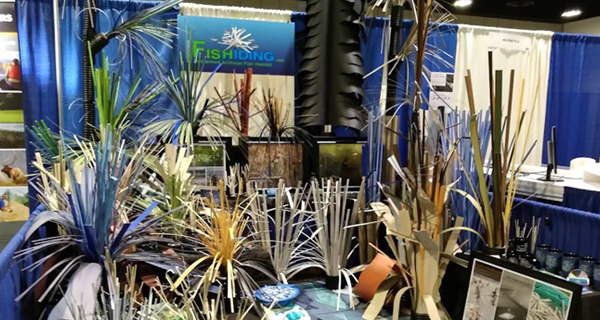
Fishiding freshwater fish habitat is best for pond owners seeking reclaimed PVC cover supported by long-term underwater observations. The range includes preassembled attractors and cribs, habitat mats, DIY components, and kits for shallow, mid-depth, and deep freshwater placement.
The material comes from reclaimed PVC destined for landfills. That gives the material choice a specific basis without requiring an unsupported claim about the environmental impact of an entire project.
Every Fishiding preassembled habitat model and unit, including modular and legacy habitat mats, is self-weighted with cement built into the patented design. Do not add ballast or anchoring to these products; follow the installation instructions.
The practical tradeoff is fit: an existing model's dimensions still need to match your chosen location and handling method. A broad product range does not, by itself, confirm acceptance of a made-to-measure fabrication request.
Use Fishiding to review the habitat categories, then ask about the specific dimensions and arrangement your site requires. Keep an exact-size request separate from a request for help selecting existing units.
What evidence should support your choice?
Fishiding has more than 15 years and thousands of hours of freshwater underwater filming documenting fish use of its dense, intricate habitat models. That footage supports the company's claims that all freshwater fish species use the habitat and that the habitat grows more fish.
Ask for observations that match your intended application: species, fish size, depth, season, and placement context. When those details are available, they tell you more than an isolated image of fish beside a structure.
Keep the questions distinct. Footage showing shelter or foraging documents behavior; measuring a pond-wide population change requires population-level evidence. Do not turn an observed gathering of fish into a numerical recruitment or survival claim.
For a 2026 project, save the observations that informed your choice alongside your placement map. That gives you a clear reason for the design rather than a folder full of unrelated product pictures.
Can several standard units replace one custom-sized structure?
Several standard units can create a site-specific layout without becoming a single custom-built structure. Compare the combined footprint, the spaces between units, and the installed height before deciding that the arrangement meets your goal.
Separate patches let you work around existing cover and access needs. Their limitation is continuity: gaps remain gaps, so check whether your intended habitat calls for separated patches or a more continuous arrangement.
Draw both layouts on the same pond sketch. Compare usable cover and installation access, not just the number of units.
Can you build a custom-sized fish crib yourself?
A DIY fish crib lets you choose the assembly dimensions, but it also makes you responsible for verifying the finished build. Confirm material suitability, connection methods, stability, openings, and installation instructions before placing it in freshwater.
Do not assume instructions for a preassembled unit also cover loose DIY components. Ask which requirements apply to the actual materials or kit you intend to use.
Natural brush piles deserve the same practical attention. Inspect the material and placement plan rather than treating familiar materials as a substitute for design.
Should you choose shallow, mid-depth, or deep-water habitat?
Choose the depth zone from your pond conditions and management goal, not from the custom dimensions alone. Record the actual placement depth and water-level range before asking which structure fits.
Deep water is not automatically useful habitat throughout the year. Temperature and dissolved oxygen can vary with depth, so use site measurements or fisheries guidance when choosing a deeper location.
A structure adds cover; it does not replace water-quality management. Keep habitat placement and aeration or oxygen management as connected but separate decisions.
FAQ
Can I order fish habitat built to my exact pond dimensions?
Treat an exact-size build as a request until the manufacturer confirms acceptance. Get the finished dimensions, materials, assembly requirements, and installation method in writing before ordering.
What measurements should I send for custom sized fish habitat structures?
Send length, width, and installed height in feet or inches, plus the placement depth and low-water level. Include a labeled sketch showing access restrictions and nearby equipment or existing cover.
Is a custom layout the same as a custom-built fish structure?
No. A custom layout arranges existing units around your pond, while a custom-built structure changes the fabrication dimensions or design.
Do Fishiding preassembled structures need extra weight?
No. Every preassembled habitat model and unit, including modular and legacy habitat mats, is self-weighted with cement built into the patented design; follow the installation instructions without adding ballast or anchoring.
Are DIY kits a good option for a narrow placement area?
DIY kits deserve consideration when you need control over the assembled arrangement. Confirm that the permitted assembly dimensions, connections, and installation requirements fit the narrow area before choosing that approach.
Should I make my pond habitat as tall as possible?
No. Choose installed height from the intended depth zone, low-water conditions, fish-use goal, and access needs rather than maximizing height.
How do I know whether fish are using the new habitat?
Use underwater observations where practical and record the species, fish sizes, behavior, and conditions you observe. Fish presence documents use; a population-level claim needs evidence beyond fish gathering around cover.
One last thing: customize the map before the structure
A better placement map can solve a fit problem without changing the fabrication. Before requesting a special build, draw the proposed habitat at scale and mark its full outline at low water.
For your 2026 installation plan, finish one clear brief: target fish and life stage, measured placement area, depth range, access route, and desired cover arrangement. Then ask whether an existing model, a grouped layout, a DIY build, or an accepted custom design meets it.
Your next step is to measure the placement zone—not order the biggest fish crib that fits on the trailer.
Related guides
- DIY fish habitat kits for pond owners
- Can artificial fish habitat protect fry and young-of-year fish?
- Can fish habitat structures be moved once installed?