
How many crappie stake beds does a pond need?
Posted by dwe on 31st Oct 2026
You need fewer stake beds than you think and more spread than most people give them. For a typical crappie pond, start with a few beds set in clusters rather than one big pile, and let the fish tell you where to add more in 2026.
- How many crappie stake beds a pond needs depends on acreage, depth and existing cover, not a fixed count.
- Start with a few clustered beds, then add after watching fish use through 2026.
- Many fisheries programs cap total cover near 20 percent of a pond's surface area.
- Dense, varied habitat beats a pile of identical stakes, so quality outweighs bed count.
How many crappie stake beds does a pond need?
There is no honest single number, and anyone selling you one without asking about your pond is guessing. Acreage, depth, bottom type, vegetation and the cover you already have set the count. For crappie, we start small: a few beds grouped in clusters, then we add more after you see how the fish use them.
Here is the rule of thumb we work from. Many state and university fisheries programs suggest keeping artificial cover to a modest share of a pond, commonly cited as about 20 percent of the surface area, up to 40%. Past that, you can dilute your own forage and make fish harder to find and harder to catch. For a small pond, that ceiling is a limit, not a goal.
If you want acreage-specific counts, our guide to habitat structures for a 1-acre pond and the half-acre version break it down further.
How many stake beds per pond size?
We will not hand you a made-up per-acre table. What we can give you is the logic that produces the count, and it works on any pond.
| Pond situation | Starting approach | Best for |
|---|---|---|
| Small pond with almost no cover | A few beds in one or two clusters | New crappie ponds |
| Pond with some brush or vegetation | Fewer beds, placed where cover is missing | Established ponds |
| Larger pond with varied depth | Clusters at different depths along the drop-off | Anglers targeting crappie by season |
| Pond with heavy vegetation | Beds at edges of weed lines, not inside them | Mixed panfish ponds |
The pattern is the same each time. Cluster first, spread second, and add only after you have watched.
Why clusters beat single beds
A lone stake bed is a lonely thing. Crappie like to suspend near cover and slide between pieces of it as light, temperature and forage change. Two or three beds close together give fish a choice of ledge, shade and escape route without leaving the neighborhood.
Think of a food court versus one vending machine. Fish will visit the vending machine, but they live around the food court.
Spacing matters more than total count. Beds placed in a tight group concentrate fish for anglers and give small fish and forage somewhere to retreat. Beds scattered one at a time across the pond spread the same fish thin.
What drives the number of stake beds you need
Six factors change your count more than anything else:
- Surface acreage. Bigger water takes more beds, but the 20 percent ceiling still applies.
- Depth range. A pond with a shelf and a deeper basin wants beds at more than one depth, not all in one band.
- Existing cover. Standing timber, docks, weed edges and rock all count. Add beds where cover is absent.
- Crappie population and size. A pond with a thin crappie population gains more from protection for young fish than from extra angling spots.
- Forage base. Habitat that grows periphyton and holds copepods and zooplankton feeds the fish you want to grow.
- Fishing pressure. Heavily fished ponds benefit from beds placed so fish can retreat, not just so they can be caught.
Depth deserves its own look. Our crappie stake bed length benchmarks by water depth explain how stake length changes what a bed does at different depths.
Stake bed or something denser?
Here is where we part ways with the usual advice. A bed of widely spaced vertical stakes gives crappie a place to hang, but a fry or a copepod does not see much shelter in it. Dense, intricate habitat gives you protection at the small end of the food chain, and that is the end that grows more fish.
That is why bed count is only half the question. Ten sparse beds can do less for a pond than three dense ones.
| Option | Pros | Cons | Best for |
|---|---|---|---|
| Basic stake bed | Simple, familiar, easy to understand | Open spacing gives small fish less protection | Anglers wanting a quick suspension spot |
| Dense preassembled habitat | Intricate cover for fry and forage, built to hold up | Costs more per unit than a DIY stake | Ponds focused on growing fish |
| Habitat mats | Covers a wider footprint on the bottom | None | Shallow and mid depths |
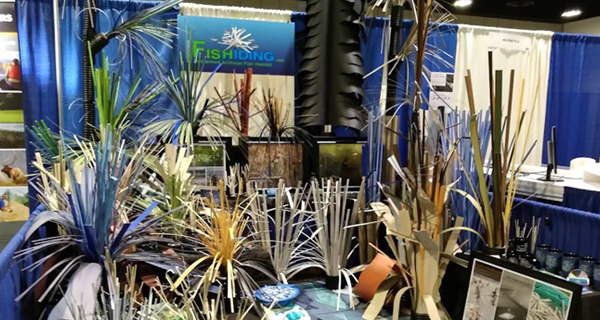
If you are weighing mats against individual pieces, read whether a habitat mat beats individual attractors. Our reclaimed PVC habitat is built for freshwater ponds, lakes and reservoirs, and the preassembled units are self-weighted with cement built into the patented design, so you do not have to add weight to sink them.
PVC also grows periphyton, the slime layer on submerged surfaces that we call the mother's milk of the aquatic food chain. Periphyton feeds copepods and zooplankton, and those feed fry. More surface area in a tight space means more of that growth, which is another reason dense beats sparse.
What if my pond is small?
A small pond needs fewer beds, and it is the easiest place to overbuild. Put in a small cluster, wait, and watch where fish stack up. If crappie are using it, add a second cluster at a different depth. If they are not, the problem is usually placement or a lack of nearby forage, not a shortage of beds.
Our comparison of the best crappie stake beds lays out what to look for before you buy.
How many beds should I add after the first season?
Add after you have evidence. Use the first season in 2026 to learn how fish use the first cluster: where they hold, at what depth, and in what weather. A second cluster built on that information beats a second cluster built on a hunch.
A simple routine works:
- Place the first cluster along a depth change or next to existing cover.
- Fish it and watch it through the season.
- Note where crappie hold and where they ignore.
- Add the next cluster at a different depth or near the best-performing one.
- Stop well short of burying the pond in structure.
Does more structure always mean more crappie?
- More structure gives fish more places to be, which is not the same as more fish. The gain comes from protection and food, and that comes from density and variety in the habitat itself. A pond with a few well-built clusters outperforms one covered in thin, repeated cover.
This is also why we keep telling people to use different shapes and heights. Crappie, bluegill and bass use different parts of the water column, and a pond with variety serves all of them.
Can I use stake beds alongside other habitat?
Yes, and you should. Stake beds work as the vertical piece, mats cover bottom area, and denser cribs protect the smallest fish. Mixed habitat gives the pond a full range of cover instead of one repeated trick.
One last thing
Before you add a single bed, walk or paddle the shoreline and find where your pond already has cover. The spot with none is the spot where your first cluster pays off fastest.
FAQ
How many crappie stake beds does a pond need?
It depends on acreage, depth and existing cover, so start with a few clustered beds and add after a season of observation. Many fisheries programs keep total cover to about 20 percent of surface area or slightly more.
Is one big stake bed better than several small ones?
Several clustered beds usually work better than one large pile. Crappie move between pieces of cover, and a cluster gives them options without leaving the area.
How far apart should crappie stake beds be?
Keep beds in a group close enough that fish can move between them, then separate groups by depth or location. Spacing within a cluster matters more than a fixed distance.
Can too many stake beds hurt a pond?
No. Too much cover can dilute forage, scatter fish and make them harder to catch. Keep total cover modest and add only after you see how fish use the first beds.
Do stake beds protect fry and small fish?
Widely spaced stakes offer limited protection to fry. Dense, intricate habitat gives small fish and forage far better shelter. Not as well as dense shallow models.
What depth should I place crappie stake beds?
Use more than one depth, usually near a depth change or drop-off. Stake length should match the water so the bed reaches where fish suspend.
Should I add stake beds in 2026 or wait?
Place a first cluster in 2026 and watch it through the season. Add more once you know where crappie are moving into it.
Browse Fishiding habitat
Reclaimed PVC habitat for freshwater ponds, lakes and reservoirs.