
Fish habitat won't stop summer fish kills | 2026
1st Oct 2026
Fish habitat structures cannot prevent a summer fish kill caused by low dissolved oxygen. They can give fish shelter and places to forage, but they do not add oxygen to the water. In 2026, the right decision is to check which depths remain usable before placing cover.
- No: fish habitat structures cannot stop an oxygen-driven fish kill in summer; check dissolved oxygen before placing cover.
- Summer stratification can leave deep water low in oxygen even when it feels cooler.
- Fishiding freshwater fish habitat provides shelter, not an oxygen treatment; place it where fish can use it.
- If fish are distressed, address the water-quality problem before adding structure.
Can fish habitat structures reduce fish kill during summer stratification?
Not by themselves. During summer stratification, warm surface water and cooler deep water resist mixing. Fish can be squeezed into the portion of the water column that has both tolerable temperature and enough dissolved oxygen. A fish crib on a low-oxygen bottom does not make that bottom usable.
The useful sequence is to assess oxygen, identify usable depth, then choose cover. The pond aeration and fish habitat installation workflow separates the water-quality decision from the placement decision. In 2026, treating those as separate jobs is more useful than asking one structure to do both.
| Choice | Best for | What it can do | What it cannot do |
|---|---|---|---|
| Dissolved-oxygen assessment | Finding the usable water column | Shows where oxygen is available when readings are taken | Supply oxygen or provide cover |
| Aeration planned for the pond | Addressing an identified oxygen problem | Supports a water-quality plan suited to the site | Replace shelter or automatically make every depth suitable |
| Fishiding freshwater fish habitat | Adding dense cover at a usable depth | Provides places for fish and other aquatic life to shelter and forage | Correct low dissolved oxygen |
| Brush piles or other natural cover | Adding natural structure where appropriate | Provides cover with materials already available at the site | Correct low dissolved oxygen; placement and condition still need checking |
Fishiding freshwater fish habitat is best for adding shelter where fish can already live, not for preventing an oxygen-driven fish kill. That distinction determines the next move: investigate the water first, then map cover to the depths fish can use.
Why this matters in a summer pond or lake
The coolest water is not automatically the safest water. In a stratified pond or lake, the deeper layer can lose oxygen while remaining cooler than the surface. A structure placed there can look well positioned from shore yet offer little usable cover during the period you care about most.
The reverse mistake is possible too. Putting every attractor close to the surface without checking temperature, oxygen, and local conditions treats shallow water as a universal answer. Fish use different parts of a pond, lake, or reservoir as conditions change. In 2026, plan around conditions in your water body rather than a fixed depth copied from another one.
Fishiding documents fish use of its dense habitat through more than 15 years and thousands of hours of freshwater underwater filming. Observed use of cover is not the same measurement as prevention of an oxygen-driven fish kill. Keep both questions in view: where can fish survive now, and where would shelter help them within that usable water?
Check the water before you choose a depth
A depth recommendation without an oxygen profile is incomplete during stratification. You need to know whether the bottom near your proposed location remains usable, and whether that changes through the summer. A single attractive-looking drop-off does not answer either question.
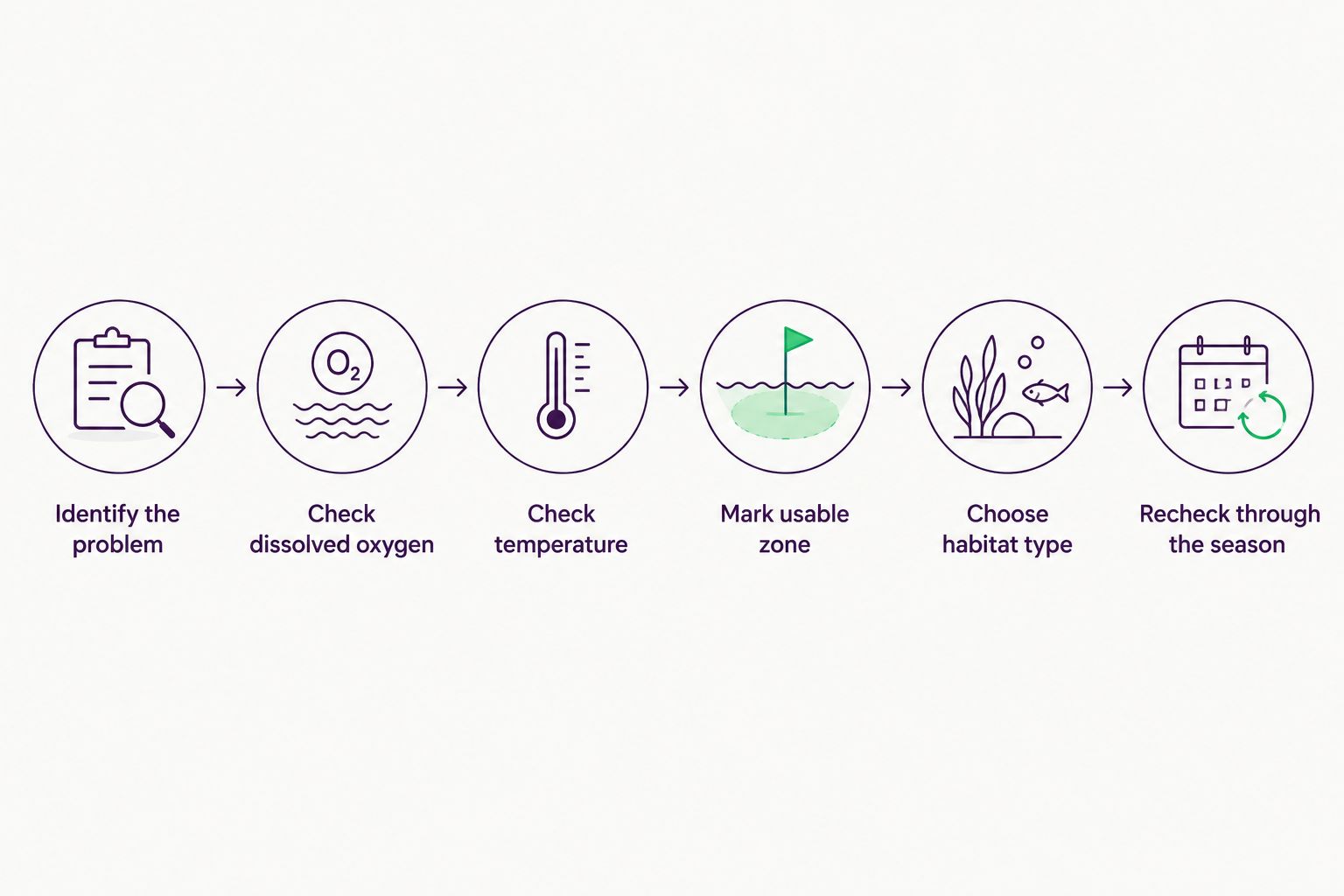
- Identify the problem. If fish are gasping at the surface, gathering near inflows, or dying, treat water quality as the immediate issue. Do not respond by installing cover and waiting for it to work.
- Check dissolved oxygen at different depths. Record where readings were taken and repeat checks when conditions change. A surface reading alone cannot describe the deeper water.
- Check temperature at those same depths. Compare temperature and oxygen together. Cooler water with too little oxygen is not a refuge.
- Mark the usable zone on a depth map. Note shoreline features, existing cover, access, and the proposed placement area. Keep the measurements tied to locations rather than applying one reading to the whole pond.
- Choose a habitat type for that zone. Decide whether fish need dense shelter, a larger crib, a mat, or a DIY layout. Then confirm that the selected structure fits the actual site and installation instructions.
- Recheck through the season. A location that works when you install a structure is not automatically usable throughout summer 2026.
This process does not require you to guess a universal placement depth. It asks a narrower, answerable question: is there enough oxygen where you intend fish to use the cover?
If you do not have the equipment or experience to assess a suspected oxygen problem, ask a local fisheries professional or pond manager to evaluate it. That is particularly important when fish are already showing distress. The installation plan comes after the immediate water-quality assessment, not before it.
Why the answer varies between water bodies
Fish habitat is one part of a pond or lake plan. Its value during summer depends on whether fish can reach and use the cover without leaving suitable water. Check these factors before choosing a site:
- Dissolved oxygen: A structure does not change the oxygen reading at its placement depth. Measure the water, rather than judging it by appearance.
- Temperature layers: Warm surface water and cooler deep water create different conditions. Neither layer is automatically suitable on temperature alone.
- Depth and placement: Cover belongs where conditions support fish use. The deepest available location is not necessarily the best summer location.
- Habitat density and variety: Dense, varied forms provide different spaces for shelter and foraging. Match the form to the fish and life stages you are trying to support.
- Fish size and access: Small fish and fry use cover differently from larger fish. Examine openings and the surrounding area instead of treating every structure as interchangeable.
- Seasonal change: The usable zone can shift. A placement decision based on one visit needs checking as summer conditions develop.
For 2026 placement decisions, write these findings on a simple site map. Mark the proposed location, the measured depths, and the dates of your readings. That record makes it easier to distinguish a habitat-placement problem from a change in water quality.
Shelter, natural cover, and aeration do different jobs
Best for an oxygen problem: assess the water and plan an appropriate water-quality response. Aeration belongs in that discussion, but the right approach depends on the pond and its condition. Do not assume that switching equipment on or changing circulation suddenly is the right response to a stratified pond in distress; get site-specific guidance.
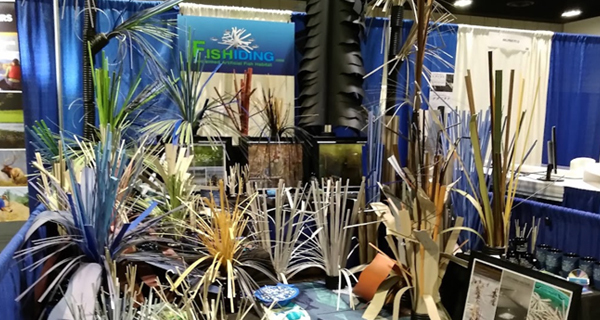
Best for adding cover: use a structure in water fish can occupy. Fishiding makes freshwater habitat from reclaimed PVC materials destined for landfills, including preassembled attractors and cribs, mats, DIY materials, and kits. Its preassembled units are self-weighted by cement built into the design; do not add ballast to those units. Match the model and placement instructions to the depth zone you mapped.
Best when suitable materials and locations already exist: consider natural cover or brush piles. They can add structure, but they still need placement in usable water. Their shape and condition can also change over time. Compare that tradeoff with the defined form of a preassembled structure or the flexibility of a DIY build; none of these choices supplies oxygen.
These are not competing answers to the same question. Water-quality work addresses whether fish can use a zone. Cover selection addresses what fish find within that zone. In a pond with both problems, solve them in that order.
What Fishiding’s underwater observations show
Fishiding reports more than 15 years and thousands of hours of underwater filming in freshwater lakes. Its observations document fish using dense, intricate habitat models and support its claim that the habitat grows more fish. That evidence is relevant when you are choosing shelter and structure for a pond, lake, or reservoir.
It does not turn a fish crib into an aerator. To show that a particular installation prevented a summer fish kill, you would need evidence about the water conditions and fish survival for that event. Underwater footage of fish using cover answers a different question: whether fish use the habitat where it is placed.
Use the footage as evidence for habitat use, then use site measurements for the oxygen decision. In 2026, keeping those two forms of evidence separate gives you a clearer installation plan and a more honest way to judge results.
Will putting fish cribs in deeper water protect fish from summer heat?
Not if that deeper water lacks oxygen. Cooler deep water can be unsuitable during summer stratification. Check temperature and dissolved oxygen at the proposed crib depth before treating it as a heat refuge.
A crib also needs to be reachable from water fish can use. Place the structure according to current site conditions, not the assumption that deeper always means safer. Revisit that choice if conditions shift during summer 2026.
Can aeration and fish habitat structures work together?
Yes, but they have different roles. An appropriate aeration plan addresses a water-quality problem; habitat structures add shelter and foraging space in usable water. Installing habitat does not replace oxygen assessment or an aeration decision.
If your pond already has aeration, do not infer that every depth is suitable for cover. Measure conditions at the actual proposed placement sites. That gives you a reason to select a location rather than relying on the presence of equipment.
Should you add structure while fish are dying?
No: investigate the fish kill first. New cover will not correct low oxygen. Record what you see, check water conditions, and seek site-specific help if fish are in distress.
Once the immediate problem is understood, revisit habitat placement. The useful question is where shelter would sit within a usable depth zone, not how quickly you can put a structure on the bottom.
FAQ
Can fish habitat structures reduce fish kill in summer?
Fish habitat structures cannot prevent a summer fish kill caused by low dissolved oxygen. They provide cover only where water conditions allow fish to use it.
Does a fish crib add oxygen to a pond?
No, a fish crib does not add oxygen to pond water. Check dissolved oxygen separately before choosing its placement depth.
Is deeper water safer for fish during summer stratification?
Deeper water is not automatically safer during summer stratification. It can be cooler but low in dissolved oxygen, so check both conditions.
Can brush piles prevent an oxygen-driven fish kill?
No, brush piles cannot prevent an oxygen-driven fish kill. They provide natural cover when placed in water fish can use.
Where should I put fish habitat in a stratified pond?
Put fish habitat at a location and depth that your oxygen and temperature checks show fish can use. Recheck conditions as summer changes.
What does Fishiding’s underwater footage establish?
Fishiding’s footage documents fish using its dense freshwater habitat. More than 15 years and thousands of hours of filming support its habitat-use claims, not a claim that structures correct low oxygen.
One last thing
Before buying or building more cover, draw the usable summer water column on your pond map. A structure on the wrong side of that boundary cannot solve the problem you bought it for. In 2026, measure first, choose the depth zone second, and select the habitat type last.