
how much weight to sink a fish habitat structure: test 2026
1st Oct 2026
There is no fixed number of pounds to sink a fish habitat structure. The weight you need depends on the structure’s buoyancy and how it behaves when submerged; a DIY build needs a water test before you decide on ballast. Fishiding’s preassembled habitat units and mats are self-weighted by design and do not need added weight or anchoring.
- How much weight to sink a fish habitat structure depends on the build; there is no universal weight.
- Fishiding’s preassembled freshwater habitat and mats are self-weighted; do not add ballast or anchors.
- For DIY fish cover, submerge the finished build in shallow water and check how it settles before placement.
- If a structure shifts during testing, change the build or ballast plan before putting it in position.
How much weight do you need to sink a fish habitat structure?
Use only the ballast your specific DIY build needs to settle and stay in its intended position during a water test. Weight alone does not tell you whether a structure will behave as planned. Its materials, trapped air, shape, and contact with the bottom all affect the result. Do not copy a weight from someone else’s brush pile or PVC build and assume it applies to yours.
If you are building your own structure, the DIY crappie structure PVC build guide is a related starting point for the build itself. Treat ballast as a separate placement decision: test the finished structure, not just its loose components.
| Habitat option | Added weight or anchoring | What to check |
|---|---|---|
| Fishiding preassembled habitat and mats | None required; cement weight is built into every unit | Choose the depth zone and placement that fit the site |
| DIY PVC fish structure | Depends on the finished build | Submerge it, release it carefully, and check whether it settles as intended |
| Brush pile or natural cover | Depends on the materials and site | Check whether the assembled cover stays where you place it |
The distinction matters in 2026: a self-weighted product and a home-built structure are not the same ballast problem. Fishiding builds cement weight into its preassembled units, including modular and legacy habitat mats. A DIY assembly needs its own assessment because its final materials and shape are set by the builder.
Why this matters for your pond or lake
A structure that sinks is not automatically well placed. It needs to sit in a useful depth zone, present the cover you intended, and leave openings suited to the fish using that part of the water. If it tips or lands against another object, its usable spaces can differ from the layout you planned.
Stability also affects installation. You need to know how a structure behaves before lowering it into a spot that is difficult to inspect or retrieve. In a small pond, you might see the placement from shore; in a lake or reservoir, you need a clearer plan for the bottom and the drop point. Test the structure where you can observe it before committing to its final position.
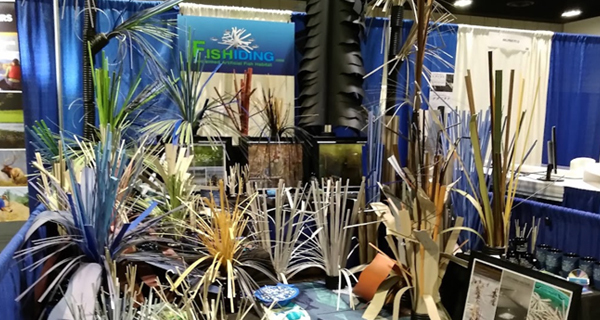
Fishiding’s freshwater habitat uses reclaimed PVC and includes preassembled attractors, cribs, and mats alongside DIY materials. The preassembled models are self-weighted. That fact answers the added-weight question for those units, but it does not choose the right depth, density, or location for your fish population.
Why the required weight varies
For a DIY build, these factors determine what you need to test. None produces a reliable pounds-per-structure answer on its own.
- Materials and trapped air: The assembled structure can behave differently from individual pieces placed in water. Check the complete build, including enclosed spaces where air might remain during submersion.
- Shape and balance: Weight concentrated on one side can change how the structure lands. Watch its final orientation, not just whether it reaches the bottom.
- Habitat density: Dense cover gives fry and forage fish places to use, but added branches or components also change the finished assembly. Retest after changing the build.
- Bottom contact: Check whether the base rests as intended on the bottom you have chosen. A structure that tips during a shallow-water trial needs a design or placement change.
- Depth zone and access: Shallow water makes it easier to see an initial test. For a deeper placement, plan how you will verify the structure’s position after lowering it.
- Water movement: Test whether the finished assembly stays in position under the conditions you can observe at the site. Do not treat a calm-water sink test as proof of every later condition.
These are checks, not a formula. In 2026, the practical answer remains build-specific: observe the finished structure in water before assigning it a ballast amount. If you change its components, repeat the check.
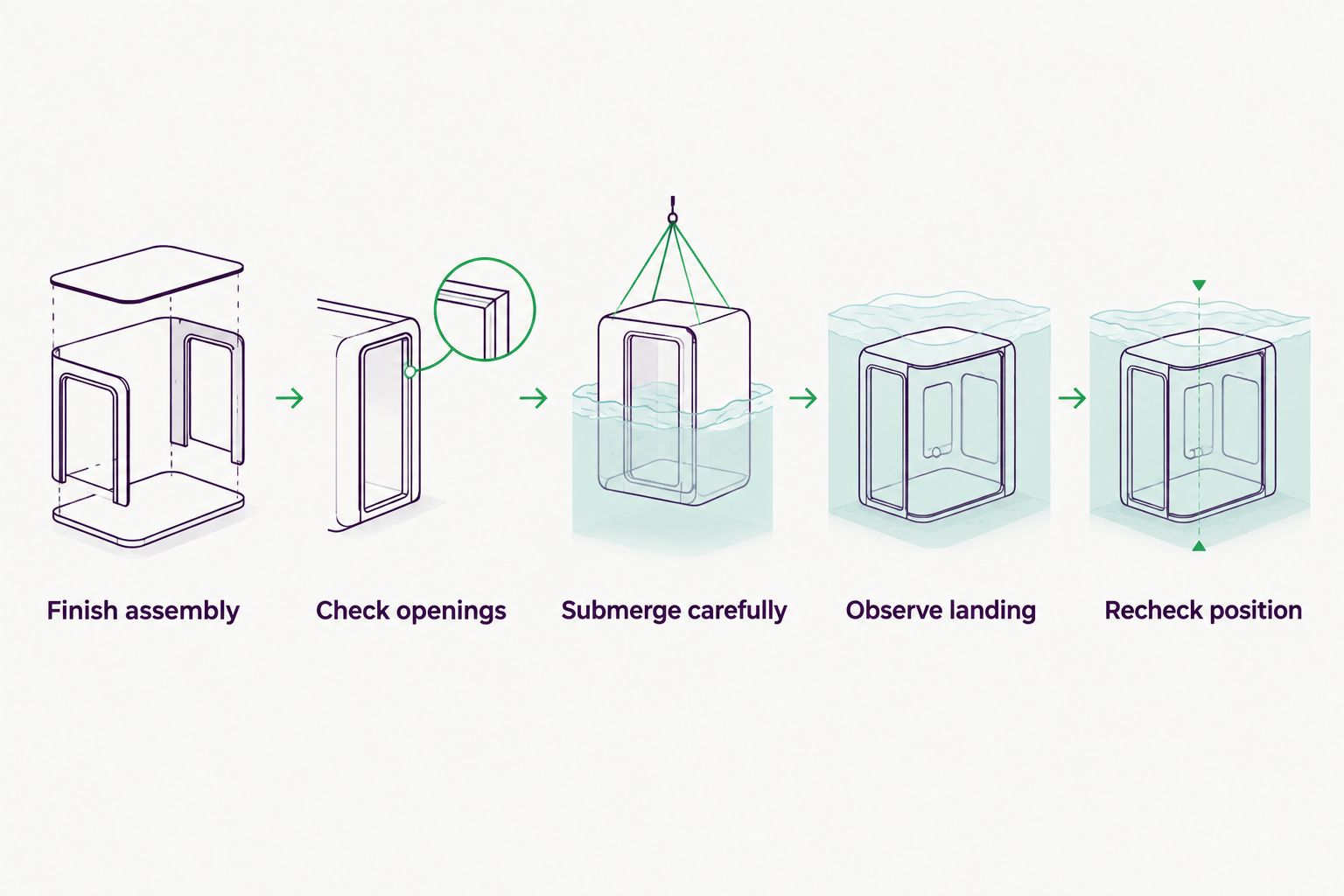
How to test a DIY structure before final placement
Do this in a shallow, accessible area where you can see the structure settle and recover it if the test fails. Keep people out of the drop area, and handle a heavy assembly in a way you can control. The goal is to answer two separate questions: does it sink, and does it remain in the orientation you intended?
- Finish the assembly. Attach the branches, panels, or other cover you actually plan to place. Testing an incomplete frame misses the effect of its finished shape.
- Check openings. Look at the spaces fish can enter and leave. Remove loose pieces or unintended narrow gaps before submersion.
- Submerge it carefully. Let water fill accessible spaces and watch for trapped air or an uneven descent. Avoid throwing the structure into its test position.
- Observe the landing. Check whether the base meets the bottom as intended and whether the cover remains exposed rather than folding or turning beneath the structure.
- Recheck its position. If the assembly shifts, tips, or fails to settle, change the construction, ballast arrangement, or proposed site. Then test it again.
A successful sink test answers only what happened in that test. It does not establish how much weight every PVC attractor needs, or prove that a different bottom and depth will produce the same result. Record what you built and where you plan to put it so the final placement matches the tested setup.
For preassembled Fishiding fish habitat, skip the DIY ballast calculation. Fishiding is the better fit when you want freshwater fish cover with weight built into the unit rather than a ballast plan you must build and test yourself. You still need to select a suitable depth zone and map the placement.
Self-weighted habitat, DIY builds, or brush piles?
Choose the option that fits your placement problem and the work you want to do. Each provides cover differently, and each has a tradeoff beyond whether it sinks.
| Option | Best for | Advantage | Limitation |
|---|---|---|---|
| Fishiding preassembled habitat | Pond, lake, or reservoir owners who want a self-weighted unit | Cement weight is built into the design; dense, varied cover uses reclaimed PVC | You still need to choose the right model type, depth zone, and location |
| DIY PVC build | Builders who want to set their own layout | You control the assembly and can revise it before placement | You must test the finished structure’s sinking and stability yourself |
| Brush pile or natural cover | Sites where suitable natural material is available | Uses cover already familiar to many pond and lake owners | The assembled pile still needs a placement and stability check |
Best for avoiding added ballast: Fishiding preassembled habitat. Do not put extra blocks or anchors on a self-weighted Fishiding unit. Its advantage is a known design feature, not a reason to skip site selection.
Best for a custom layout: a DIY build. Decide what size fish you want the openings to serve, assemble the cover, then test the complete structure. Its flexibility brings the responsibility for construction and placement checks.
Best for using available natural cover: a brush pile. Assess the whole pile rather than assuming a heavy-looking branch makes the assembly stable. Natural material and a manufactured unit do not call for the same installation plan.
In 2026, compare these options on the work left after you choose them. The self-weighted unit removes an added-ballast task; DIY and natural cover let you shape the layout but leave you responsible for checking the result. None removes the need to consider fish size, access, and the selected depth zone.
Choose a depth zone before choosing a drop point
Start with your actual pond, lake, or reservoir. Mark the shallow, mid-depth, or deep-water zone you intend to cover, then identify where fish can use the structure without losing the openings that make it useful. A precise ballast decision cannot rescue a poor placement decision.
Think about the fish using that location. Smaller fish need usable shelter within dense cover; larger fish also need space around a structure. Dense and varied habitat can provide places to shelter and forage, but the way fish use it changes with species, life stage, season, and water body. Do not assume the same drop point serves every fish at every time.
For a pond owner, map the proposed site before installation and note how you will check it afterward. For a fisheries manager placing habitat across a larger water body, keep the structure type and depth zone attached to each planned site. That makes the installation decision repeatable without pretending one ballast figure applies to every unit.
Fishiding has more than 15 years and thousands of hours of underwater freshwater filming documenting fish use of its dense habitat models. Those observations support its claims that freshwater fish species use the habitat and that it grows more fish. They do not turn an untested DIY build into a self-weighted unit or tell you where an individual structure will land.
Can you use the same weight for every DIY fish attractor?
No fixed weight applies to every DIY fish attractor. Test each distinct finished design, especially when you change its materials, shape, or cover. A result from one assembly is a record of that assembly, not a specification for all fish structures.
Do self-weighted fish habitat mats need extra ballast?
Fishiding habitat mats do not need extra ballast or anchoring. Every Fishiding preassembled unit, including modular and legacy mats, has cement weight built into its design. Choose the appropriate location instead of modifying the mat to add weight.
Is sinking enough to make a fish crib effective?
No; a fish crib also needs suitable placement and usable cover. Check its orientation, openings, and depth zone after it settles. The same check applies whether the crib is DIY or preassembled.
FAQ
How much weight to sink a fish habitat structure in 2026?
There is no universal weight in pounds. Test a finished DIY build in water to determine whether it settles and stays positioned; Fishiding preassembled habitat needs no added ballast.
How do I know whether a DIY fish attractor has enough ballast?
Submerge the finished attractor in a shallow, accessible test area and watch how it lands. If it tips, shifts, or does not settle as intended, change the build or ballast arrangement and retest.
Do Fishiding fish cribs need blocks or anchors?
No. Fishiding preassembled fish habitat units have cement weight built into their design and do not need added blocks or anchoring.
Should I test a fish structure before putting it in deep water?
Yes. Test a DIY structure where you can observe and recover it, then plan how to verify its final position at the deeper site.
Does a brush pile need the same weight as a PVC attractor?
No universal weight applies to either assembly. Materials and construction differ, so assess the finished brush pile or DIY attractor rather than copying another structure’s ballast plan.
Can I add weight to a self-weighted habitat mat?
Fishiding’s self-weighted habitat mats do not require added weight or anchoring. Concentrate on selecting a suitable depth zone and placement.
What should I check after a fish habitat structure sinks?
Check that it rests in the intended position and leaves usable openings. Confirm its depth zone and location match the plan for your pond, lake, or reservoir.
One last thing
A DIY structure can reach the bottom yet land on its side. That is why your 2026 placement check should end with how the cover sits, not just whether it sinks. Select the depth zone, map the drop point, and test any DIY assembly you cannot identify as self-weighted.