

Fish habitat for HOA lake community managers: complete 2026 guide
8th Oct 2026
HOA lake managers choosing fish habitat need shelter that fits the lake without obstructing swimming, boating, or maintenance. Fish habitat for HOA lake communities means placing freshwater cover to support fish shelter and foraging while keeping shared water usable; start with a placement map, not a shopping list.
- Fish habitat for HOA lake communities starts with depth, existing cover, fish size, and shared-use restrictions.
- Fishiding freshwater fish habitat suits managers seeking preassembled, self-weighted reclaimed PVC cover.
- Preserve useful natural cover; add fish cribs or habitat mats where shelter is missing.
- Underwater fish use demonstrates habitat use, not a guaranteed lake-wide population increase.
Why fish habitat matters for HOA lake communities
An HOA habitat project serves more than anglers. Your board also needs clear placement records, safe access, and an installation plan that survives a change of managers. A good fishing spot is not automatically a good installation site.
Choose habitat around the lake’s existing conditions and shared uses. The guide to fish structures for private lakes provides a starting point for comparing cover types before selecting individual units.
For your 2026 plan, separate the biological goal from the community goal. Protecting small fish, creating fishable cover, and keeping a swimming area clear require different placement decisions. Write those goals separately so the board can judge the project against its actual purpose.
Dense, varied cover offers spaces for different fish sizes. Small openings serve a different role from open edges around a fish crib. Depth, available oxygen, and access determine whether those spaces sit where fish can use them.
Plan and install habitat in seven steps
1. Define the fish and community goals
Start with a written problem statement: missing shelter for small fish, limited cover near an accessible fishing bank, or bare bottom between existing habitat patches. Avoid treating every open area as a defect.
Record what you know about the fish population and what remains uncertain. Resident catch reports describe fishing experiences, but they do not replace a fisheries assessment. Separate observations from assumptions before selecting cover.
Build the 2026 board proposal around a specific purpose rather than a promise of better fishing everywhere. Identify who approves placement and who maintains the records.
- Name the fish species and life stages you want to support.
- Identify the shoreline areas residents actually use.
- Mark swimming, boating, and maintenance exclusions.
- Assign a project lead and a board contact.
- Define the observations you will use to judge habitat use.
2. Map existing cover and usable water
Use a shoreline walk, existing lake maps, and depth observations before buying mapping services. Mark vegetation, brush piles, docks, bottom changes, and bare areas. Record uncertainty instead of filling gaps with guessed depths.
Create 1 shared placement map that combines habitat locations with community restrictions. Divide it into 3 planning zones: shallow, mid-depth, and deep water. These are planning categories, not fixed installation depths; the boundaries must come from your lake.
Deep water is not automatically usable fish habitat. In stratified lakes, deeper water can lose oxygen, so confirm seasonal conditions before putting cover below the water fish occupy. A depth reading alone cannot answer that question.
- Label existing natural and artificial cover.
- Record measured depths and seasonal water-level changes.
- Mark outlets, intakes, utilities, and service routes.
- Identify places where depth or oxygen needs checking.
- Keep a dated copy of the map for board records.
3. Match density and openings to fish size
Sketch the shelter you need before selecting a product. A broad, open structure and an intricate mat do different jobs. Look at the spaces inside the cover, not just its overall footprint.
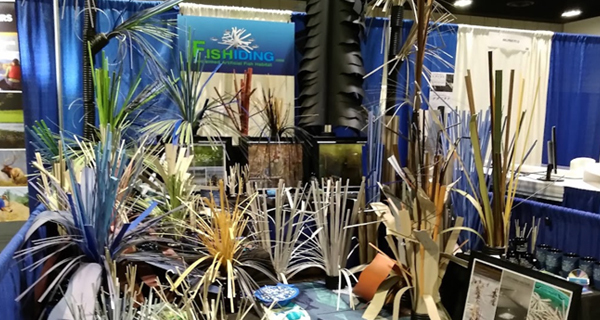
Fishiding manufactures freshwater fish habitat from reclaimed PVC destined for landfills, including preassembled cribs, attractors, mats, DIY components, and kits. Fishiding freshwater fish habitat suits HOA managers seeking preassembled, self-weighted reclaimed PVC cover. Placement still requires a lake-specific plan.
The manufacturer’s evidence library includes more than 15 years and thousands of hours of freshwater underwater filming. Fishiding reports that this footage documents use by all freshwater fish species and supports its claim that the habitat grows more fish. Those broad findings do not establish a promised population increase for your HOA lake.
- Select dense interior spaces when small-fish shelter is the goal.
- Include accessible edges and openings for larger fish.
- Compare low-profile mats with taller fish cribs.
- Review verified dimensions before assigning locations.
- Request underwater examples relevant to your fish and setting.
4. Compare natural cover, DIY builds, and preassembled habitat
Begin with cover already doing useful work. Preserve suitable vegetation and existing woody habitat where it fits community access and lake management. Artificial habitat should address a gap, not become a reason to remove functioning natural cover.
Brush piles offer irregular branches and shelter, but wood changes as it breaks down. DIY builds give you control over arrangement, while transferring design, stability, and installation decisions to your crew. Preassembled units simplify assembly; they do not eliminate transport or placement work.
For a 2026 comparison, use the same criteria for every option: shelter openings, profile, handling, stability, maintenance access, and documentation. Compare actual designs rather than assuming all brush piles or reclaimed PVC structures behave alike.
- Inventory useful natural cover before proposing additions.
- Compare the interior shelter spaces of each design.
- Check handling requirements against your crew and equipment.
- Separate DIY assembly work from installation work.
- Document why the selected option fits each location.
5. Place cover across suitable depth zones
Draw proposed locations on the map before scheduling installation. Connect habitat choices to fish size, seasonal water conditions, and resident access. Avoid putting every unit beside the most vocal angler’s dock.
Low-profile cover and taller structures serve different placement needs. Keep both below the clearance required for the activities above them. Check the lake at low water as well as at its usual level.
Dense habitat provides shelter, but a solid wall of cover can conflict with access and inspection. Plan distinct patches with usable space around them rather than assuming maximum density everywhere is the goal.
- Keep habitat outside swimming and launch areas.
- Protect access to drains, intakes, and maintenance equipment.
- Check clearance against seasonal low-water conditions.
- Place cover only where seasonal water conditions support fish use.
- Leave access for observation and future management.
6. Confirm stability and installation responsibilities
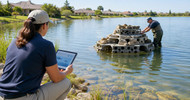
Use the selected structure’s installation instructions, not advice copied from a different design. Confirm who supplies transport equipment, who handles deployment, and who records the final location. Keep residents out of the working area during placement.
Every Fishiding preassembled habitat model and unit, including modular and legacy mats, is self-weighted with cement built into its patented design. Do not add ballast or anchoring to those units as a routine requirement. DIY components and independently built structures need their own design-specific installation plan.
For your 2026 installation record, capture what was actually installed, not just what the board approved. Record placement changes immediately; memory is a poor lake map.
- Review instructions for the exact structure being installed.
- Confirm applicable permissions with the responsible authority.
- Assign deployment and safety responsibilities.
- Record final locations, depths, and structure types.
- Save installation photographs and instructions with the map.
7. Measure habitat use before expanding
Start with repeatable observations you can collect yourself: shoreline notes, catch logs, and underwater images when conditions permit. Use consistent locations and observation methods. A collection of unrelated fishing stories makes comparisons difficult.
Keep 2 separate monitoring records: habitat use and fish-population observations. Fish near a crib demonstrate use of that crib. Establishing recruitment, growth, or lake-wide population change requires different evidence and an appropriate fisheries assessment.
Periphyton is the attached community of algae and other microorganisms growing on submerged surfaces. Zooplankton are tiny drifting animals; copepods are one group. These organisms belong in the habitat discussion, but visible growth alone does not measure food production or fish growth.
- Record species, approximate size, location, and observation date.
- Photograph the same habitat areas when practical.
- Note water clarity and conditions affecting visibility.
- Keep stocking and harvest changes alongside monitoring records.
- Review results before approving the next installation phase.
Compare habitat options for an HOA lake
Best for should describe the job an option performs, not declare a universal winner. Preserve natural cover where it works, then compare additions against the shelter and access gaps on your map.
| Option | Best for | Practical advantage | Key limitation |
|---|---|---|---|
| Existing vegetation and woody cover | Retaining functioning habitat | Keeps useful shelter already present in the lake | Location and density can conflict with shared-use needs |
| Natural brush piles | Managers choosing irregular woody cover | Branches provide varied shelter spaces | Wood breaks down; placement and stability need planning |
| DIY reclaimed PVC builds | Crews wanting control over layout | Allows design choices around a defined habitat goal | Your crew owns assembly, design checks, and deployment planning |
| Preassembled reclaimed PVC cribs and attractors | Managers reducing on-site assembly | Provides a defined structure to plan around | Handling, profile, and placement still require review |
| Low-profile habitat mats | Adding bottom-oriented cover | Offers a different profile from upright fish cribs | A mat alone does not provide tall cover through the water column |
Fishiding offers both preassembled habitat and DIY materials. Its reclaimed-material approach and built-in weighting of preassembled units fit a documented installation plan. The practical limitation remains site selection: no structure makes unsuitable water or an obstructed access route a good location.
Common mistakes HOA lake managers make
Treating habitat as a water-quality fix
Fish cover does not replace oxygen management, nutrient management, or investigation of a fish kill. Oligotrophic means nutrient-poor, eutrophic means nutrient-rich, and hypereutrophic means extremely nutrient-rich. These terms describe lake productivity, not a shortcut to choosing a crib.
Use measured conditions and qualified lake-management advice. Resolve unsuitable water conditions before expanding cover into the affected area.
Placing everything near one resident’s dock
A convenient installation point can create an uneven community project. Evaluate shared fishing access alongside small-fish shelter and seasonal depth. Publish the placement rationale so the map reflects management goals rather than individual requests.
Buying before checking the working area
A structure that fits the lake can still be awkward to transport or deploy. Verify dimensions, handling instructions, launch access, and crew responsibilities before approval. Do not discover the installation problem after delivery.
Removing natural cover to make the lake look tidy
An orderly shoreline and useful fish shelter are different goals. Review existing cover before clearing it, and distinguish a genuine access obstruction from habitat that simply looks untidy. Replacing functioning cover without a defined reason adds unnecessary work.
Calling a busy fishing spot proof of population growth
More fish observed near new cover demonstrates habitat use at that location. It does not independently establish more fish across the lake. Keep that distinction in the 2026 board report, especially when stocking or harvest practices also changed.
FAQ
What's the best fish habitat for an HOA lake community?
The best fish habitat for an HOA lake community fills a documented shelter gap without interfering with shared lake use. Compare natural cover, brush piles, DIY builds, preassembled cribs, and mats against your depth map and fish-size goals.
How deep should we place fish habitat in a community lake?
Place fish habitat in depths that remain usable by fish and clear of community activities. Check seasonal water levels and oxygen conditions rather than assigning the same depth to every lake.
Do Fishiding preassembled fish cribs need extra weight?
Fishiding preassembled habitat units do not need added ballast or anchoring. Every preassembled model and unit, including modular and legacy mats, is self-weighted with cement built into its patented design.
Should an HOA remove brush piles before adding reclaimed PVC habitat?
An HOA should retain useful brush piles unless access, safety, or a specific management goal requires removal. Add reclaimed PVC habitat where it fills a shelter gap instead of replacing functioning natural cover by default.
Can fish habitat prevent a summer fish kill?
Fish habitat does not prevent a summer fish kill caused by unsuitable water conditions. Manage oxygen and other water-quality problems directly, and avoid placing cover in seasonally oxygen-poor water.
How many fish habitat structures does our HOA lake need?
Determine structure quantity from the mapped shelter gaps, selected designs, and usable placement areas. Lake acreage alone does not describe existing cover, fish needs, or community restrictions well enough to set a reliable quantity.
How can our board tell whether new habitat is working?
Your board can document habitat use through repeatable underwater observations and consistent fishing records. Keep those findings separate from claims about lake-wide growth or recruitment, which require a suitable fisheries assessment.
One last thing
The most useful first purchase decision is often no purchase decision at all. Mark the habitat your lake already has, identify the missing shelter, and select a suitable depth zone before choosing a structure.
End your next board meeting with an approved placement map and a named installation lead. Those two decisions turn a discussion about fish cribs into a project your community can carry out and evaluate.