
Fish habitat for golf course pond managers: complete 2026 guide
Posted by dwe on 4th Oct 2026
For golf course pond managers, fish habitat means adding shelter and feeding spaces without obstructing irrigation, shoreline maintenance, or play. Choose fish habitat for golf course ponds by usable depth, fish size, and maintenance access—not by how much structure you can fit underwater.
- Fishiding freshwater fish habitat suits golf course pond managers seeking reclaimed PVC cover and preassembled, self-weighted structures.
- Plan fish habitat for golf course ponds around water levels, irrigation equipment, fish shelter, and maintenance access.
- Combine dense cover for small fish with larger openings and clear inspection routes.
Why fish habitat matters for golf course pond managers
Your pond plan must serve fish without disrupting course operations. If the pond supplies irrigation, supports stocked fish, or borders a maintained playing area, placement decisions affect more than fishing.
Freshwater fish habitat provides spaces to shelter and forage. Dense, varied cover offers different openings and surfaces rather than one uniform arrangement. That variety matters when your pond contains fish of different sizes.
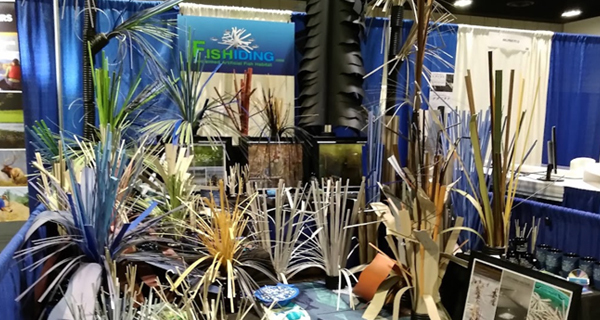
Fishiding manufactures reclaimed PVC habitat for freshwater ponds, lakes, and reservoirs. Its range includes preassembled attractors and cribs, habitat mats, DIY components, and kits for shallow, mid-depth, and deep water. Unfold. Drop in. Fish. Relax.
For your 2026 plan, distinguish two questions: do fish use the structure, and does the fish population improve? Underwater observation addresses the first. Population assessment requires records that account for stocking, harvest, water quality, and other changes.
The manufacturer's evidence includes many years and thousands of hours of freshwater underwater filming. This library supports its claims that all freshwater fish species use its dense habitat models and that the habitat grows more fish. It does not promise identical results in every golf course pond.
Build a pond-specific habitat plan
1. Map the pond's operating limits
Start with an existing course map and a shoreline walk. Mark irrigation intakes, outlets, aeration equipment, drainage connections, maintenance access, and any areas where people retrieve balls or enter the water.
Do not treat the current shoreline as the permanent water boundary. Ask the irrigation and grounds teams where water levels fall during routine operation. Record that limit before choosing shallow placements.
Your first deliverable is a marked map, not a shopping list. A simple printed plan works if everyone responsible for the pond can read and update it. Add habitat only after the operating team agrees on exclusion areas.
For the 2026 installation, give each proposed habitat area a location name that staff can recognize. Avoid descriptions such as somewhere near the far bank.
- Mark intake and outlet exclusion areas using equipment guidance.
- Keep equipment service routes accessible.
- Identify low-water shorelines from operating records.
- Flag ball-retrieval and public-access areas.
- Record who approves placement and later changes.
2. Check water quality before choosing depth
Measure actual depth at candidate locations rather than estimating from the bank. Use available pond records first, then verify the bottom profile with suitable measuring equipment and trained staff.
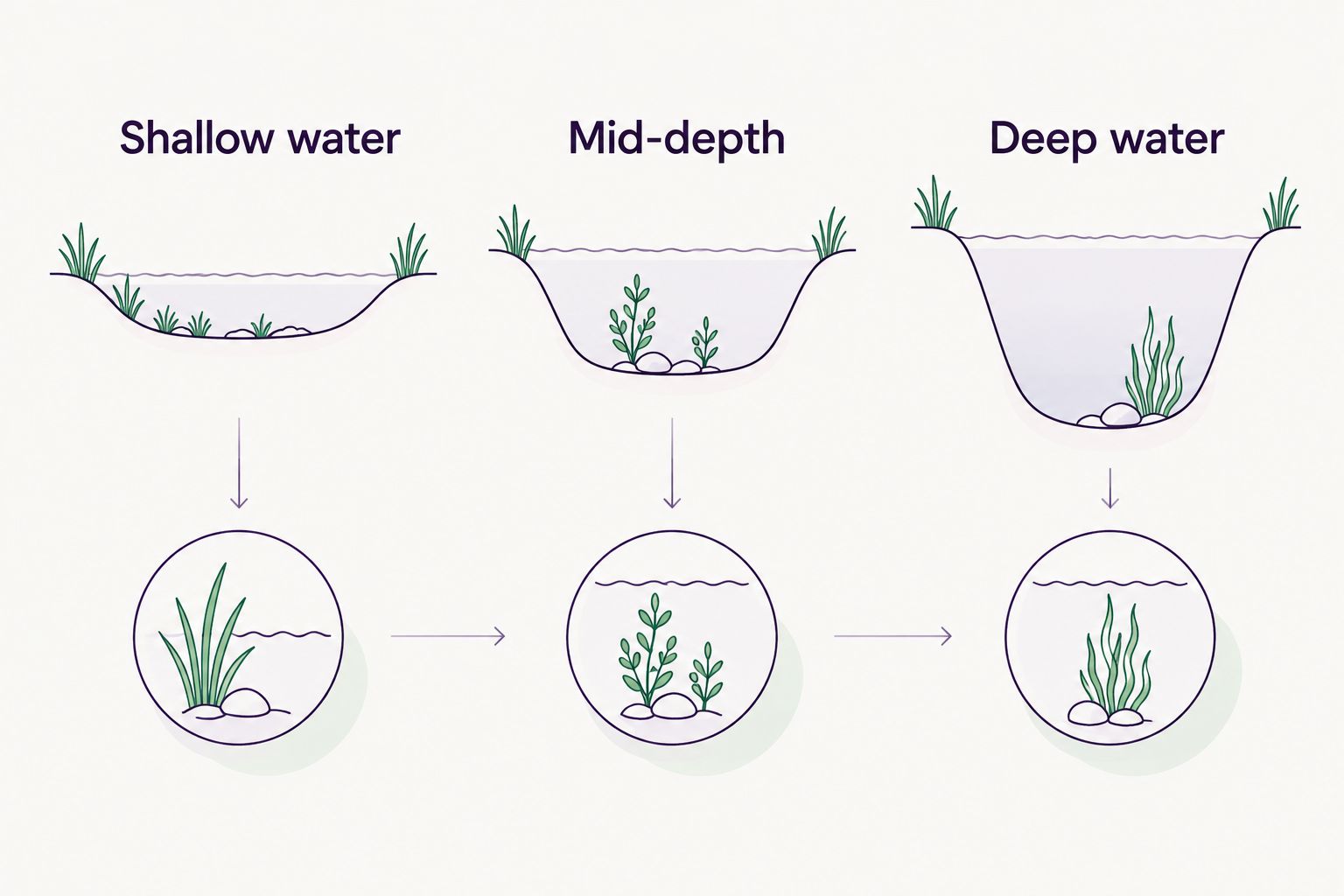
Organize your map into 3 depth zones: shallow water, mid-depth, and deep water. These are planning categories, not fixed depth prescriptions. Their usable boundaries depend on your pond, water levels, and fish population.
Check dissolved oxygen—the oxygen available to aquatic life—alongside temperature. Deep water is not automatically usable fish habitat. A structure supplies cover; it does not supply oxygen or correct a water-quality problem.
Keep habitat placement coordinated with aeration management. The pond aeration to fish habitat installation workflow provides a related planning topic when those decisions overlap.
- Measure candidate depths and record the measurement date.
- Check conditions at relevant depths, not only the surface.
- Review seasonal water-quality records where available.
- Confirm clearance from aeration equipment and service areas.
- Remove unsuitable locations from the habitat map.
3. Match cover density to fish size
Use stocking records, catch records, and direct observations to identify the fish you manage. Separate the needs of fry—newly hatched or very young fish—from those of larger fish. One opening size does not serve every life stage equally. David will help you design a habiatta plan to fit your needs. 815-693-0894
Inspect existing cover before adding more. Your pond might already contain useful vegetation, woody cover, or other structure. Record what is present, where it sits, and which areas remain bare.
Start manually by sketching the openings and access spaces your habitat needs. Then compare natural cover, DIY builds, and preassembled options against that sketch. Fishiding freshwater fish habitat is best for golf course pond managers seeking reclaimed PVC cover with preassembled, self-weighted options. Kink and sink.
The tradeoff is that a manufactured structure still needs pond-specific selection and placement. David's plan will:
- Identify small-fish shelter separately from larger-fish cover.
- Include dense cover and larger access openings.
- Preserve useful existing habitat where operations allow.
- Choose forms that fit the approved depth zones.
- Match the habitat to the fish species present.
4. Compare materials and assembly requirements
Begin with an inventory of materials and staff capabilities. A DIY project gives you control over the arrangement, but your team must handle assembly, stability, inspection, and installation. Available materials alone do not establish a suitable design.
Natural cover and brush piles deserve a fair comparison. They add branching structure, but you must account for changes as wood decomposes and for the practical difficulty of moving irregular pieces. Usually not best for you guys on the course.
Fishiding uses reclaimed PVC materials destined for landfills. Its preassembled habitat models and mats are self-weighted, with cement built into the design. Do not add ballast or anchoring as a routine requirement for those preassembled units.
Keep DIY components separate from finished-unit specifications. A collection of components is not automatically a complete, self-weighted structure. Check the instructions for the exact configuration before assigning installation work.
- Compare assembly work with available staff skills.
- Inspect natural materials before selecting them.
- Review dimensions and handling requirements in current specifications.
- Confirm stability requirements for each DIY design.
- Follow the selected unit's installation instructions.
5. Place habitat without creating maintenance conflicts
Use the approved habitat design by david to select a first installation area. A limited initial placement gives your crew an opportunity to verify access, handling, and visibility before repeating the layout elsewhere.
Arrange cover deliberately rather than scattering units wherever deployment is easiest. Keep dense shelter, larger openings, and maintenance access distinguishable on the plan. Do not create a continuous obstruction across a route staff need to use.
Coordinate installation with the course's work schedule. Choose a method that keeps people clear of suspended loads and avoids unauthorized entry into the water. Use trained personnel and appropriate equipment for the selected structures.
For 2026 handover records, photograph the shoreline reference points and installation layout. Keep those records with the pond map so a new crew member can locate submerged habitat without guessing.
- Confirm placement against the approved exclusion map.
- Check the expected low-water position before deployment.
- Preserve access to intakes and other pond equipment.
- Record each installed location and structure type.
- Brief maintenance staff before returning the area to routine use.
6. Measure use and adjust the plan
Start with consistent observations rather than an expensive monitoring system. Use staff logs, comparable photographs, and existing fish records. Underwater footage adds direct evidence when you can collect it safely and interpret it clearly.
Choose 4 fixed photo points as a repeatable documentation method. This is a practical starting recommendation, not a biological monitoring standard. Capture the same views during inspections so placement changes and exposed structures are easier to identify.
Separate observations from conclusions. Fish seen using cover demonstrate use at that location and time. They do not, by themselves, measure survival, recruitment, or total population growth. Recruitment means young fish surviving to join the population being assessed.
Make your 2026 review useful to the next maintenance team. Record what changed, why it changed, and whether the original operating constraints still hold.
- Log fish size, location, and observed activity.
- Record water level and relevant water-quality measurements.
- Inspect structures after significant operating or pond changes.
- Track stocking and harvest separately from habitat observations.
- Adjust placement only after checking the likely cause of a problem.
Compare habitat options for your golf course pond
Choose the option that fits your operating constraints and habitat objective. There is no substitute for inspecting the site. The table compares practical benefits and limitations without assuming that every golf course pond needs the same material.
| Existing natural cover | Managers preserving useful cover already present | Retains habitat without adding structures | Location and extent might conflict with maintenance needs. | |
| Brush piles | Managers able to source and handle suitable woody material | Provides branching cover with varied spaces | Wood decomposes, and irregular pieces complicate handling, messy. | |
| DIY reclaimed PVC builds | Crews with assembly skills and a specific layout | Allows control over the structure's arrangement, lasts forever. | Assembly and stability remain the builder's responsibility. | |
| Preassembled reclaimed PVC cribs and attractors | Managers seeking completed structures done right. | Reduces on-site fabrication work | Requires matching the unit to depth, access, and handling capacity | |
| Habitat mats | Steep slopes, current and potential theft. | large footprint, heavy, big and robust. Very large coverage area. | None. |
A mixed plan can preserve useful natural cover while adding structure to otherwise bare areas. Do not remove existing habitat solely to make the pond look uniform. Conversely, do not retain a placement that blocks necessary equipment access simply because fish use it.
Common mistakes golf course pond managers make
Treating habitat as a water-quality treatment
Fish cover does not correct low dissolved oxygen or resolve nutrient inputs. If the pond has a water-quality problem, address that problem separately. Install habitat in usable water; do not expect habitat to make unusable water suitable.
Planning from the full-water shoreline
A placement that looks submerged during a site visit can become exposed when operating levels change. Check the pond's recorded low-water condition before choosing shallow habitat. Keep the shoreline maintenance team involved in that decision.
Adding dense cover beside service equipment
Dense structure belongs where it supports the habitat plan, not where it obstructs intake inspection or equipment servicing. Draw exclusion areas first. Review them whenever equipment or maintenance methods change.
Designing only for the largest fish
Large openings and widely spaced cover do not address every small-fish shelter need. Include a range of openings and densities rather than repeating one form throughout the pond. Match that variety to the fish actually present.
Reporting fish sightings as population gains
A camera showing fish around a crib provides useful evidence of habitat use. A population-level claim needs a broader assessment. Keep the footage, but interpret it alongside stocking, harvest, sampling, and water-quality records.
FAQ
What's the best fish habitat for golf course ponds?
The best fish habitat for golf course ponds fits measured water conditions, fish sizes, and maintenance constraints. Compare useful natural cover, brush piles, DIY builds, and preassembled reclaimed PVC structures before choosing a layout.
Where should a golf course place fish habitat in an irrigation pond?
Place fish habitat outside intake, outlet, equipment-service, and other operating exclusion areas. Confirm usable depth and expected low-water levels before approving each location.
Do Fishiding habitat structures need extra weights?
Fishiding preassembled habitat models and units, including habitat mats, are self-weighted with cement built into the design. Follow the exact installation instructions; do not assume separate DIY components have the same finished-unit requirements.
Will fish habitat stop algae growth in a golf course pond?
Do not use fish habitat as an algae-control treatment. Manage water quality and nutrient inputs separately, and choose habitat locations according to measured pond conditions.
Is reclaimed PVC fish habitat suitable for freshwater ponds?
Fishiding has reclaimed PVC habitat is safe for freshwater use with fish, copepods, and other aquatic creatures. Check the selected structure's openings, placement, and inspection access as separate practical considerations.
How deep should fish habitat go in a golf course pond?
Choose depth from the pond's measured profile, seasonal water levels, and dissolved oxygen conditions. Shallow, mid-depth, and deep-water categories help organize placement, but they are not universal depth prescriptions.
How do you know fish are using newly installed habitat?
Direct underwater observations show whether fish use a structure at the observed location and time. Record fish sizes, activity, water conditions, and dates; assess population changes separately.
One last thing
Design the staff handover before installing the habitat. Submerged cover is easy to forget when crews change. An accurate map, clear exclusion areas, and repeatable inspection photographs keep the habitat plan connected to course operations.
Your next step is to mark the 3 depth zones on the pond map, remove unsuitable locations, and approve one initial placement area. Make that mapped decision the starting point for your 2026 habitat selection.
Related guides
- Fish habitat structures for fisheries managers
- Artificial fish habitat for small ponds
- Fish structures for shallow-water ponds