Eat more fish to clean your lake?
Posted by David Ewald on 19th Jul 2012

From my July 2012 field notes at Shepherd Ranch, Montana. This is a historical visit report, not a fish-harvest prescription for every lake.
A few weeks ago, my wife Renee’ and I took a trip to Shepherd Montana, headquarters of Floating Island International Inc.
We had been invited to stay on the ranch and to see for ourselves how Bruce Kania and his wife Anne are growing fish with a woven matrix of inert substrates called BioHaven, or Floating Treatment Wetlands.
I had been in contact with Bruce for some time, learning about how excessive nutrients brought in from runoff can be turned into fish food.
What we saw at Shepherd Ranch
Channels and wetlands ran throughout the property. Perch and crappie were abundant in Fish Fry Lake, and we spent part of our visit catching fish for the table. Watching fish use the water and its growing surfaces helped connect the habitat work with the food web supporting it.
The visit was not just about adding something for fish to hide beside. It was about providing submerged surfaces where attached communities could develop and support feeding activity.
Where periphyton fits into the food web
Periphyton is the attached community of algae, microbes and other organisms that develops on submerged surfaces. Surface area, circulation and water conditions affect how that community grows. Small invertebrates and fish use the food web associated with it.
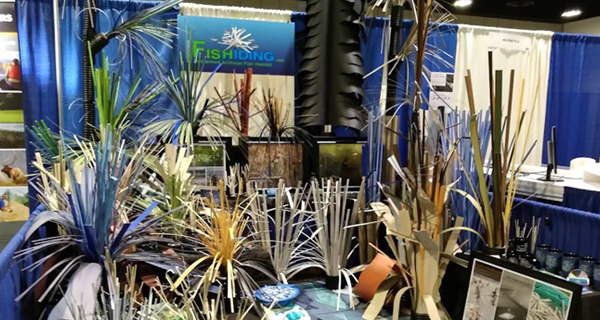
That connection matters to our habitat work. Fishiding manufactures freshwater habitat from reclaimed PVC, adding dense shelter and submerged growing surface in ponds, lakes and reservoirs. The cover and the surface community perform different jobs; one should not be mistaken for proof of the other.
Why harvesting fish was part of this visit
At Fish Fry Lake, catching and removing fish was part of the nutrient-management concept Bruce showed us. Nutrients incorporated into harvested fish leave the waterbody with those fish. That does not mean unlimited harvest is appropriate in another pond or lake.
Follow local fishing rules and fish-consumption advisories. A harvest plan needs to fit the species, population and waterbody; habitat does not replace water-quality management or a fisheries assessment.
Applying the observation to freshwater habitat
Look at both the spaces fish can enter and the surfaces available for growth. Dense refuge for fry, feeding areas and travel cover are related parts of a habitat plan, not interchangeable features.
Our mid-depth fish habitat range addresses transition cover between shallow nursery areas and deeper water. Choose placement for the fish and water conditions present rather than assuming that more submerged material alone will solve a nutrient problem.
The lesson I brought home was stewardship: connect the habitat, the food web and the management plan, then observe what actually happens underwater.
Original field report
The full Shepherd Ranch field report on StructureSpot preserves the longer account of our visit and the nutrient-management concept discussed at the time.