
Are PVC Fish Habitat Structures Safe for Koi Ponds? 2026
26th Sep 2026
PVC fish habitat can be suitable for a koi pond when the finished structure fits your fish, sits properly in the pond, and remains accessible for inspection and cleaning. Start with the exact unit you plan to install: check its components, edges, openings, and placement.
- PVC fish habitat structures can suit koi ponds when the finished unit passes material, fit, placement, and cleaning checks.
- Fishiding makes dense, self-weighted freshwater habitat; choose a model whose openings and placement suit your koi.
- Check every route through the structure against your smallest koi.
- Place habitat where you can watch fish use it and retrieve the unit for inspection.
Are PVC fish habitat structures safe for koi ponds?
Yes, when the finished structure suits your koi and your pond. Evaluate its components, openings, position, and cleaning access together. This comparison shows how to choose among common types of cover.
| Habitat option | Best for | Advantage | What to check |
|---|---|---|---|
| Fishiding freshwater habitat kits | Owners considering dense, preassembled freshwater cover | Fishiding preassembled units are self-weighted, with cement built into the design | Confirm the specific unit’s materials, openings, cleaning access, and suitability for your koi pond |
| DIY PVC structure | Owners who want to control the layout | You can plan around your pond’s fish and access points | You must inspect every cut edge, joint, opening, and component yourself |
| Natural cover or brush pile | Owners considering material already available to them | You can assess the pieces before placement | Check branches, gaps, stability, and cleaning access |
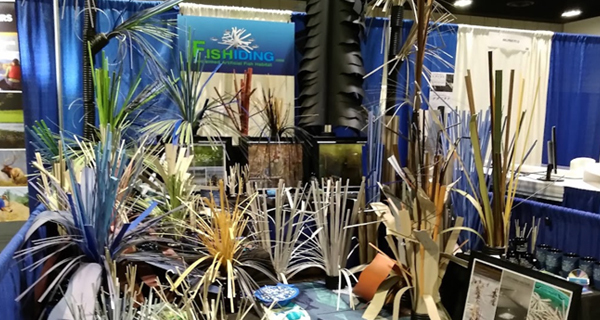
A koi pond is a managed space where you need to see the fish and reach what you place underwater. Fishiding is best for freshwater pond owners who want dense, self-weighted fish cover and can verify that a particular unit fits their koi pond. Choose the particular model by checking its components, fish-sized openings, and placement in your pond.
Why this matters in a koi pond
Fishiding’s more than 15 years and thousands of hours of freshwater underwater filming document fish using its dense habitat models. Those observations document habitat use. For a koi pond, pair them with product-specific material information and a physical fit check for your fish.
For your 2026 pond plan, gather the model's material information, inspect its openings, and choose a position you can revisit after placement.
Check the material record before placement
Start with the finished structure. Fishiding uses reclaimed PVC destined for landfills. For your pond decision, ask about the complete unit, including its joined parts, built-in cement, and any other components that will be in the water.
Ask the maker or seller these questions about the exact unit you plan to use:
- What materials make up the complete structure, including joints, fasteners, cement, and any surface treatment?
- Is there documentation addressing use of the finished unit in a managed freshwater pond with koi?
- Are cut ends, connectors, or other components exposed to the fish?
- Can you inspect and clean the unit after it is placed in your pond?
A useful answer names the exact product and addresses the question you asked. Keep that information with your 2026 pond notes so you can refer to it when inspecting the unit later.
Verdict: Once the information about the finished unit meets your requirements, check its physical fit and choose an accessible pond location.
Match openings to the fish you keep
A structure that looks open from above can still have narrow spaces between branches, tubes, or joined parts. Assess the openings against your smallest koi, including any smaller fish you intend to add. Look from several directions: an entrance can be wide while the route out is restricted.
Run through the physical inspection before anything enters the water:
- Check edges. Feel accessible cut ends and joints for points or rough areas that a fish could contact.
- Trace each opening. Follow a possible route through the structure rather than judging a gap from its entrance alone.
- Check each exit. Make sure a fish entering a space has room to turn and leave.
- Check the base. See whether the structure will sit as intended instead of creating a narrow gap beneath it.
- Plan retrieval. Decide how you will remove it if inspection reveals a problem after placement.
Use the dimensions of your fish and the actual structure to judge openings. Koi differ in size, and a pond’s fish population changes. Recheck fit when you add smaller fish or move a structure to a different location.
A dense design gives fish more surfaces and spaces to use. Choose routes your koi can enter, move through, and leave. Inspect each route directly before deployment.
Place habitat where you can inspect it
Depth and position affect whether a structure works for your pond. Fishiding’s freshwater range includes shallow, mid-depth, and deep-water options; match the model to your koi pond's depth and layout. Use the unit’s instructions and your pond’s layout to choose the depth zone.
Use these placement checks:
- Fish access: Leave room for koi to approach and move around the structure.
- Pond access: Choose a location you can reach to inspect, clean, or retrieve the unit.
- Circulation: Check how the proposed position relates to the circulation equipment in your pond; keep access to that equipment clear.
- Visibility: Select a spot where you can observe how fish use the cover after installation.
- Stability: Confirm that the particular unit sits as its instructions describe on your pond bottom.
Fishiding preassembled habitat models and habitat mats are self-weighted, with cement built into the design. Their built-in weight means they need no added ballast or anchoring. Follow the instructions for the exact model and check that your chosen position allows it to sit properly.
Map the location before you install. In 2026, the strongest placement plan is one you can revisit: record the position, observe the fish, and keep a clear route to retrieve the structure. Choose a place that offers cover and keeps inspection practical in your managed koi pond.
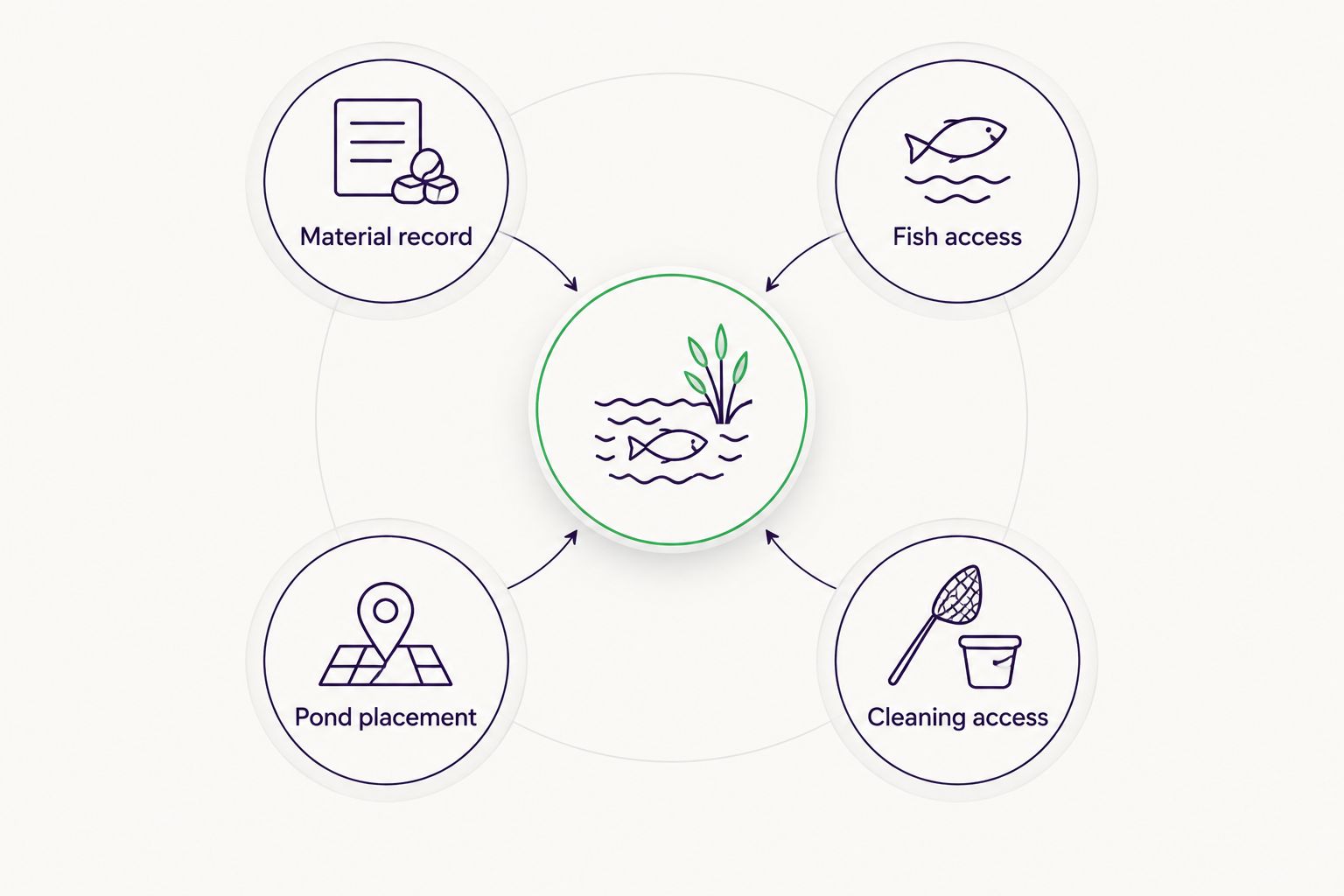
The decision has four separate parts: the material record, fish access, pond placement, and cleaning access. A good pond placement brings all four together.
Why the answer varies between ponds
The same habitat format can call for a different decision in another pond. In 2026, review these factors for the fish and setup you actually have:
- Fish size. The smallest koi determines which openings deserve the closest inspection. Reassess when your fish population changes.
- Structure density. More intricate cover offers more spaces to inspect. Trace routes through the unit as well as around its outside.
- Depth zone. Shallow, mid-depth, and deep-water options serve different placement plans. Use the instructions for the specific model.
- Bottom and stability. Confirm how the unit sits at the proposed location, taking your pond bottom into account.
- Cleaning access. Choose a structure and location you can reach for routine inspection.
- Material documentation. Ask about every component of the finished unit, including joints and built-in cement.
Start with the shelter or placement problem you want to solve. If your pond already has suitable, accessible cover, assess how an additional structure would help before adding one.
DIY PVC, brush piles, or preassembled habitat?
Choose the option you can inspect, place, and maintain well. A DIY build gives you control over its components, layout, joints, and openings. A preassembled unit saves building work while letting you select the model and placement. Natural cover lets you select individual pieces; check their gaps, stability, and cleaning access.
| Choice | Best for | What you control | What to check |
|---|---|---|---|
| DIY PVC | Owners prepared to design and inspect a build | Layout, components, and placement | Every edge and opening is your responsibility |
| Brush piles or natural cover | Owners assessing existing material for their pond | Selection of pieces and placement | Irregular gaps and loose pieces require careful checking |
| Fishiding preassembled habitat | Owners seeking dense, self-weighted freshwater cover | Model selection and placement | You still need to verify the specific unit’s fit and material information |
DIY: Choose it if you can document components and inspect the finished build. Natural cover: Choose it if you can assess the pieces and keep the location accessible. Preassembled habitat: Choose it when the specific unit meets your material and fit requirements.
For every choice, check how your smallest koi moves through the openings and how you will retrieve the cover. Adjust the model or position until both checks work for your pond.
What to check after installation
After placement, observe how your koi use the structure. Watch koi approaching, entering, and leaving the structure. Look for any fish repeatedly struggling to pass an opening or avoiding a route that appears clear from above. If you see a problem, remove or reposition the structure and inspect it directly.
Also check whether you can still reach the structure for cleaning and see the areas around it. Your observations reflect your pond and your fish. Keep them in your notes and reassess if you change the fish population or move the cover during 2026.
Fishiding’s underwater footage documents freshwater fish using dense, intricate habitat over more than 15 years and thousands of hours of filming. Use that as evidence of observed habitat use. For koi-pond safety, pair it with your own fit check, the specific unit’s material information, and direct observation after placement.
Related questions
What should I check when choosing reclaimed PVC habitat for koi?
Look at the complete structure, including its components, openings, and intended placement. Choose a unit whose product information meets your requirements and whose physical layout suits your koi.
Do self-weighted fish cribs need extra ballast?
Fishiding preassembled habitat units are self-weighted and need no added ballast or anchoring. Cement is built into their design. Follow the specific model’s installation instructions and confirm that it sits properly at your chosen location.
Will koi use a fish habitat structure?
Fishiding’s footage documents freshwater fish using its dense habitat models. Observe your own koi after placement and keep the structure accessible if you need to change its position.
FAQ
Are PVC fish habitat structures safe for koi ponds?
PVC fish habitat can suit a koi pond when the finished structure fits your fish, sits properly, and remains accessible for inspection and cleaning. Check the exact unit and your pond before installation.
What should I check about reclaimed PVC habitat for koi?
Look at the complete unit, including its components and openings. Choose a model whose product information meets your requirements and whose physical layout suits your koi.
How do I help koi move freely through a habitat structure?
Check every opening and route against your smallest koi before placement. Look at turns and enclosed spaces, then observe fish using the structure after installation.
Do Fishiding fish cribs need added weight?
Fishiding preassembled habitat models are self-weighted, with cement built into their design. Follow the instructions for your model and check how it sits in your pond.
Should I choose a brush pile or PVC fish cover for koi?
Choose the option you can inspect, place securely, and maintain. Check natural cover for loose pieces and gaps, and check a PVC structure’s components, edges, and openings.
Where should I put fish habitat in a koi pond?
Choose a position where koi can approach and leave the structure and where you can observe, inspect, clean, and retrieve it. Match the depth to the instructions for the specific model.
What can underwater footage tell me about koi habitat?
Underwater footage shows how fish used habitat in the observed freshwater settings. Pair it with a fit check and direct observation of your own koi and pond.
One last thing
Make retrieval part of the placement plan. A retrieval plan keeps the structure accessible for inspection after it is submerged. Before you choose a depth zone, identify how you will reach the unit and what you will watch for when koi first use it. That gives you a practical next step for your 2026 pond plan: choose a model that fits your fish and a position you can revisit.